Frequently Asked Questions
Q: Why does the Torah say not to use iron tools when building the altar?
A: Rashi explains that iron is associated with weapons of war, which shorten life, while the altar represents peace and atonement, which lengthen life. Therefore, iron should not be used on the stones of the altar (Rashi on Deuteronomy 27:5). The Midrash also teaches that iron was used to build instruments of destruction, like swords, and is thus unfit for the altar, which brings people closer to G-d (Mechilta on Exodus 20:22).
Q: What is the significance of building an altar from whole stones?
A: The Rambam (Hilchot Beit HaBechirah 1:13) teaches that the stones must remain in their natural state, untouched by iron tools, to symbolize purity and humility before G-d. The altar represents a connection to the Divine, and using unhewn stones reminds us that our service must be sincere and unaltered by human arrogance.
Q: Does this commandment about the altar still apply today?
A: While the Temple is not standing today, the principles behind this mitzvah still apply. The prohibition against using iron tools teaches us about the sanctity of holy objects and the importance of approaching divine service with humility. The Talmud (Sotah 48a) also discusses how these laws will be relevant when the Temple is rebuilt in the future.
Q: Why does the verse say 'there' when referring to building the altar?
A: The word 'there' (שָּׁם) refers to Mount Eival, where this altar was to be built as part of the covenant ceremony (Deuteronomy 27:4). Rashi explains that this was a one-time commandment for that specific event, unlike the permanent altar in the Mishkan (Tabernacle) and later the Temple (Rashi on Deuteronomy 27:5).
Q: What lesson can we learn from the commandment to build an altar of stones?
A: The Talmud (Makkot 22a) derives from this verse that just as the stones of the altar bring peace between Israel and G-d, we should strive to be peacemakers in our lives. Additionally, the unhewn stones teach us that true service to G-d does not require artificial refinement—we should serve Him with simplicity and sincerity.


Source and Context
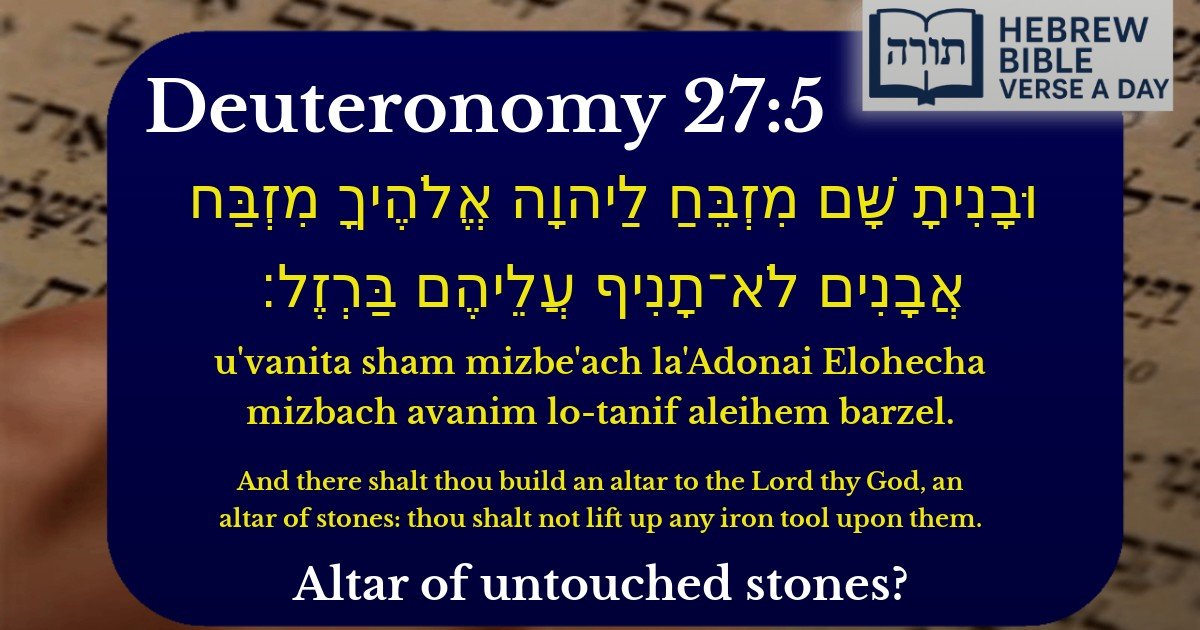
The verse appears in Devarim (Deuteronomy) 27:5, where Moshe instructs Bnei Yisrael regarding the mitzvah of building an altar upon entering Eretz Yisrael. This altar was to be constructed at Har Eival as part of the covenant ceremony (see Devarim 27:1-8).
Prohibition of Iron Tools
The Torah explicitly forbids using iron tools to shape the stones of the altar. Rashi (Devarim 27:5) explains that iron shortens human life (as it is used for weapons), while the altar prolongs life (by facilitating atonement). Therefore, it is inappropriate for the two to interact. Rambam (Hilchot Beit HaBechirah 1:14) codifies this as halacha, stating that even if an iron tool merely touches the stones without cutting them, the stones become invalid for altar use.
Altar of Whole Stones
The verse emphasizes that the altar must be built from whole, unhewn stones. Ibn Ezra (Devarim 27:5) notes that this contrasts with pagan altars, which were often elaborately carved. The simplicity of the stones reflects the purity of Divine service—korbanot (offerings) are accepted based on sincerity, not craftsmanship. Sforno adds that unhewn stones symbolize the natural state of creation, aligning with the altar’s purpose of drawing closer to Hashem.
Midrashic Insights
Halachic Implications
Rambam (Hilchot Beit HaBechirah 1:16) rules that this prohibition applies specifically to the altar in the Mikdash, but not to other Temple structures. Sefer HaChinuch (Mitzvah 503) explains that the mitzvah instills reverence for the altar, as its sanctity requires avoiding even indirect association with violence (symbolized by iron).