Frequently Asked Questions
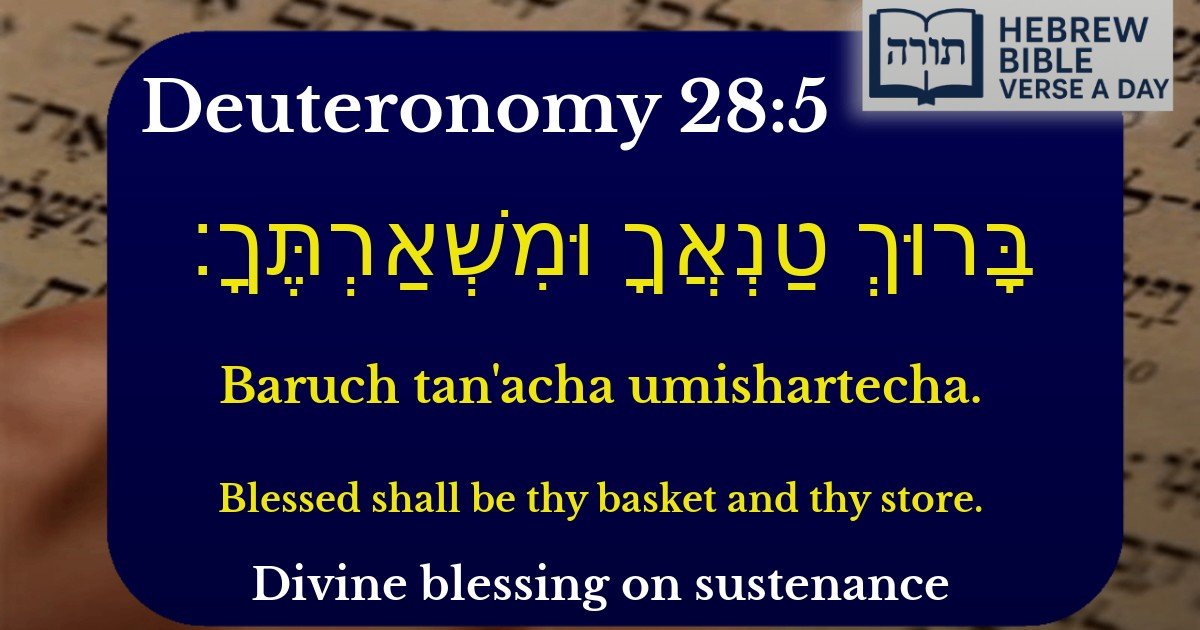
Q: What does 'Blessed shall be thy basket and thy store' mean in Deuteronomy 28:5?
A: This verse is part of the blessings promised for keeping the Torah. 'Basket' (טַנְאֲךָ) refers to the produce you gather, and 'store' (מִשְׁאַרְתֶּךָ) refers to your stored goods. Rashi explains that this means Hashem will bless both what you take to the market (basket) and what remains at home (store), ensuring abundance in all your possessions.
Q: Why is this blessing about baskets and stores important?
A: This blessing emphasizes that Hashem's blessings extend to all aspects of livelihood—both what is visible (like produce taken to market) and what is stored away. The Talmud (Bava Metzia 42a) teaches that blessing rests in what is hidden from view, showing that true prosperity comes from divine favor, not just human effort.
Q: How can we apply the message of this verse today?
A: This verse reminds us to recognize that all material success comes from Hashem. The Rambam (Hilchos Brachos 10:16) teaches that we must acknowledge blessings with gratitude. Whether in business, farming, or daily sustenance, we should remember that our 'basket' (income) and 'store' (savings) are sustained by divine blessing when we follow Torah.
Q: Does this verse only apply to agricultural societies?
A: No, the principles apply universally. While the terms 'basket' and 'store' refer to agricultural produce, the Midrash (Sifrei Devarim 28:3) explains that these are metaphors for all forms of livelihood. Whether one is a merchant, laborer, or professional, the blessing signifies prosperity in one's work and resources.
Q: What is the connection between this verse and the rest of Deuteronomy 28?
A: This verse is part of the 'blessings' section (Devarim 28:1-14), which lists rewards for fulfilling the Torah. The Vilna Gaon notes that the order progresses from personal blessings (verse 3-4) to material blessings (verse 5-6), showing that spiritual commitment brings both physical and spiritual abundance.


Understanding the Verse in Context
The verse "בָּרוּךְ טַנְאֲךָ וּמִשְׁאַרְתֶּךָ" (Devarim 28:5) appears in the section of Tochacha (rebuke) and blessings, where Hashem outlines the rewards for observing the mitzvot. The phrase emphasizes material prosperity as a divine blessing for faithfulness to Torah.
Rashi's Explanation
Rashi (Devarim 28:5) explains that "טַנְאֲךָ" refers to the basket used for gathering produce in the field, while "מִשְׁאַרְתֶּךָ" refers to the kneading trough used for preparing dough at home. Thus, the blessing encompasses both agricultural success (out in the fields) and sustenance in one's household.
Ibn Ezra's Insight
Ibn Ezra adds that the term "מִשְׁאַרְתֶּךָ" can also refer to stored provisions, indicating that Hashem will bless not only immediate produce but also long-term reserves, ensuring that one's sustenance remains abundant.
Midrashic Interpretation
The Midrash (Sifrei Devarim 28:5) connects this verse to the broader theme of divine reward for mitzvah observance. It teaches that when Bnei Yisrael follow Hashem's commandments, even mundane vessels like baskets and kneading troughs become conduits for blessing, symbolizing that every aspect of life is elevated through Torah.
Halachic Implications
Symbolic Meaning
The Or HaChaim (Devarim 28:5) suggests that "טַנְאֲךָ" (basket) represents the mitzvot performed in public, while "מִשְׁאַרְתֶּךָ" (store) represents private mitzvot. The blessing thus applies to both outward and inward devotion, ensuring reward in all spheres of life.