Frequently Asked Questions
Q: What does Deuteronomy 28:29 mean?
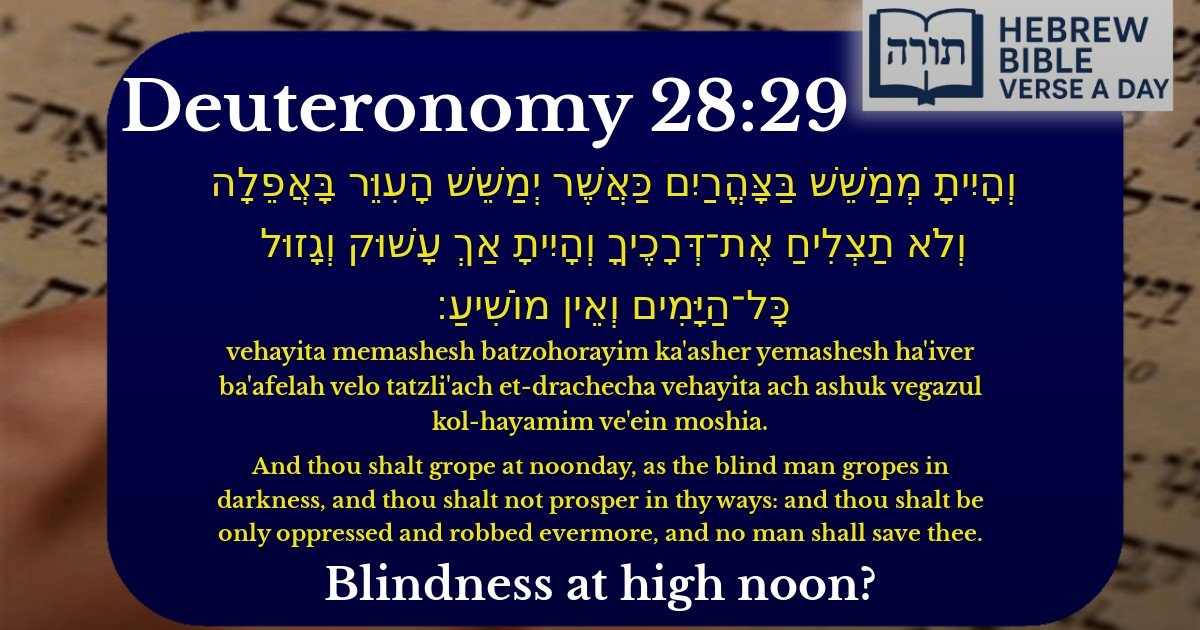
A: Deuteronomy 28:29 is part of the 'Tochacha' (rebuke), where Moshe warns the Jewish people of the consequences they will face if they do not follow Hashem's commandments. This verse describes a state of confusion and helplessness—like a blind person groping in darkness—where one's efforts will not succeed, and they will face constant oppression with no savior. Rashi explains that this refers to a loss of clarity and direction in life when straying from Torah.
Q: Why is this verse important in Judaism?
A: This verse is important because it emphasizes the principle of reward and punishment in the Torah. The Rambam (Hilchos Teshuvah) teaches that suffering and hardship can serve as a wake-up call to return to Hashem. The verse reminds us that true success and protection come only through following the Torah, and straying from it leads to spiritual and physical disarray.
Q: How does this verse apply to us today?
A: The message of this verse remains relevant today. When we feel lost or unsuccessful in life, the Torah teaches us to examine our actions and return to mitzvos. The Talmud (Berachos 5a) says that suffering can be a sign of Hashem’s love, urging us to improve. This verse reminds us that true success comes from aligning our lives with Torah values.
Q: What does it mean to 'grope like a blind man' in this verse?
A: The metaphor of a blind man groping in darkness, even at noon (when it should be bright), symbolizes a loss of spiritual clarity. The Midrash (Sifrei) explains that even when the path should be clear, those who abandon Torah will stumble as if in darkness. It represents confusion, misdirection, and the inability to find true purpose without Torah guidance.
Q: Does this verse mean that Hashem won’t help those who sin?
A: No, the verse describes a consequence of straying from Torah, but it does not mean Hashem abandons us forever. The Talmud (Yoma 86a) teaches that sincere teshuvah (repentance) can reverse even the harshest decrees. The lack of a 'savior' in this verse refers to the natural outcome of distancing from Hashem, but He is always ready to accept our return.


Context in Devarim
This verse appears in Devarim (Deuteronomy) 28:29 as part of the Tochacha (the rebuke), which details the consequences of abandoning the covenant with Hashem. The imagery of groping like a blind man at noon underscores the severity of spiritual and physical disorientation that will result from straying from Torah observance.
Rashi's Explanation
Rashi interprets this verse as describing a state of utter confusion and helplessness. Even at tzaḥarayim (noon), when light is brightest, one will grope as if in darkness—symbolizing that clarity and success will elude them despite favorable circumstances. Rashi emphasizes that this is a punishment for neglecting Torah study and mitzvot, leading to a loss of divine guidance (Rashi on Devarim 28:29).
Ibn Ezra's Insight
Ibn Ezra adds that the phrase "and no man shall save thee" reflects a complete absence of human or divine assistance. This condition arises when the Jewish people forsake their relationship with Hashem, leaving them vulnerable to continuous oppression without redemption (Ibn Ezra on Devarim 28:29).
Midrashic Interpretation
The Midrash Tanchuma connects this verse to the idea of hester panim (the hiding of Hashem’s face). When the Jewish people sin, Hashem withdraws His protection, causing them to "grope" without direction, as if blind. The Midrash likens this to a king who abandons his rebellious son to the consequences of his actions (Midrash Tanchuma, Ki Tavo 4).
Rambam's Perspective
Rambam, in Hilchot Ta'anit, discusses how suffering and exile are meant to awaken repentance. This verse illustrates the futility of human efforts without divine favor—a call to return to Torah and mitzvot to restore Hashem’s protection (Mishneh Torah, Hilchot Ta'anit 1:1-3).
Key Themes