Frequently Asked Questions
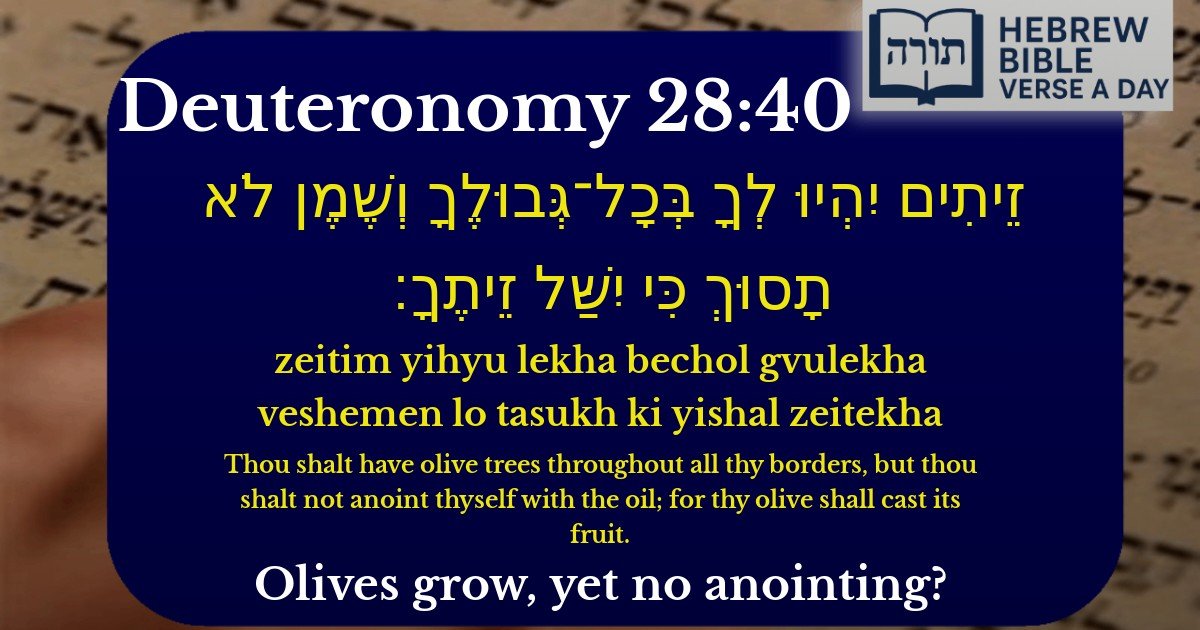
Q: What does Deuteronomy 28:40 mean when it says 'you shall have olive trees but not anoint with the oil'?
A: This verse is part of the 'Tochacha' (rebuke) in Deuteronomy, warning of consequences if the Jewish people stray from Torah observance. Rashi explains that although olive trees will grow, they will not produce enough oil for anointing, symbolizing loss of blessing despite outward appearances of prosperity.
Q: Why is the olive tree mentioned specifically in Deuteronomy 28:40?
A: The olive tree is a symbol of wisdom and prosperity in Jewish tradition (Talmud Menachot 53b). Its mention here emphasizes how even a blessed resource will fail to provide its full benefit when mitzvot are neglected. The Rambam teaches that material success is directly tied to spiritual observance.
Q: What practical lesson can we learn from Deuteronomy 28:40 today?
A: The verse teaches that mere physical possessions are meaningless without Hashem's blessing. As the Sforno explains, one might have olive trees (resources), but without proper connection to Torah, they won't yield their full potential. This reminds us to prioritize spiritual growth over material accumulation.
Q: How does the phrase 'your olive shall cast its fruit' relate to Jewish law?
A: The Talmud (Moed Katan 11a) discusses this as referring to olives falling prematurely. Halachically, this shows how nature itself responds to our spiritual state. The Maharal explains that when we're distant from Torah, even natural processes don't function optimally.
Q: Is there a positive interpretation of Deuteronomy 28:40?
A: Yes, the Alshich teaches that even in times of difficulty, the verse assures we'll always have some olive trees - showing Hashem's mercy. The Netziv adds that this hints at eventual repentance and return, as olive oil (symbolizing wisdom) will ultimately be restored through Torah study.


Context in Deuteronomy 28:40
The verse appears in the Tochacha (Rebuke) section of Parashat Ki Tavo, where Moshe warns of the curses that will befall Bnei Yisrael if they abandon the Torah. This specific verse describes a paradoxical agricultural failure: olive trees will grow, but their oil will be unusable for anointing.
Literal Interpretation (Peshat)
Rashi explains that the olive trees will produce fruit, but the olives will rot or fall prematurely ("yishal zitecha"—"your olive shall cast its fruit"). The oil will be unfit for anointing, a basic use of olive oil in ancient times. This reflects a curse of futility—effort without benefit.
Symbolic Meaning (Derash)
The Midrash Tanchuma (Ki Tavo 4) connects this to spiritual decline: just as olive oil gives light (symbolizing Torah wisdom, as in Menorah oil), failure to uphold Torah leads to the "extinguishing" of wisdom. The Rambam (Hilchot Ta'anit 1:1-3) similarly interprets agricultural curses as divine warnings to repent.
Halachic Implications
Kabbalistic Insight
The Zohar (III:168a) associates olives with gevurah (divine judgment). Here, the wasted oil signifies harsh judgment without the balancing attribute of chesed (kindness), as oil typically represents (e.g., in anointing).