Frequently Asked Questions
Q: What does 'He is the Rock' mean in Deuteronomy 32:4?
A: In this verse, calling Hashem 'the Rock' (הַצּוּר) symbolizes His unchanging, steadfast, and reliable nature. Rashi explains that just as a rock is strong and enduring, so too is Hashem a firm foundation for His people. This metaphor emphasizes His eternal faithfulness and protection.
Q: Why does the verse say 'all His ways are justice'?
A: The Torah teaches that every action of Hashem is perfectly just, even if we don't always understand it. The Rambam (Hilchot Yesodei HaTorah 1) explains that Hashem's justice is absolute, meaning He rewards good and administers consequences with perfect fairness. This reassures us that nothing in the world happens without divine justice.
Q: What does 'a God of truth' (אֵל אֱמוּנָה) mean in this verse?
A: The phrase 'אֵל אֱמוּנָה' means Hashem is completely truthful and keeps His promises. The Midrash (Sifrei Devarim 307) connects this to His covenant with the Jewish people—He will never abandon them. This teaches us to emulate His attribute of truthfulness in our own lives.
Q: How can we apply the message of Deuteronomy 32:4 in daily life?
A: This verse reminds us to trust in Hashem's perfect justice and truthfulness, especially during challenges. The Talmud (Berachot 60b) teaches that one should accept both good and difficult events with faith, recognizing that everything comes from Hashem's righteous judgment. Practically, this means living with emunah (faith) and striving for honesty in our actions.
Q: Why is this verse part of the Song of Ha'azinu?
A: Ha'azinu (Deuteronomy 32) is a prophetic song about Jewish history. This verse sets the foundation by declaring Hashem's righteousness before describing how He guides the world. Ibn Ezra explains that it introduces the theme that all events—blessings and punishments—stem from Hashem's just and truthful governance.

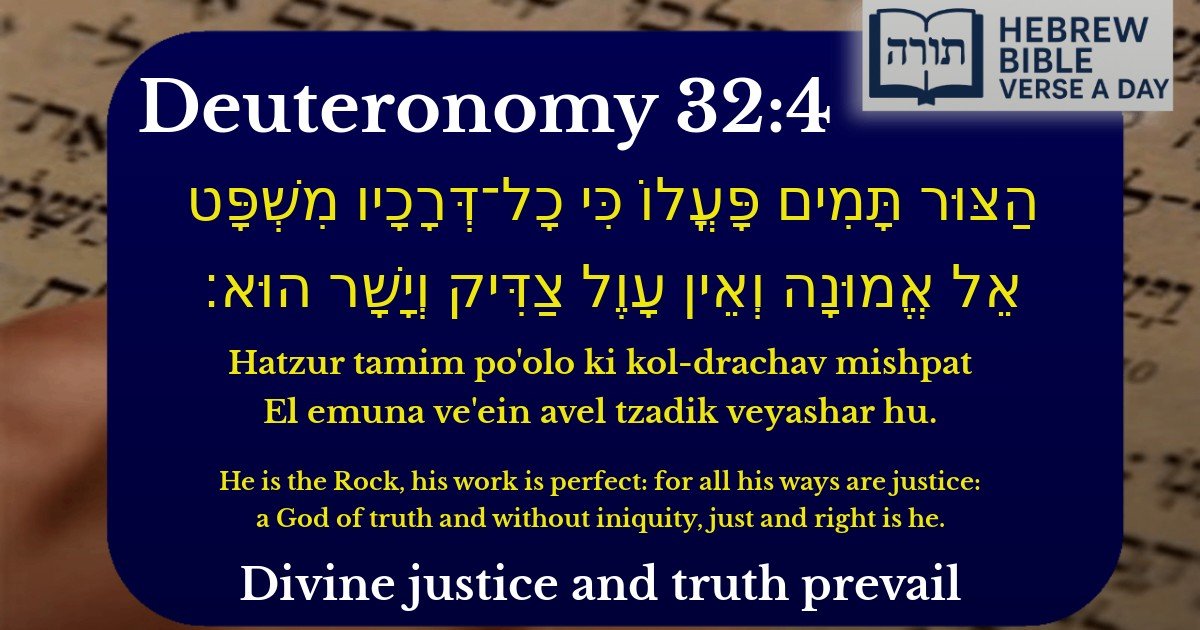

The Divine Perfection of Hashem
The verse describes Hashem as "הַצּוּר תָּמִים פָּעֳלוֹ" ("The Rock, His work is perfect"). Rashi explains that "הַצּוּר" (the Rock) refers to Hashem as the unwavering foundation of the world, whose deeds are flawless and without blemish. The term "תָּמִים" (perfect) emphasizes that all of Hashem's creations and decrees are complete and just, leaving no room for error.
Justice and Truth in Hashem's Ways
The verse continues: "כִּי כָל־דְּרָכָיו מִשְׁפָּט" ("for all His ways are justice"). The Rambam (Hilchot Yesodei HaTorah 1:1-2) teaches that Hashem's governance of the world is entirely based on מִשְׁפָּט (justice), meaning every divine action is measured and purposeful. The Midrash (Sifrei Devarim 32:4) elaborates that even events that appear harsh are ultimately just, as human understanding is limited compared to divine wisdom.
Hashem as the God of Truth
The phrase "אֵל אֱמוּנָה" ("a God of truth") underscores that Hashem is unchanging and faithful to His word. The Talmud (Shabbat 55a) states that "חותמו של הקדוש ברוך הוא אמת" ("the seal of the Holy One, blessed be He, is truth"), meaning truth is the essence of divine conduct. Malbim explains that unlike human judgments, which may be flawed, Hashem's rulings are absolute truth without deception.
Absence of Injustice
The verse concludes: "וְאֵין עָוֶל צַדִּיק וְיָשָׁר הוּא" ("and without iniquity, just and upright is He"). Ibn Ezra notes that "עָוֶל" (iniquity) implies any distortion of justice, which is impossible for Hashem. The Sforno adds that "צַדִּיק" (just) refers to Hashem's strict adherence to justice, while "יָשָׁר" (upright) denotes His kindness and mercy in guiding creation toward ultimate good.