Frequently Asked Questions
Q: What does 'the Rock that begot thee' mean in Deuteronomy 32:18?
A: In this verse, 'the Rock' (צוּר) is a metaphor for Hashem (God), emphasizing His strength and permanence as the foundation of the Jewish people. Rashi explains that this refers to God's role as our Creator and Sustainer, just as a rock provides stability. The phrase 'begot thee' highlights how God brought Israel into existence and cares for us like a parent.
Q: Why does the verse say Israel 'forgot God that formed thee'?
A: The verse criticizes the Jewish people for neglecting their relationship with Hashem despite His constant care. Ramban (Nachmanides) teaches that this forgetfulness refers to failing to recognize God's miracles and providence in our lives. The Torah warns against this spiritual amnesia, especially when we experience comfort and success.
Q: How can we avoid forgetting God as mentioned in this verse?
A: The Talmud (Berachot 12b) teaches that regular Torah study, prayer, and recalling God's kindnesses help maintain awareness of Him. The Sforno suggests that remembering our history - how God formed us as a nation through the Exodus and Sinai - prevents forgetfulness. Practical steps include saying daily blessings and studying Jewish history.
Q: What is the significance of using both 'Rock' and 'God that formed thee' in this verse?
A: The Midrash (Devarim Rabbah) explains that these two descriptions represent different aspects of our relationship with Hashem. 'The Rock' denotes God's unchanging nature and protection, while 'God that formed thee' refers to how He shaped us spiritually at Mount Sinai. Together, they remind us of both God's might and His personal involvement in our development.
Q: How does this verse apply to Jewish life today?
A: The Malbim explains this verse remains relevant as a warning against assimilation and spiritual complacency. When Jews become comfortable in exile, we risk forgetting our divine source. The verse calls us to: 1) Recognize God's ongoing role in Jewish survival 2) Maintain Jewish practices that connect us to our heritage 3) Remember that our strength comes from Hashem, not material success.

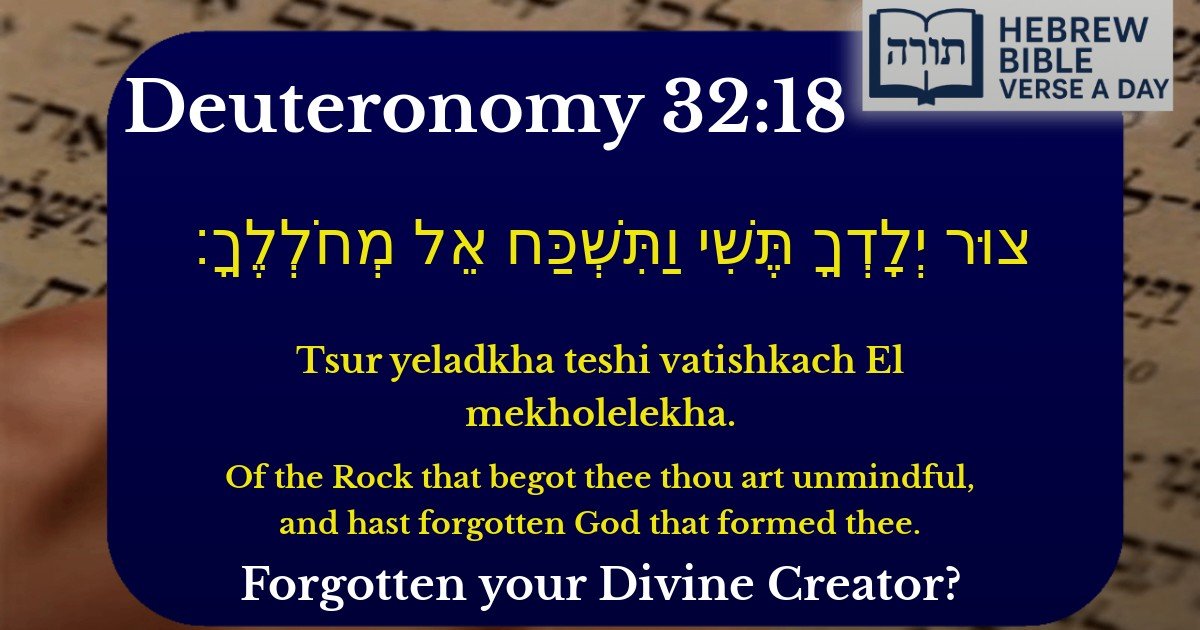

Context in Deuteronomy 32:18
The verse appears in Shirat Ha'azinu (Deuteronomy 32), Moshe's prophetic song warning Bnei Yisrael against forsaking Hashem. The imagery of "the Rock" (Tzur) and "God that formed you" (El Mecholelecha) emphasizes Hashem's role as both Creator and sustainer of the Jewish people.
Rashi's Explanation
Rashi interprets "צור ילדך" ("the Rock that begot thee") as referring to Avraham Avinu, whom Hashem called "a rock" (Isaiah 51:1-2). However, he also notes the broader meaning: Hashem is the enduring foundation (Tzur) of Israel, like a parent who nurtures a child. The phrase "ותשכח אל מחוללך" ("forgetting God who formed you") parallels this, condemning Israel's abandonment of their Divine source despite His constant care.
Ibn Ezra's Linguistic Insight
Ibn Ezra highlights the poetic doubling of "תשי" (you neglected) and "ותשכח" (you forgot), emphasizing deliberate spiritual negligence. The term "מחוללך" (formed you) evokes childbirth (from חיל, to writhe in labor), portraying Hashem as intimately involved in Israel's formation and ongoing existence.
Midrashic Interpretation (Devarim Rabbah)
Rambam (Maimonides) on Spiritual Forgetfulness
In Hilchot Teshuva (3:1-3), Rambam links such forgetfulness to avodah zarah (idolatry). When one denies divine providence—symbolized by ignoring "the Rock"—they reject the foundation of Torah. Remembering "El Mecholelecha" is a prerequisite for repentance.
Chassidic Perspective (Sefat Emet)
The Sefat Emet teaches that "Tzur" represents the unchanging divine spark within each Jew. Forgetting this core leads to exile—both physical and spiritual. True remembrance (zachor) reconnects a person to their holy origin.