Frequently Asked Questions
Q: What does Deuteronomy 32:41 mean in simple terms?
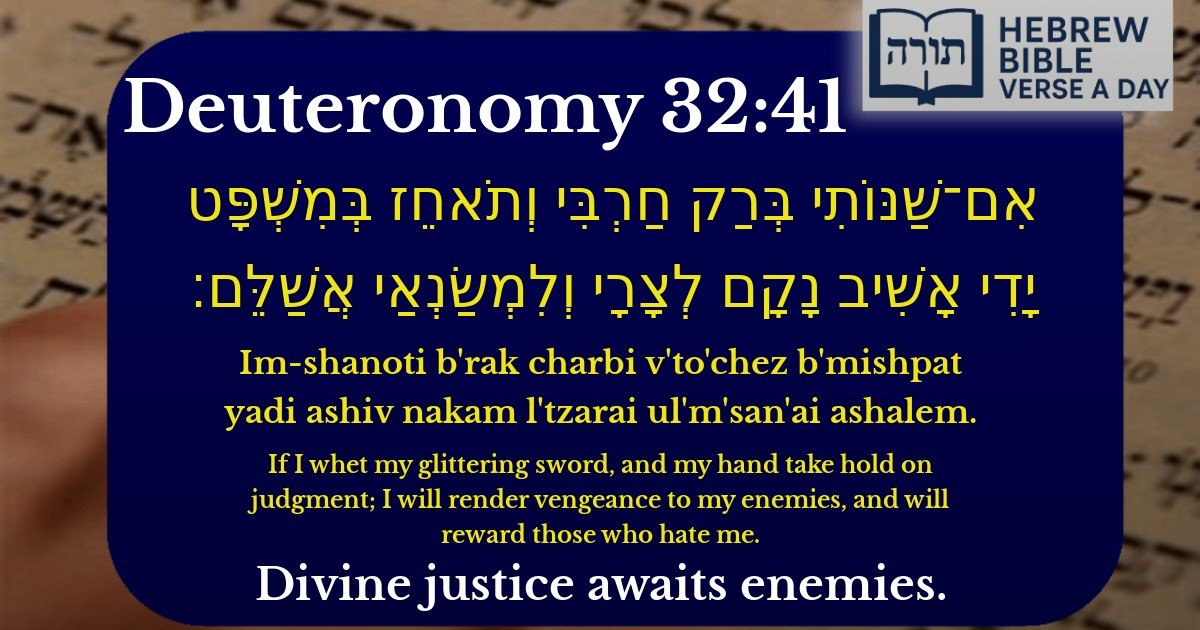
A: This verse, part of the 'Song of Haazinu,' describes Hashem's promise to bring justice against those who oppose Him and harm the Jewish people. It uses the imagery of a sharpened sword to symbolize divine retribution against enemies. Rashi explains that this refers to Hashem's readiness to punish the wicked when the time for judgment comes.
Q: Why is this verse important in Jewish tradition?
A: This verse is important because it reassures the Jewish people of Hashem's justice and protection. The Rambam (Hilchot Teshuvah) teaches that divine justice is precise—reward for good deeds and punishment for wrongdoing. This verse emphasizes that even if justice seems delayed, it will ultimately be carried out.
Q: How does Deuteronomy 32:41 apply to us today?
A: This verse reminds us that Hashem oversees the world with justice. The Midrash (Sifrei) connects this to the idea that no evil goes unpunished. In daily life, it encourages trust in divine justice, even when wrongdoing seems to go unchecked, reinforcing the principle of 'measure for measure' (middah k'neged middah) found in Jewish thought.
Q: What does 'my hand take hold on judgment' mean?
A: Rashi explains that this phrase means Hashem carries out judgment with full authority and precision. The 'hand' symbolizes divine power, and 'judgment' refers to the exact measure of justice. The Talmud (Sanhedrin 90a) teaches that Hashem's judgments are perfectly balanced—neither excessive nor insufficient.
Q: Does this verse mean G-d seeks revenge?
A: No, this is not about personal revenge but about divine justice. The Malbim explains that the term 'vengeance' here refers to restoring moral balance in the world. Hashem punishes the wicked to uphold righteousness, not out of anger. The Talmud (Berachot 7a) teaches that divine justice is an expression of truth, not vengeance.


Context in the Torah
The verse (Devarim 32:41) appears in Shirat Ha'azinu, the song Moshe Rabbeinu recited before his passing, which serves as a prophetic warning to Bnei Yisrael about future consequences of straying from Hashem's path. Rashi explains that this passage reflects Hashem's ultimate justice—He delays punishment to allow for repentance, but if necessary, He will exact retribution with precision.
Interpretation of "If I whet my glittering sword"
The Metzudat David interprets the "glittering sword" as a metaphor for Hashem's readiness to execute judgment. The sharpening symbolizes the meticulous preparation for divine justice, ensuring it is exact and unavoidable when the time comes. The Ibn Ezra adds that the "glittering" (barak) aspect emphasizes the swiftness and unmistakable clarity of Hashem's retribution.
"My hand takes hold on judgment"
Ramban explains that this phrase underscores that divine justice is never arbitrary—it is measured and deliberate. The Sforno elaborates that "taking hold" implies Hashem's direct involvement in administering justice, rather than leaving it to natural consequences alone. This aligns with the principle of middah k'neged middah (measure for measure), where punishment corresponds precisely to the wrongdoing.
Vengeance against enemies and requital for haters
The Malbim distinguishes between two categories: "enemies" (tzarai)—those who actively oppose Israel, and "haters" (mesanai)—those who harbor malice. The verse teaches that Hashem responds to both external adversaries and internal animosity. The Kli Yakar notes that "I will render vengeance" uses the future tense, indicating that divine justice may be delayed but is inevitable.
Moral and theological implications