Frequently Asked Questions
Q: Who is Hoshea the son of Nun mentioned in Deuteronomy 32:44?
A: Hoshea the son of Nun is another name for Yehoshua (Joshua), Moshe's devoted student and successor who would later lead the Jewish people into the Land of Israel. The name 'Hoshea' was changed to 'Yehoshua' by Moshe (Numbers 13:16), adding the letter 'yud' to include G-d's name, symbolizing a prayer for divine assistance in his leadership role (Rashi on Numbers 13:16).
Q: Why did Moshe and Yehoshua recite the poem (Ha'azinu) together in Deuteronomy 32:44?
A: Moshe and Yehoshua recited the poem together to show unity and to establish Yehoshua's authority as the next leader. The Talmud (Sanhedrin 8a) teaches that this public joint declaration helped ease the transition of leadership, ensuring the nation would accept Yehoshua after Moshe's passing. It also demonstrated that Yehoshua fully understood and could teach Moshe's Torah.
Q: What is the significance of the 'poem' (shira) mentioned in Deuteronomy 32:44?
A: The 'shira' (poem) refers to the prophetic song of Ha'azinu (Deuteronomy 32:1-43), which contains profound lessons about Jewish history, divine providence, and the consequences of straying from Torah. The Rambam (Hilchot Teshuvah 9:2) explains that this song serves as an eternal witness, as its predictions about Jewish history have consistently come true, validating Torah's divine origin.
Q: Why does the verse emphasize that Moshe spoke the poem 'in the ears of the people'?
A: The phrase 'in the ears of the people' emphasizes that Moshe ensured every individual heard and understood the message. The Midrash (Sifrei Devarim 306) explains this teaches the importance of clear, direct Torah education where leaders must make Torah accessible to all. The Malbim adds that hearing it directly from Moshe left an indelible impression on their hearts.
Q: How does Deuteronomy 32:44 relate to Torah study today?
A: This verse models two essential Torah principles: 1) The chain of Torah transmission from teacher to student (Pirkei Avot 1:1), as seen in Moshe teaching Yehoshua, and 2) The obligation to teach Torah clearly and publicly (Deuteronomy 6:7). The Sforno notes that just as Moshe and Yehoshua taught together, Torah is best learned and taught through partnership and dialogue.


The Context of the Verse
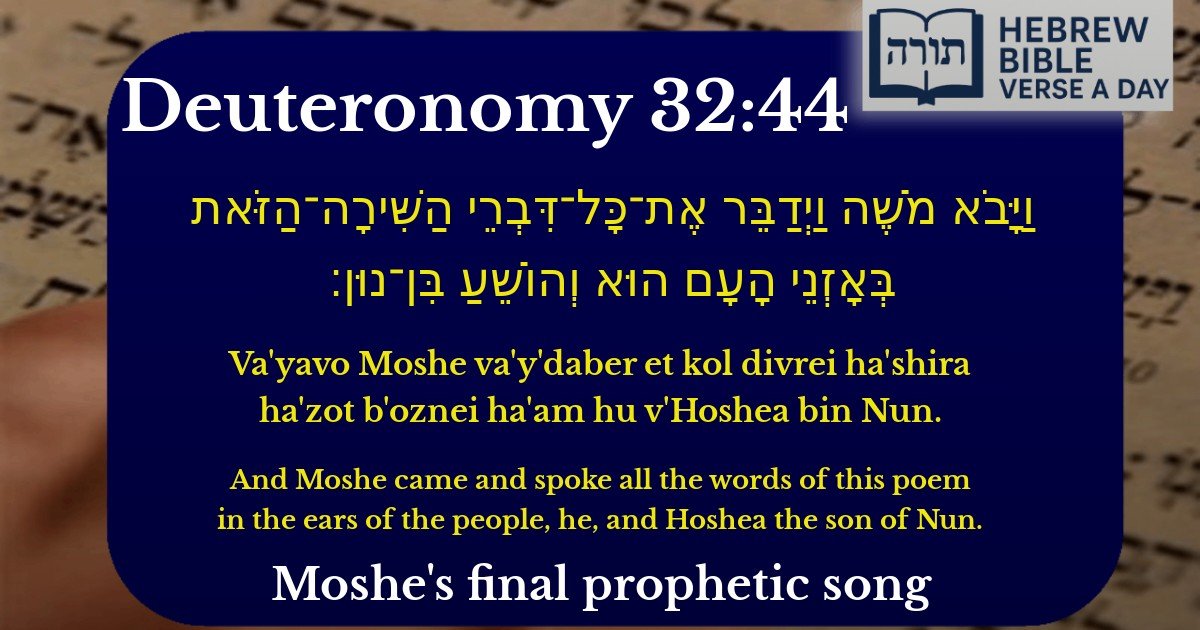
The verse appears in Devarim (Deuteronomy) 32:44, introducing Moshe's recitation of Shirat Ha'azinu (the Song of Ha'azinu) to Bnei Yisrael. This song serves as both a prophetic warning and a testimony about the future of the Jewish people, emphasizing their covenant with Hashem.
Moshe and Yehoshua Together
Rashi explains that Moshe and Yehoshua (referred to here as "Hoshea" before his name was changed by Moshe in Bamidbar 13:16) delivered the song together to emphasize its importance and to reinforce Yehoshua's future leadership role. The presence of Yehoshua alongside Moshe signifies the continuity of Torah leadership.
The Significance of "In the Ears of the People"
The phrase "בְּאָזְנֵי הָעָם" ("in the ears of the people") suggests an active, attentive listening. The Kli Yakar notes that Moshe ensured the people heard the words clearly, as this song was meant to serve as a lasting witness (as later stated in Devarim 31:19). The use of "ears" rather than simply "speaking to them" underscores the need for deep internalization.
Why Yehoshua is Mentioned
The Ibn Ezra comments that Yehoshua's inclusion highlights his role as Moshe's successor, ensuring the people would accept his authority. The Ohr HaChaim adds that Yehoshua's presence demonstrated that the Torah's transmission would not be interrupted—Moshe was preparing the nation for the transition.
Midrashic Insights