

Join Our Newsletter To Be Informed When New Videos Are Posted
Hebrew Text
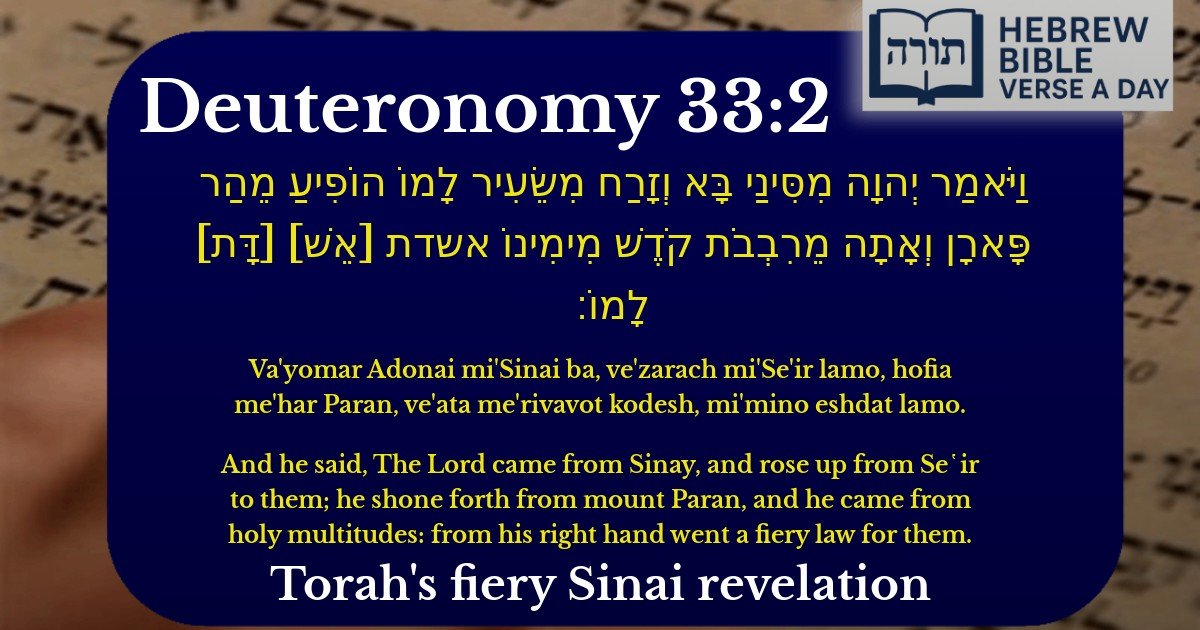
וַיֹּאמַר יְהוָה מִסִּינַי בָּא וְזָרַח מִשֵּׂעִיר לָמוֹ הוֹפִיעַ מֵהַר פָּארָן וְאָתָה מֵרִבְבֹת קֹדֶשׁ מִימִינוֹ אשדת [אֵשׁ] [דָּת] לָמוֹ׃
English Translation
And he said, The Lord came from Sinay, and rose up from Se῾ir to them; he shone forth from mount Paran, and he came from holy multitudes: from his right hand went a fiery law for them.
Transliteration
Va'yomar Adonai mi'Sinai ba, ve'zarach mi'Se'ir lamo, hofia me'har Paran, ve'ata me'rivavot kodesh, mi'mino eshdat lamo.
Hebrew Leining Text
וַיֹּאמַ֗ר יְהֹוָ֞ה מִסִּינַ֥י בָּא֙ וְזָרַ֤ח מִשֵּׂעִיר֙ לָ֔מוֹ הוֹפִ֙יעַ֙ מֵהַ֣ר פָּארָ֔ן וְאָתָ֖ה מֵרִבְבֹ֣ת קֹ֑דֶשׁ מִימִינ֕וֹ (אשדת) [אֵ֥שׁ דָּ֖ת] לָֽמוֹ׃
🎵 Listen to leining
Parasha Commentary
📚 Talmud Citations
This verse is quoted in the Talmud.
📖 Avodah Zarah 2b
The verse is discussed in the context of God offering the Torah to various nations before giving it to Israel.
📖 Sifrei Devarim 343
The verse is referenced in a midrashic interpretation about the revelation at Sinai and God's presence.
Overview of the Verse
The verse (Devarim 33:2) describes Hashem's revelation at Har Sinai and His relationship with the Jewish people. It employs poetic imagery to convey the grandeur of Matan Torah (the Giving of the Torah) and the uniqueness of Bnei Yisrael as the chosen recipients of the Divine law.
Rashi's Explanation
Rashi explains that the verse describes how Hashem first offered the Torah to other nations before giving it to Israel. "From Sinai" refers to the revelation to the Jewish people, while "from Se'ir" and "from Paran" allude to Hashem offering the Torah to the descendants of Esav (who dwelled in Se'ir) and Yishmael (who dwelled in Paran), respectively. However, they rejected it, and only Israel accepted it with the declaration of "Na'aseh v'Nishma" (We will do and we will hear).
Midrashic Interpretation
The Midrash (Sifrei Devarim 343) elaborates that the phrase "from His right hand went a fiery law for them" (אשדת אש דת למו) refers to the Torah being given with fire, symbolizing both its divine origin and its purifying power. The word "אשדת" is interpreted as "fire" (אש) and "law" (דת), emphasizing that the Torah is a fiery, living force.
Rambam's Perspective
Rambam (Moreh Nevuchim 2:30) discusses this verse in the context of prophecy, explaining that the revelation at Sinai was unique because it was a direct, national encounter with the Divine Presence—unlike other prophetic experiences, which were individual. The "fiery law" represents the clarity and intensity of this revelation.
Symbolism of the Locations
The "Fiery Law" (אשדת אש דת)
The Talmud (Shabbat 88a) teaches that the Torah was given with fire, indicating that just as fire cannot exist without consuming something, the words of Torah cannot endure unless one dedicates oneself fully to its study and observance. The "right hand" symbolizes strength and favor, showing that Hashem gave the Torah with love and as a cherished gift to Israel.