
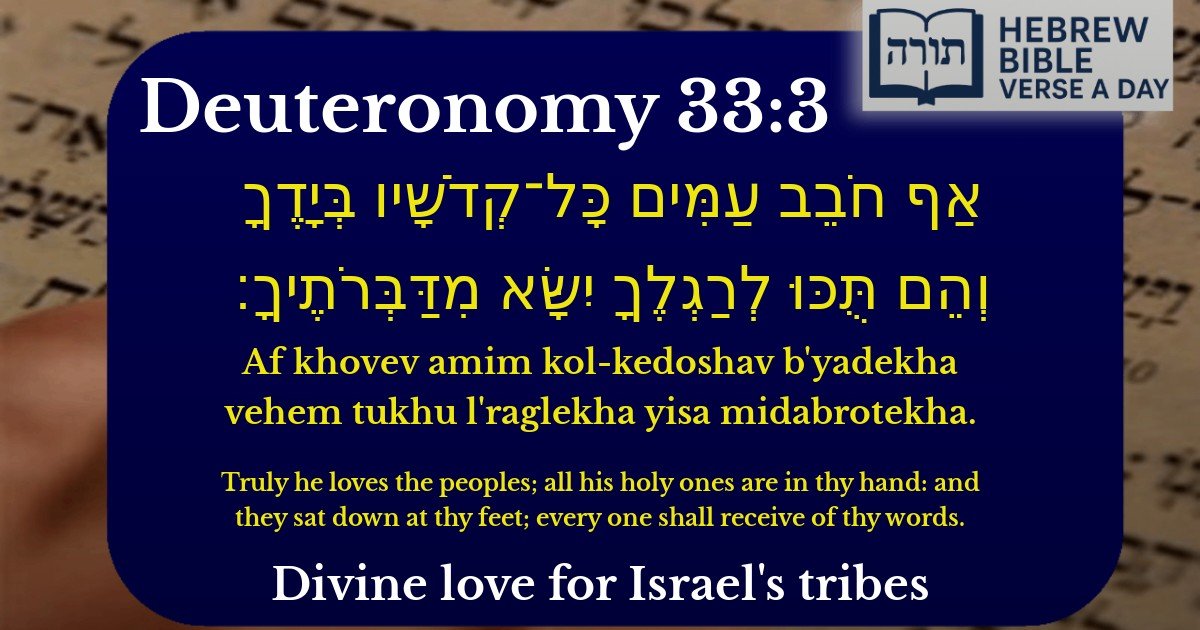

Deuteronomy 33:3 - Divine love for Israel's tribes

Deuteronomy 33:3 - דברים 33:3

Hebrew Text

אַף חֹבֵב עַמִּים כָּל־קְדֹשָׁיו בְּיָדֶךָ וְהֵם תֻּכּוּ לְרַגְלֶךָ יִשָּׂא מִדַּבְּרֹתֶיךָ׃

English Translation

Truly he loves the peoples; all his holy ones are in thy hand: and they sat down at thy feet; every one shall receive of thy words.

Transliteration

Af khovev amim kol-kedoshav b'yadekha vehem tukhu l'raglekha yisa midabrotekha.

Hebrew Leining Text

אַ֚ף חֹבֵ֣ב עַמִּ֔ים כׇּל־קְדֹשָׁ֖יו בְּיָדֶ֑ךָ וְהֵם֙ תֻּכּ֣וּ לְרַגְלֶ֔ךָ יִשָּׂ֖א מִדַּבְּרֹתֶֽיךָ׃

🎵 Listen to leining

Parasha Commentary

Understanding the Verse in Context

The verse (Devarim 33:3) appears in Moshe's final blessing to Bnei Yisrael before his passing. It speaks of Hashem's relationship with His people and the transmission of Torah. The phrasing is poetic and rich with meaning, as interpreted by our Sages.

Key Phrases and Their Meanings

  • "אַף חֹבֵב עַמִּים" (Truly he loves the peoples) - Rashi explains that this refers to Hashem's love for the nations, but specifically in the context of their potential to draw close to Him through accepting the Seven Noahide Laws. The Sifrei adds that this love is conditional upon their righteous conduct.
  • "כָּל־קְדֹשָׁיו בְּיָדֶךָ" (all his holy ones are in thy hand) - The Ramban interprets this as referring to the Jewish people, who are sanctified through mitzvot and are under Hashem's direct protection. The "hand" symbolizes divine providence and care.
  • "וְהֵם תֻּכּוּ לְרַגְלֶךָ" (and they sat down at thy feet) - The Talmud (Berachot 63b) understands this as the Jewish people humbly receiving Torah at Har Sinai, sitting at the "feet" of the Divine presence. The imagery evokes the posture of students before their teacher.
  • "יִשָּׂא מִדַּבְּרֹתֶיךָ" (every one shall receive of thy words) - The Midrash (Devarim Rabbah) explains this as each Jew receiving Torah according to their individual capacity and understanding, yet all partaking in the same divine wisdom.

Theological Implications

The Ibn Ezra notes that this verse encapsulates three foundational concepts:

  1. Hashem's universal concern for all humanity
  2. The special sanctity of Klal Yisrael
  3. The intimate transmission of Torah to the Jewish people

Practical Lessons

The Kli Yakar derives from this verse that our relationship with Torah must mirror the imagery of sitting at Hashem's feet - approaching Torah study with humility and reverence. Just as the Jewish people received Torah at Sinai with complete submission, so too must we approach divine wisdom with awe and willingness to accept its teachings.

📚 Talmud Citations

This verse is not quoted in the Talmud.

Frequently Asked Questions

Q: What does Deuteronomy 33:3 mean?
A: Deuteronomy 33:3 describes Hashem's love for the Jewish people ('עַמִּים' here refers to Israel) and His protection over them ('all His holy ones are in Your hand'). Rashi explains that 'they sat down at Your feet' refers to the Israelites accepting the Torah at Mount Sinai, showing their devotion to Hashem's commandments.
Q: Why is Deuteronomy 33:3 important?
A: This verse is part of Moshe's final blessing to the tribes of Israel before his passing. It emphasizes Hashem's eternal love and guardianship over the Jewish people, reinforcing the covenant at Sinai. The Rambam teaches that accepting Torah (as referenced in 'they sat down at Your feet') is the foundation of Jewish faith and practice.
Q: What can we learn from 'they sat down at Your feet' in Deuteronomy 33:3?
A: The phrase teaches humility and readiness to receive Torah wisdom. The Talmud (Eruvin 54b) compares Torah learning to a student sitting at a teacher's feet, showing respect and attentiveness. This reminds us to approach Torah study with dedication and reverence.
Q: How does 'all His holy ones are in Your hand' apply today?
A: This assures Jews in every generation of Hashem's protection. The Midrash (Sifrei Devarim) explains that just as Hashem guarded Israel in the wilderness, He continues to watch over those who keep His Torah. This offers comfort that our spiritual efforts are cherished by Hashem.
Q: What does 'every one shall receive of Your words' mean?
A: This teaches that Torah is accessible to all Jews. The Talmud (Shabbat 88a) states that at Sinai, each person received the Torah according to their capacity. Today, this means every Jew—regardless of background—can connect to Torah through study and mitzvot.