

Join Our Newsletter To Be Informed When New Videos Are Posted
Hebrew Text
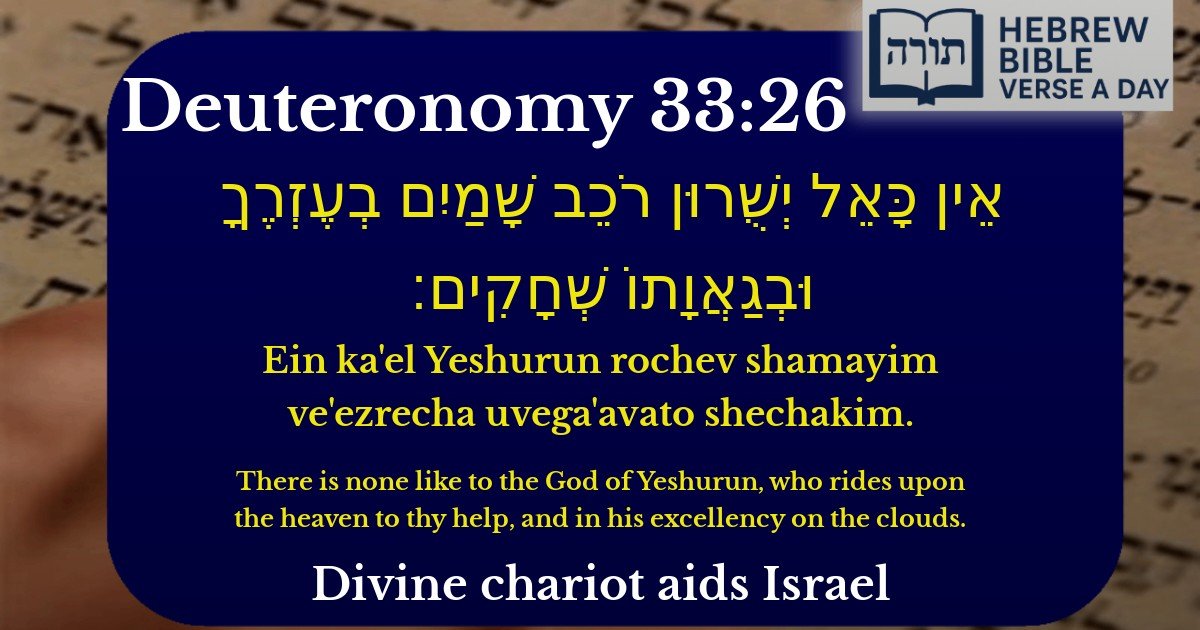
אֵין כָּאֵל יְשֻׁרוּן רֹכֵב שָׁמַיִם בְעֶזְרֶךָ וּבְגַאֲוָתוֹ שְׁחָקִים׃
English Translation
There is none like to the God of Yeshurun, who rides upon the heaven to thy help, and in his excellency on the clouds.
Transliteration
Ein ka'el Yeshurun rochev shamayim ve'ezrecha uvega'avato shechakim.
Hebrew Leining Text
אֵ֥ין כָּאֵ֖ל יְשֻׁר֑וּן רֹכֵ֤ב שָׁמַ֙יִם֙ בְּעֶזְרֶ֔ךָ וּבְגַאֲוָת֖וֹ שְׁחָקִֽים׃
🎵 Listen to leining
Parasha Commentary
📚 Talmud Citations
This verse is not quoted in the Talmud.
Understanding the Verse
The verse (Devarim 33:26) proclaims the uniqueness of Hashem as the protector and sustainer of the Jewish people, referred to here as "Yeshurun." The imagery of Hashem "riding upon the heaven" and "in His excellency on the clouds" conveys His supreme dominion over creation and His readiness to assist His people.
Rashi's Commentary
Rashi explains that the phrase "רוכב שמים בעזרך" ("who rides upon the heaven to thy help") means that Hashem harnesses the heavens and all celestial forces to come to the aid of Israel. The term "Yeshurun" is a poetic name for Israel, derived from "ישר" (straight or upright), emphasizing the nation's ideal relationship with Hashem when they follow His ways.
Rambam's Perspective
Rambam (Hilchot Yesodei HaTorah 1:1-5) discusses the concept of Hashem's transcendence and omnipotence. This verse aligns with his teachings, illustrating that Hashem is beyond physical limitations yet actively involved in guiding and protecting His people. The metaphor of "riding the heavens" signifies His absolute control over all natural forces.
Midrashic Insights
Kabbalistic Interpretation
The Zohar (III, 291a) interprets "רוכב שמים" as an allusion to Hashem's governance of the upper spiritual realms ("שמים") and His channeling of divine energy ("עזרך") to sustain the world. The "clouds" ("שחקים") represent the hidden, lofty sefirot through which His glory is revealed.
Practical Lesson
This verse teaches that even when Israel faces challenges, they must trust in Hashem's boundless power and providence. Just as He controls the heavens, He orchestrates events for their ultimate benefit, reinforcing the need for unwavering faith in His divine plan.