Frequently Asked Questions
Q: Why did the Israelites cry for Moses for 30 days?
A: The Israelites cried for Moses for 30 days because this was the standard period of mourning for a great leader in Jewish tradition (as mentioned in the Talmud, Moed Katan 27b). Moses was their teacher, prophet, and the one who brought them out of Egypt, so his passing was a tremendous loss.
Q: What is the significance of the 'plains of Moab' in this verse?
A: The 'plains of Moab' is where the Israelites were camped before entering the Land of Israel. According to Rashi, this location is significant because it was near the Jordan River, where Moses had delivered his final speeches (the Book of Deuteronomy) before his passing.
Q: Why does the Torah mention that the 'days of weeping and mourning for Moses were ended'?
A: The Torah emphasizes that the mourning period had a set duration (30 days) to teach that while grief is natural, it must eventually conclude so that life can continue. The Rambam (Hilchot Avel 13:12) explains that excessive mourning is discouraged in Jewish law.
Q: What can we learn from the Israelites' mourning for Moses?
A: We learn the importance of honoring and showing gratitude to our teachers and leaders. The Midrash (Devarim Rabbah 11:10) states that the mourning for Moses was sincere and heartfelt, showing the deep connection between the people and their righteous leader.
Q: How does Jewish tradition view the mourning process for a leader like Moses?
A: Jewish tradition (based on the Talmud and Halacha) teaches that mourning for a righteous leader like Moses follows specific guidelines, including a 30-day period of weeping (as seen here). This structured mourning helps the community process loss while maintaining faith and continuity.

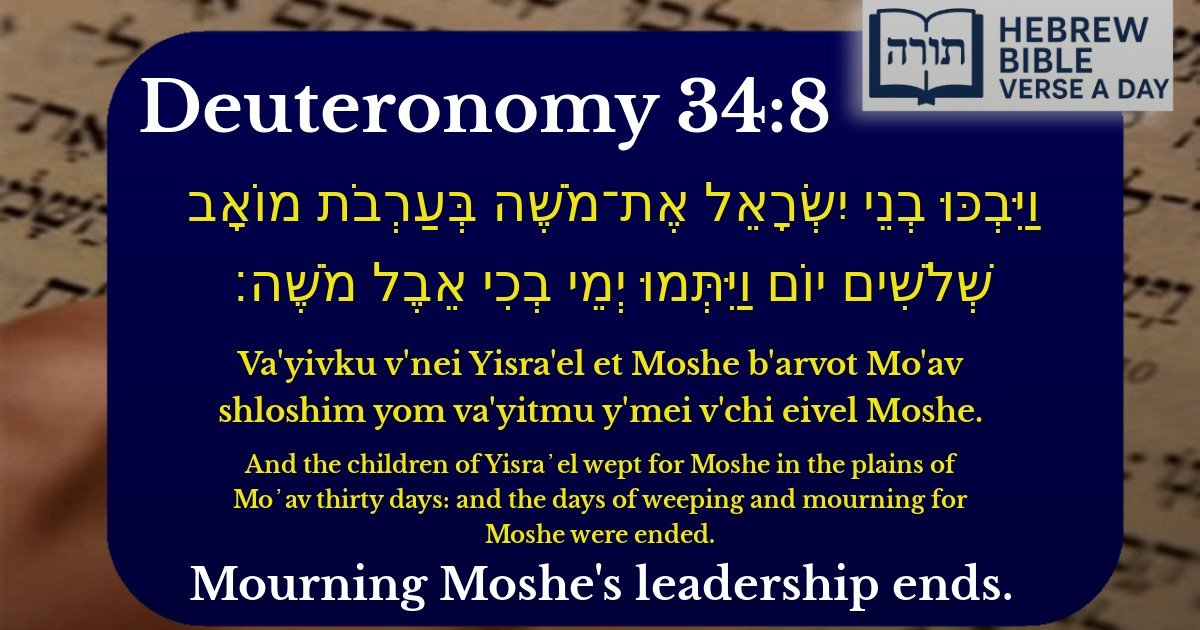

The Thirty Days of Mourning for Moshe
The verse (Devarim 34:8) describes Bnei Yisrael mourning Moshe Rabbeinu for thirty days in the plains of Moav. This period of mourning follows the halachic standard for a nasi (leader), as explained in the Talmud (Moed Katan 27b), which states that thirty days of mourning are observed for a king or nasi. Rashi comments that this demonstrates the honor Bnei Yisrael accorded Moshe, treating him with the same reverence as a monarch.
The Completion of the Mourning Period
The phrase "וַיִּתְּמוּ יְמֵי בְכִי אֵבֶל מֹשֶׁה" ("the days of weeping and mourning for Moshe were ended") indicates a formal conclusion to the mourning process. The Rambam (Hilchos Avel 13:10) notes that while the initial thirty days are marked by intense grief, the mourning gradually diminishes afterward, allowing the nation to transition back to normalcy while still retaining reverence for Moshe’s legacy.
Why the Plains of Moav?
The location—עַרְבֹת מוֹאָב (the plains of Moav)—is significant. The Midrash (Devarim Rabbah 11:10) explains that this was the place where Moshe delivered his final discourses (the book of Devarim), making it a fitting site for mourning. Additionally, the Sforno suggests that since Bnei Yisrael were about to enter Eretz Yisrael under Yehoshua’s leadership, their mourning in Moav symbolized the end of an era and the transition to a new phase in their history.
Lessons in Leadership and National Unity