Frequently Asked Questions
Q: What does 'Behold, I set before you this day a blessing and a curse' mean?
A: This verse (Deuteronomy 11:26) means that Hashem presents the Jewish people with two paths: one of following His commandments, which leads to blessings, and one of straying from them, which leads to curses. Rashi explains that this emphasizes free will—the choice is ours to make.
Q: Why is this verse important in Judaism?
A: This verse is foundational because it teaches the principle of reward and consequence based on our actions. The Rambam (Maimonides) discusses this in Hilchot Teshuvah, stating that every person has the ability to choose good or evil, and our choices determine our spiritual and physical outcomes.
Q: How does this verse apply to our lives today?
A: The verse reminds us that every day, we face choices between right and wrong. The Sforno explains that 'this day' implies that the opportunity for choosing blessings is always present in the present moment. We must strive to make choices aligned with Torah values to bring blessings into our lives.
Q: What is the significance of 'blessing and curse' being set before us?
A: The Midrash (Sifrei) teaches that the 'blessing' refers to diligently observing Torah mitzvot, while the 'curse' refers to abandoning them. This duality highlights that our relationship with Hashem is active—our actions directly influence whether we experience Divine favor or the opposite.
Q: Does this verse mean G-d causes bad things to happen?
A: No, the verse teaches that curses come as a consequence of straying from Torah, not as arbitrary punishment. The Ramban (Nachmanides) explains that blessings and curses are natural outcomes of living in harmony (or disharmony) with Hashem’s will, much like health follows healthy habits.

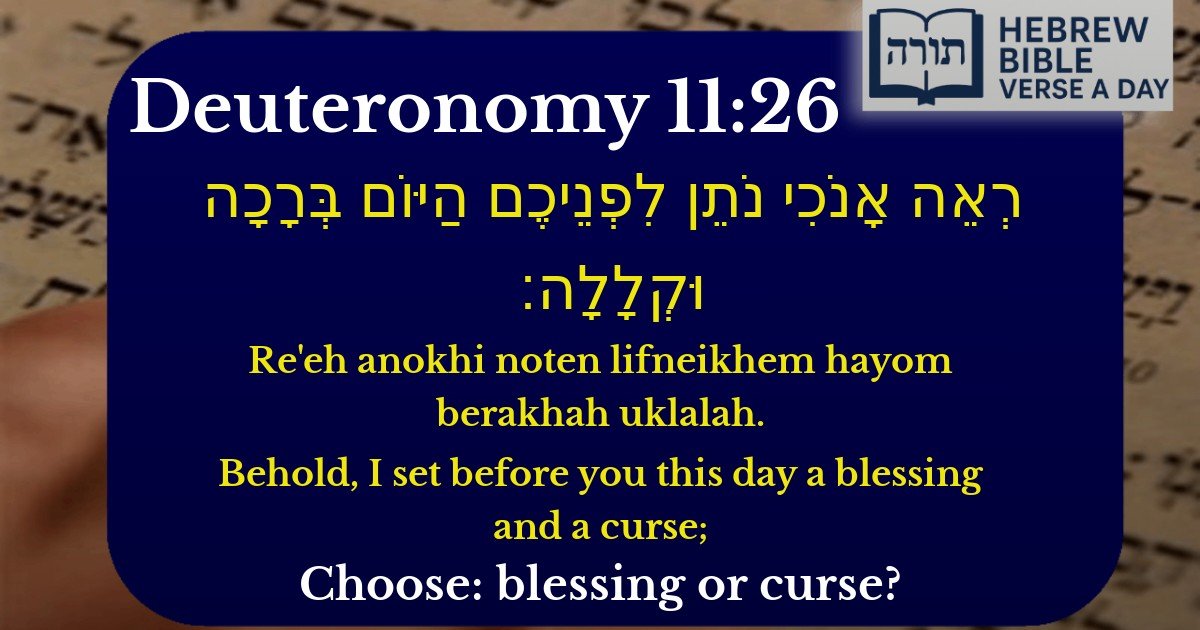

Overview of the Verse
The verse, "Behold, I set before you this day a blessing and a curse" (Devarim 11:26), introduces the fundamental concept of free will in Jewish thought. Hashem presents the Jewish people with two paths—one leading to blessing and the other to curse—emphasizing that their choices determine their fate.
Rashi's Explanation
Rashi (Devarim 11:26) explains that the phrase "this day" underscores the immediacy and constant relevance of this choice. Every day, a person stands at a crossroads where their actions can bring blessing or the opposite. The use of "Behold" (רְאֵה) suggests that this is a clear and visible truth, not hidden or ambiguous.
Rambam on Free Will
Rambam (Hilchot Teshuvah 5:1-3) elaborates on this verse, teaching that free will is a foundational principle of Torah. A person is not compelled toward good or evil but has the ability to choose. The "blessing" and "curse" represent the natural consequences of aligning with or deviating from the Torah's commandments.
Midrashic Insights
Halachic Implications
The Shulchan Aruch (Orach Chaim 1:1) begins with the principle of awakening to Divine service, reflecting the idea that every day presents a new opportunity to choose the "blessing." The Vilna Gaon notes that this verse serves as a reminder that our spiritual state is not fixed but constantly shaped by our actions.
Chassidic Perspective
The Baal Shem Tov teaches that "this day" alludes to the present moment—the only time when a person can truly exercise free will. The past is gone, and the future is uncertain, but "today" is when we can choose to draw closer to Hashem through Torah and mitzvot.