Frequently Asked Questions
Q: Why does the Torah forbid eating blood?
A: The Torah forbids eating blood because blood represents life (Deuteronomy 12:23). According to Rashi and the Talmud (Chullin 117a), consuming blood is considered a serious violation because life belongs to Hashem. Instead, we must pour the blood on the earth like water, showing respect for the sanctity of life.
Q: How do we apply the prohibition of eating blood today?
A: Today, kosher meat must undergo a process called 'kashering' (soaking and salting) to remove as much blood as possible before cooking (Shulchan Aruch, Yoreh De'ah 69). This fulfills the Torah's commandment to avoid consuming blood. Additionally, blood from eggs (blood spots) must also be discarded.
Q: What is the deeper meaning behind pouring blood on the earth like water?
A: The Midrash (Sifrei Devarim 75) explains that pouring blood on the earth symbolizes returning life to its Source (Hashem). Just as water is absorbed into the ground without a trace, we dispose of blood in a way that shows humility and recognition that life is sacred and not ours to consume.
Q: Does this verse apply to all types of blood?
A: Yes, the prohibition applies to the blood of all kosher animals and birds (Rambam, Ma'achalot Asurot 6:1). However, the blood of fish is permitted because it is not considered the same as the blood of land animals (Talmud, Chullin 117b).
Q: Why is the prohibition against eating blood repeated so many times in the Torah?
A: The Torah emphasizes this prohibition multiple times (e.g., Leviticus 7:26, Deuteronomy 12:23-24) because it is a fundamental principle of kashrut and Jewish ethics. The Talmud (Keritot 20b) teaches that this repetition underscores its seriousness—violating it intentionally carries severe consequences (karet).

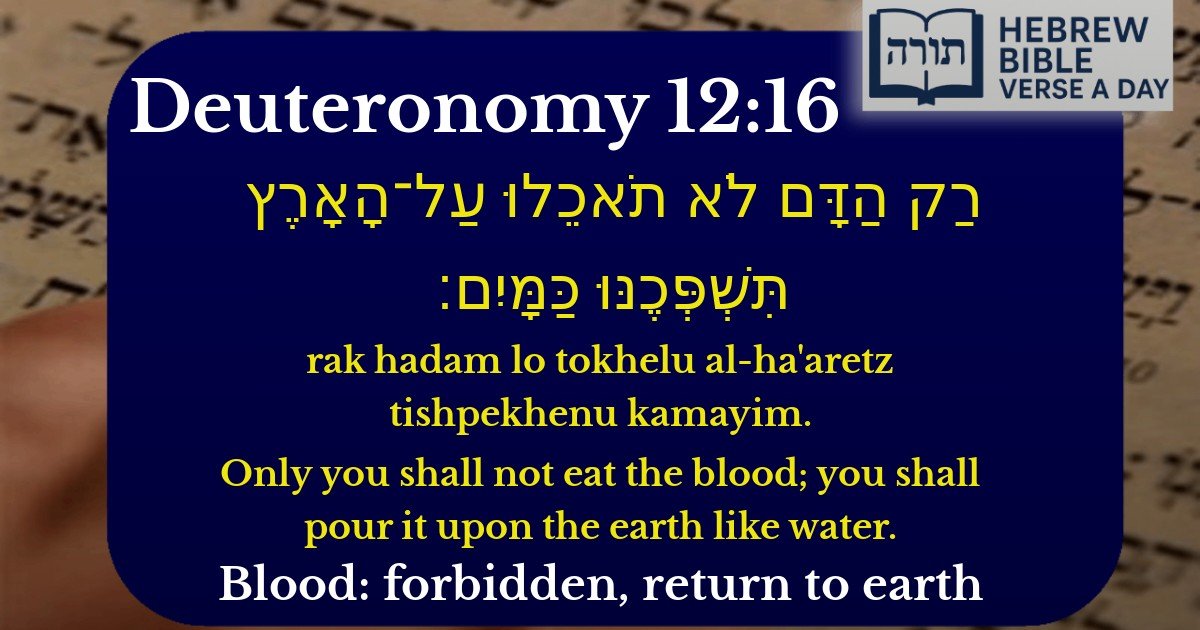

Prohibition of Consuming Blood
The verse (Devarim 12:16) prohibits the consumption of blood, commanding instead that it be poured out on the ground like water. This prohibition is rooted in the Torah's broader emphasis on the sanctity of blood, as it is the nefesh (life force) of the animal (Vayikra 17:11). Rashi explains that the comparison to water emphasizes that the blood must be completely drained and not retained for any use, just as water cannot be gathered once poured.
Halachic Implications
Rambam (Hilchot Ma'achalot Asurot 6:1) elaborates on this prohibition, stating that consuming blood is a severe transgression punishable by karet (spiritual excision). The Torah's command to pour it out like water teaches that even after slaughtering an animal in a permitted manner (shechitah), the blood must be treated with reverence and disposed of properly.
Symbolic and Ethical Dimensions
The Midrash (Sifrei Devarim 75) connects this mitzvah to the moral lesson of respecting life. By refraining from consuming blood—the symbol of life—we acknowledge Hashem's dominion over all living beings. The act of pouring it out like water also serves as a reminder of humility, as water flows downward, symbolizing our submission to divine will.
Practical Application