Frequently Asked Questions
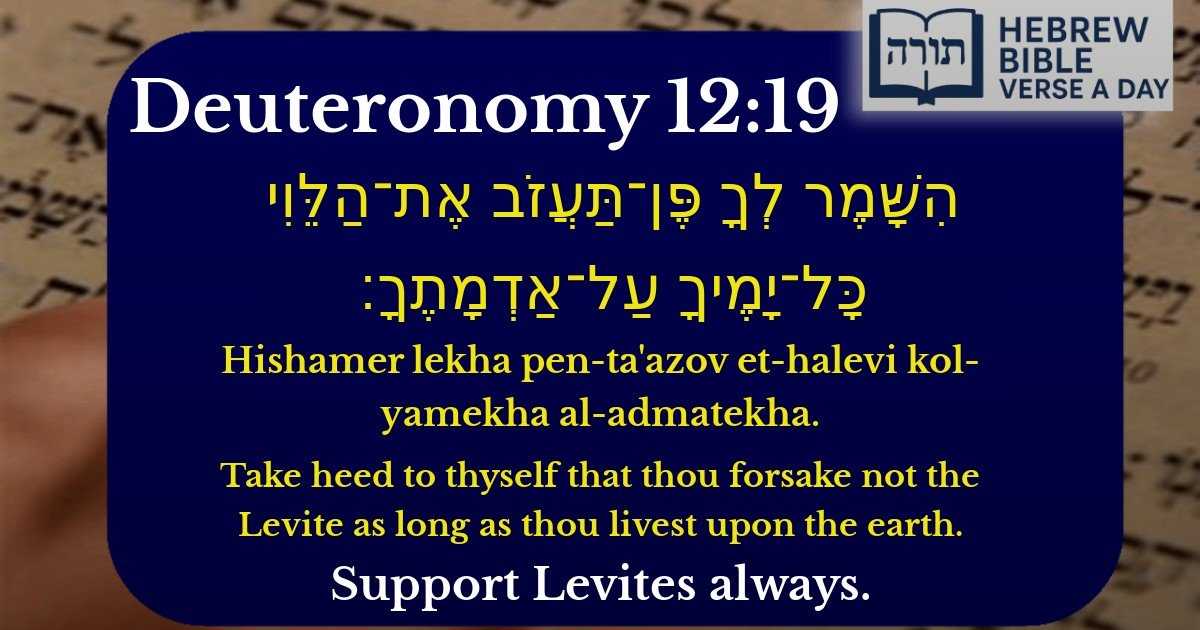
Q: What does the verse 'Take heed to thyself that thou forsake not the Levite as long as thou livest upon the earth' mean?
A: This verse from Deuteronomy 12:19 is a commandment to the Jewish people to support the Levites, who did not receive a portion of land in Israel like the other tribes. Since their role was to serve in the Temple and teach Torah, they relied on the tithes (ma'aser) and gifts from the other tribes for their livelihood. The Torah warns us not to neglect this obligation.
Q: Why is it important not to forsake the Levite?
A: The Levites had a sacred role in serving Hashem in the Mishkan (Tabernacle) and later the Beit HaMikdash (Temple), as well as teaching Torah to the people. Since they did not inherit land, their sustenance depended on the generosity of others. Neglecting them would disrupt their holy work and weaken Torah study and divine service, which are essential for the Jewish people.
Q: How does this commandment apply today when there is no Temple?
A: Although the Temple is not standing today, the principle of supporting Torah scholars—who continue the Levites' role of teaching and preserving Torah—remains. The Rambam (Hilchos Shemittah 13:12-13) explains that supporting those who dedicate their lives to Torah study is a great mitzvah, ensuring the continuity of Jewish learning and tradition.
Q: What can we learn from this verse about helping others?
A: This verse teaches us the importance of supporting those who contribute spiritually to the community. Just as the Levites served the nation, we must ensure that Torah teachers and scholars have what they need to continue their work. It also reminds us that material success should be used to uphold spiritual values, as Rashi explains that neglecting the Levite would lead to ingratitude toward Hashem.
Q: Does this verse only refer to Levites, or does it include other Torah scholars?
A: While the verse specifically mentions the Levites, Chazal (our Sages) extend this obligation to all Torah scholars (Talmud, Chullin 131a). Since their role is to teach and preserve Torah, supporting them fulfills the same principle—ensuring that Torah knowledge is accessible to all Jews, just as the Levites did in ancient times.


Context of the Verse
The verse (Devarim 12:19) appears in Parashat Re'eh, where Moshe instructs Bnei Yisrael regarding their obligations once they enter Eretz Yisrael. The Torah emphasizes the importance of not neglecting the Levites, who were not allotted a portion of land like the other tribes (Bamidbar 18:20).
Rashi's Explanation
Rashi explains that the phrase "הִשָּׁמֶר לְךָ" ("Take heed to thyself") serves as a warning to ensure that the Levites are not deprived of their rightful share in tithes and gifts. Since the Levites were dedicated to Divine service and lacked land inheritance, they relied on the generosity of the other tribes for sustenance. Rashi emphasizes that this mitzvah applies "כָּל־יָמֶיךָ עַל־אַדְמָתֶךָ" ("as long as thou livest upon the earth"), meaning it is a perpetual obligation for all generations in Eretz Yisrael.
Rambam's Perspective
In Hilchot Matnot Aniyim (9:1-2), the Rambam codifies this commandment, stating that neglecting the Levite’s portion violates a Torah prohibition. He explains that the Levites were entitled to ma'aser rishon (the first tithe) and other gifts, and withholding these constitutes a breach of their rights as servants of Hashem.
Midrashic Insights
The Midrash (Sifrei Devarim 82) elaborates that the Levites' role in teaching Torah and serving in the Beit HaMikdash made their sustenance a communal responsibility. The verse underscores that supporting them is not optional but a moral and halachic duty tied to the land’s holiness.
Practical Implications
Chizkuni's Additional Commentary
Chizkuni notes that the phrase "עַל־אַדְמָתֶךָ" ("upon thy land") reinforces that this obligation is tied to dwelling in Eretz Yisrael. Outside the land, the Levites were not entitled to tithes, highlighting the unique sanctity of the land and its agricultural laws.