Frequently Asked Questions
Q: Why does the Torah forbid eating blood?
A: The Torah forbids eating blood because blood represents the life force (nefesh) of an animal, as stated in Deuteronomy 12:23: 'for the blood is the life.' According to Rashi and other Jewish commentators, consuming blood is considered a violation of the sanctity of life, as life belongs to Hashem. This prohibition is one of the Seven Noahide Laws and applies to all humanity, with additional strictures for Jews under the Torah's commandments.
Q: How do we practically avoid eating blood according to Jewish law?
A: Jewish law (halacha) requires that meat be properly kashered (prepared) to remove blood before consumption. This involves salting and rinsing the meat, or roasting it over an open flame, as detailed in the Talmud (Chullin 113a) and codified by the Rambam (Hilchot Ma'achalot Asurot 6:10). Kosher slaughter (shechita) also ensures maximum blood drainage. These practices fulfill the Torah's commandment not to consume blood.
Q: What is the deeper meaning behind 'the blood is the life'?
A: The phrase 'the blood is the life' (ki hadam hu hanefesh) teaches that blood symbolizes the divine spark within living creatures. The Midrash (Sifrei Devarim) explains that this verse emphasizes the sacredness of life, which originates from Hashem. By prohibiting blood consumption, the Torah instills reverence for life and reminds us that our physical sustenance must align with spiritual values.
Q: Does this prohibition apply to all types of blood?
A: The prohibition applies specifically to the blood of mammals and birds (as per Vayikra 7:26), which are used for sacrificial purposes in the Temple. Fish blood and human blood are not included in this prohibition, as discussed in the Talmud (Keritot 21b). However, all blood is generally avoided as a matter of strictness (chumra) in kosher observance.
Q: How is this commandment relevant today without the Temple?
A: Even without the Temple, this commandment remains central to kashrut (Jewish dietary laws). The Rambam (Hilchot Ma'achalot Asurot 6:1) rules that the blood prohibition is eternal. It serves as a daily reminder of ethical eating, respect for life, and our covenantal relationship with Hashem. Modern kosher certification ensures compliance with these laws in food production.

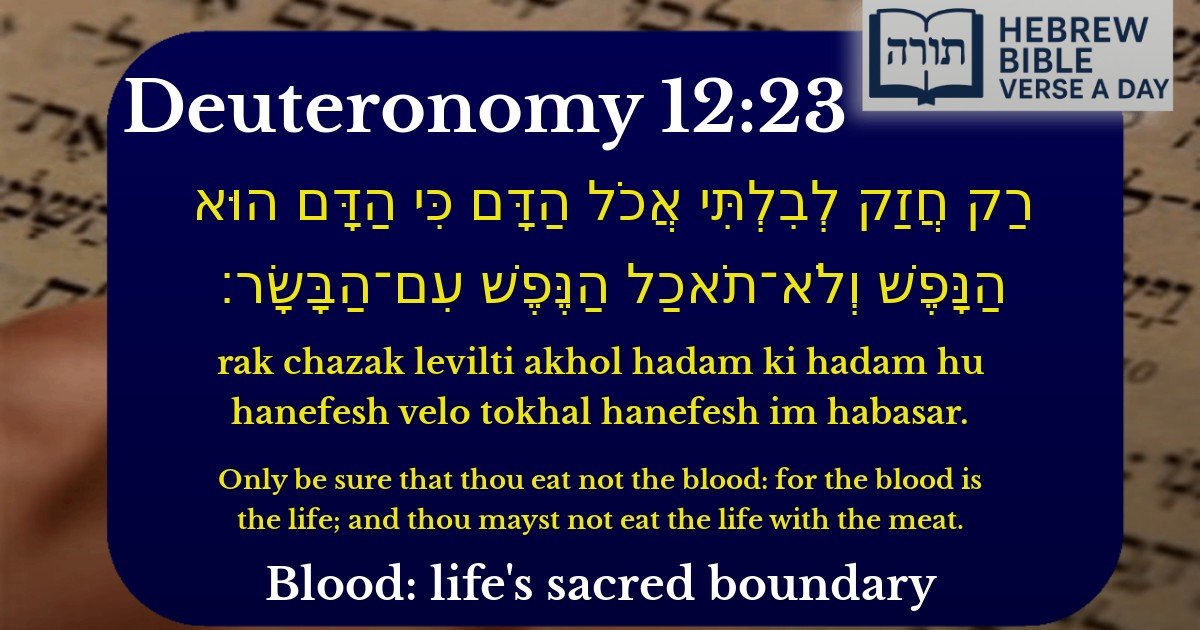

Prohibition of Eating Blood
The verse (Devarim 12:23) commands the Jewish people to refrain from consuming blood, emphasizing that "the blood is the life (נֶפֶשׁ)." This prohibition is rooted in the sanctity of life, as blood represents the life force of a creature. Rashi explains that the term "הַנָּפֶשׁ" refers to the soul, and consuming blood is akin to consuming the essence of life itself. The Torah repeatedly forbids this act (e.g., Vayikra 17:10-14), underscoring its severity.
Blood as the Seat of the Soul
Rambam (Hilchot Ma'achalot Asurot 6:1) elaborates that blood is designated as the carrier of the soul (נפש החיונית), and thus, consuming it is a violation of the respect due to life. The Talmud (Chullin 117a) further states that blood must be drained and covered (כסוי הדם) for permitted animals, reinforcing its sacred nature.
Spiritual and Ethical Implications
Halachic Applications
The Shulchan Aruch (Yoreh De'ah 65-68) details the laws of kashering meat (מליחה והדחה) to remove blood, ensuring compliance with this mitzvah. The Rema adds that even a small amount of blood is forbidden, reflecting the Torah's stringent stance.