

Join Our Newsletter To Be Informed When New Videos Are Posted
Hebrew Text
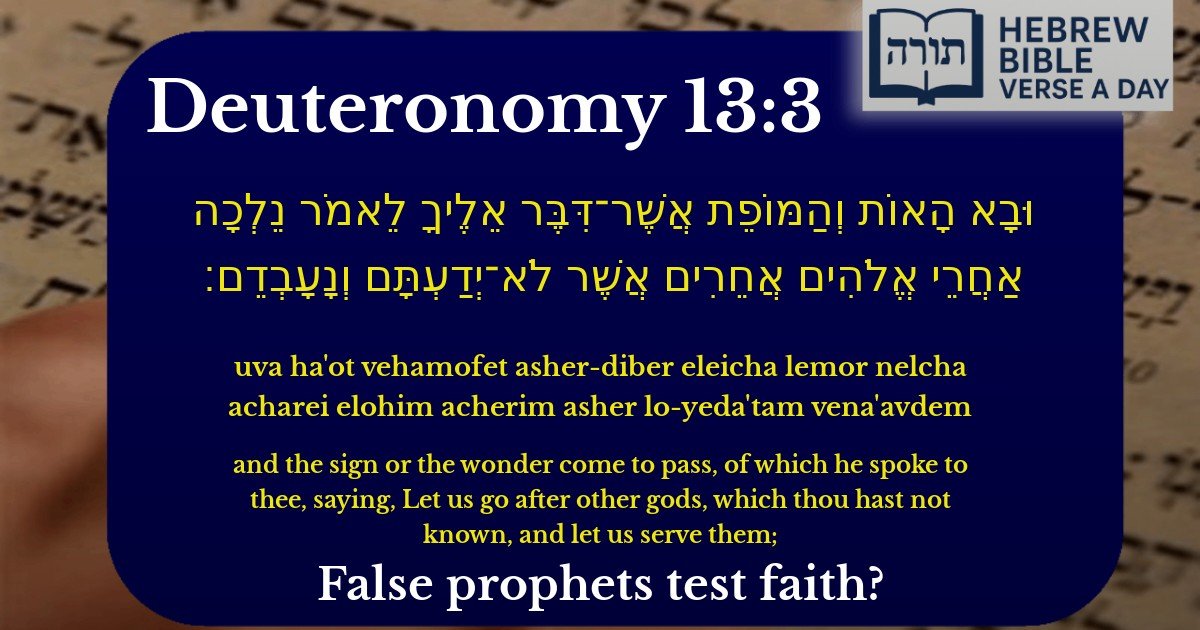
וּבָא הָאוֹת וְהַמּוֹפֵת אֲשֶׁר־דִּבֶּר אֵלֶיךָ לֵאמֹר נֵלְכָה אַחֲרֵי אֱלֹהִים אֲחֵרִים אֲשֶׁר לֹא־יְדַעְתָּם וְנָעָבְדֵם׃
English Translation
and the sign or the wonder come to pass, of which he spoke to thee, saying, Let us go after other gods, which thou hast not known, and let us serve them;
Transliteration
Uva ha'ot vehamofet asher-diber eleicha lemor nelcha acharei elohim acherim asher lo-yeda'tam vena'avdem
Hebrew Leining Text
וּבָ֤א הָאוֹת֙ וְהַמּוֹפֵ֔ת אֲשֶׁר־דִּבֶּ֥ר אֵלֶ֖יךָ לֵאמֹ֑ר נֵֽלְכָ֞ה אַחֲרֵ֨י אֱלֹהִ֧ים אֲחֵרִ֛ים אֲשֶׁ֥ר לֹֽא־יְדַעְתָּ֖ם וְנׇֽעׇבְדֵֽם׃
🎵 Listen to leining
Parasha Commentary
📚 Talmud Citations
This verse is quoted in the Talmud.
📖 Sanhedrin 90a
The verse is discussed in the context of false prophets and the criteria for identifying them, particularly focusing on the prohibition against following other gods.
📖 Avodah Zarah 17b
The verse is referenced in a discussion about the dangers of idolatry and the seduction of false prophets who lead others astray.
Context in Devarim (Deuteronomy) 13:2
This verse appears in the context of warning against false prophets who attempt to lead the Jewish people astray through signs and wonders. The Torah emphasizes that even if a prophet performs miraculous signs, if they advocate for idolatry, they must not be heeded.
Rashi's Explanation
Rashi (Devarim 13:2) clarifies that the phrase "the sign or the wonder come to pass" refers to a false prophet who successfully predicts an event or performs a miracle. However, Rashi stresses that this does not validate their message if it contradicts Torah law. The test of a true prophet is not merely their ability to perform wonders, but their adherence to Torah principles.
Rambam's Perspective
In Hilchot Yesodei HaTorah (8:1-3), Rambam (Maimonides) elaborates that a prophet who attempts to nullify any mitzvah—especially by advocating idolatry—is immediately identifiable as false, regardless of any signs they perform. The Torah's commandments are eternal, and no prophecy can override them.
Talmudic Discussion
The Talmud (Sanhedrin 90a) discusses this verse in the context of the severity of leading others to idolatry. It states that even if a false prophet's sign comes to pass, their words must be rejected because the Torah explicitly warns against such deception.
Midrashic Insight
The Sifrei (Devarim 84) comments on this verse, emphasizing that the Jewish people must remain steadfast in their faith even when faced with seemingly convincing miracles. The Midrash compares this to a king who warns his son not to be swayed by imposters, no matter how convincing their claims may appear.
Key Lessons