
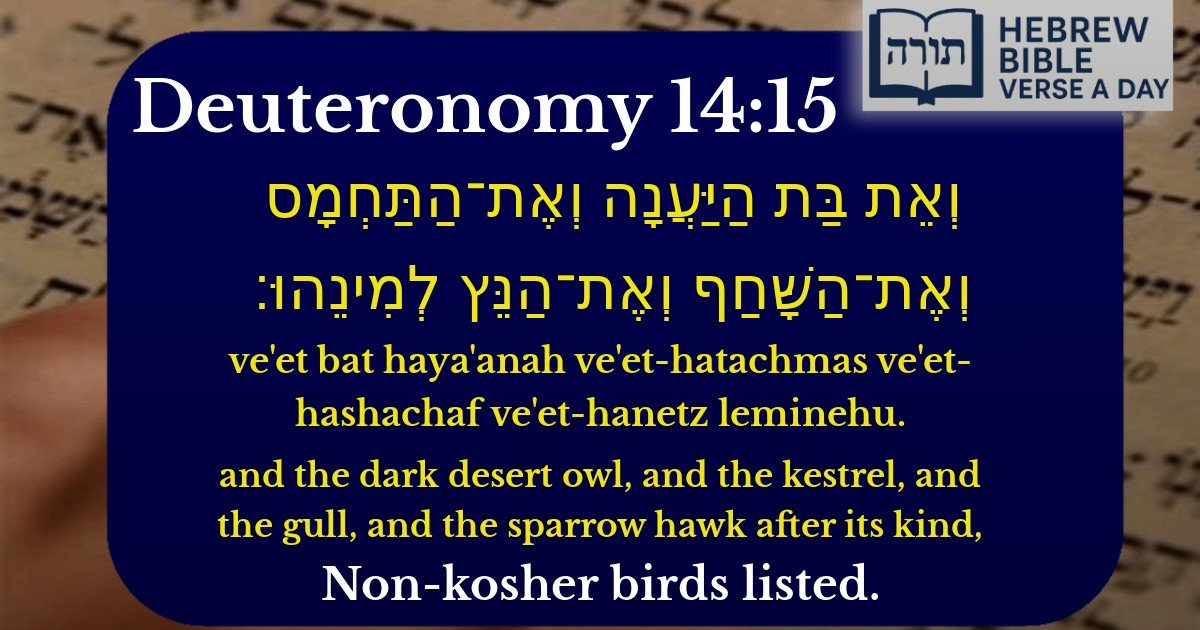

Deuteronomy 14:15 - Non-kosher birds listed.

Deuteronomy 14:15 - דברים 14:15

Hebrew Text

וְאֵת בַּת הַיַּעֲנָה וְאֶת־הַתַּחְמָס וְאֶת־הַשָּׁחַף וְאֶת־הַנֵּץ לְמִינֵהוּ׃

English Translation

and the dark desert owl, and the kestrel, and the gull, and the sparrow hawk after its kind,

Transliteration

Ve'et bat haya'anah ve'et-hatachmas ve'et-hashachaf ve'et-hanetz leminehu.

Hebrew Leining Text

וְאֵת֙ בַּ֣ת הַֽיַּעֲנָ֔ה וְאֶת־הַתַּחְמָ֖ס וְאֶת־הַשָּׁ֑חַף וְאֶת־הַנֵּ֖ץ לְמִינֵֽהוּ׃

🎵 Listen to leining

Parasha Commentary

Explanation of the Verse

The verse lists several non-kosher birds that are forbidden for consumption according to the Torah's dietary laws. These birds are enumerated in Vayikra (Leviticus) 11:16 and Devarim (Deuteronomy) 14:15 as part of the broader category of tamei (impure) creatures. The Talmud (Chullin 63a-65a) extensively discusses the identifying characteristics of non-kosher birds, noting that they are typically predatory or exhibit cruel behavior.

Identification of the Birds

  • בַּת הַיַּעֲנָה (Bat HaYa'anah) - Rashi identifies this as the ostrich, based on its description in Iyov (Job) 39:13-18. The Midrash (Bereishit Rabbah 19:1) associates it with mourning due to its wailing cry.
  • הַתַּחְמָס (Tachmas) - Rambam (Hilchot Ma'achalot Asurot 1:15) identifies this as a type of owl or night bird, known for its aggressive nature.
  • הַשָּׁחַף (Shachaf) - Rashi explains this as a seagull or a similar seabird, which scavenges and is thus unfit for consumption.
  • הַנֵּץ (Netz) - The Netz is identified as the sparrow hawk, a bird of prey. The Talmud (Chullin 63b) notes that any bird that seizes food in midair is presumed non-kosher.

Halachic Significance

The Torah prohibits these birds due to their predatory nature, as derived from the Talmudic principle (Chullin 59a) that birds of prey are inherently non-kosher. The Rambam (Hilchot Ma'achalot Asurot 1:14) emphasizes that only birds with a mesorah (tradition) of being kosher may be eaten, reinforcing the importance of transmitted knowledge in determining kosher status.

Moral and Symbolic Lessons

The Midrash (Vayikra Rabbah 22:10) teaches that non-kosher birds symbolize negative traits such as cruelty and greed, which Jews are to avoid. The prohibition serves as a reminder to distance oneself from behaviors associated with these creatures, instead cultivating compassion and righteousness.

📚 Talmud Citations

This verse is not quoted in the Talmud.

Frequently Asked Questions

Q: Why does the Torah list specific non-kosher birds like the desert owl and kestrel?
A: The Torah lists non-kosher birds to teach us which species are forbidden to eat according to Jewish law (Vayikra 11:13-19). Rashi explains that these birds share cruel characteristics like being predators, which is why they are not kosher.
Q: What is the significance of the phrase 'after its kind' in this verse?
A: The phrase 'after its kind' teaches that all similar species to the listed non-kosher birds are also forbidden. The Talmud (Chullin 63b) explains this principle applies broadly to all birds with the same characteristics as those listed.
Q: How do we identify non-kosher birds today if we don't know the exact species listed in the Torah?
A: The Rambam (Hilchos Ma'achalos Asuros 1:14) explains we rely on tradition (mesorah) to identify non-kosher birds. Only birds with a clear tradition of being kosher may be eaten, while all others are forbidden due to the Torah's general prohibition.
Q: What lesson can we learn from the Torah listing non-kosher birds?
A: The Midrash (Vayikra Rabbah 13:2) teaches that just as Hashem separates kosher from non-kosher animals, we must separate ourselves from negative influences and behaviors. The non-kosher birds represent cruelty we should avoid.
Q: Why are predatory birds like hawks and owls not kosher?
A: Rashi (on Vayikra 11:13) explains that non-kosher birds typically exhibit cruel characteristics like preying on other animals. Since kosher food must be spiritually elevating, we avoid species with violent natures (Sefer HaChinuch 156).