
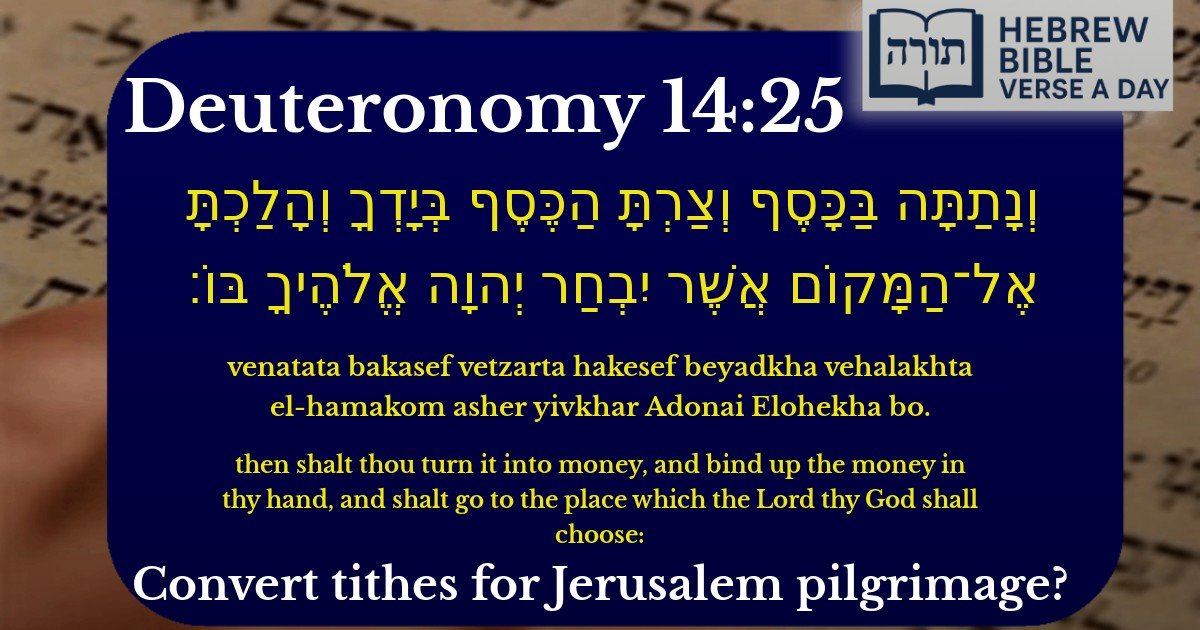

Deuteronomy 14:25 - Convert tithes for Jerusalem pilgrimage?

Deuteronomy 14:25 - דברים 14:25

Hebrew Text

וְנָתַתָּה בַּכָּסֶף וְצַרְתָּ הַכֶּסֶף בְּיָדְךָ וְהָלַכְתָּ אֶל־הַמָּקוֹם אֲשֶׁר יִבְחַר יְהוָה אֱלֹהֶיךָ בּוֹ׃

English Translation

then shalt thou turn it into money, and bind up the money in thy hand, and shalt go to the place which the Lord thy God shall choose:

Transliteration

Venatata bakasef vetzarta hakesef beyadkha vehalakhta el-hamakom asher yivkhar Adonai Elohekha bo.

Hebrew Leining Text

וְנָתַתָּ֖ה בַּכָּ֑סֶף וְצַרְתָּ֤ הַכֶּ֙סֶף֙ בְּיָ֣דְךָ֔ וְהָֽלַכְתָּ֙ אֶל־הַמָּק֔וֹם אֲשֶׁ֥ר יִבְחַ֛ר יְהֹוָ֥ה אֱלֹהֶ֖יךָ בּֽוֹ׃

🎵 Listen to leining

Parasha Commentary

Context in Devarim (Deuteronomy)

The verse (Devarim 14:25) appears in the context of the mitzvah of Ma'aser Sheni (the Second Tithe), where produce grown in Eretz Yisrael must be eaten in Yerushalayim. If transporting the produce is burdensome, the Torah permits converting it into money, which is then brought to Yerushalayim to purchase food for consumption there.

Rashi's Explanation

Rashi (Devarim 14:25) emphasizes the phrase "וְצַרְתָּ הַכֶּסֶף בְּיָדְךָ" ("bind up the money in your hand"), explaining that one should not delay fulfilling this mitzvah. The money must be carefully guarded and promptly brought to Yerushalayim to avoid loss or misappropriation. This teaches the importance of treating sanctified objects with reverence and urgency.

Rambam's Halachic Perspective

In Hilchos Ma'aser Sheni (2:4), the Rambam rules that the money must be physically brought to Yerushalayim—it cannot be sent with another person. This underscores the personal obligation to participate in the mitzvah and the spiritual elevation achieved by journeying to the Holy City.

Midrashic Insight

The Sifrei (Devarim 103) connects this verse to the broader theme of simcha (joy) in serving Hashem. By requiring Jews to bring their tithes to Yerushalayim—a place of unity and divine presence—the Torah ensures that their material blessings become sources of spiritual elevation and communal celebration.

Symbolic Meaning

  • Money as a Medium: The conversion of produce into money symbolizes the elevation of physical sustenance (grain, wine, oil) into a higher spiritual purpose when used for mitzvot.
  • Binding the Money: Represents the need to safeguard mitzvot from distraction or neglect, as taught in Pirkei Avot (2:1): "Be as careful with a minor mitzvah as with a major one."

📚 Talmud Citations

This verse is not quoted in the Talmud.

Frequently Asked Questions

Q: What does Deuteronomy 14:25 mean?
A: Deuteronomy 14:25 instructs the Jewish people on how to handle the second tithe (ma'aser sheni). If bringing the tithe's produce to Jerusalem is too difficult, the verse allows converting it into money, taking the money to Jerusalem, and using it to buy food to eat there in holiness. Rashi explains this teaches that the money must be physically carried to Jerusalem and not sent with others.
Q: Why is the 'place God chooses' mentioned in this verse?
A: The 'place God chooses' refers to the Temple in Jerusalem (as explained in Deuteronomy 12). This verse emphasizes the centrality of Jerusalem in Jewish worship and the importance of bringing our tithes there. The Rambam (Hilchos Ma'aser Sheni 2:1) discusses how this mitzvah connects Jews to the holiness of Jerusalem.
Q: What practical lesson can we learn from Deuteronomy 14:25 today?
A: While we currently cannot bring tithes to the Temple, this verse teaches us: 1) The importance of supporting Jerusalem spiritually and materially 2) That Torah makes allowances for practical difficulties in performing mitzvos 3) The value of personally participating in mitzvos rather than delegating them (based on Rashi's emphasis on 'in your hand').
Q: Why does the verse say to 'bind up the money'?
A: Rashi explains that 'binding up the money' means keeping it separate and designated solely for its holy purpose of buying food in Jerusalem. This teaches us to treat money for mitzvos with special care and not mix it with regular funds. The Talmud (Bava Metzia 42a) derives from this that money for charity should be kept separate.
Q: How does this verse relate to tithing today?
A: Although we cannot currently bring the second tithe to Jerusalem, Orthodox Jews still separate tithes from produce grown in Israel (terumos and ma'asros). The principles from this verse - setting aside portions for holy purposes and supporting Jerusalem - remain relevant through supporting Torah scholars and Jerusalem's Jewish community (based on Rambam's Hilchos Ma'aser Sheni).