Frequently Asked Questions
Q: What animals are kosher according to Deuteronomy 14:4?
A: Deuteronomy 14:4 lists three animals that are kosher (fit to eat according to Jewish law): the ox (שור), the sheep (שה כשבים), and the goat (שה עזים). These are examples of animals that meet the Torah's criteria for kosher mammals—they must have split hooves and chew their cud (as explained in Leviticus 11:3).
Q: Why does the Torah specify which animals we can eat?
A: The Torah specifies permitted and forbidden animals to teach us discipline and holiness in our daily lives. Rambam (Maimonides) explains in the Guide for the Perplexed (3:48) that kosher laws elevate our physical actions by connecting them to spiritual awareness. Rashi also notes that these laws distinguish the Jewish people in their devotion to Hashem's commandments.
Q: Are there other kosher animals besides the ox, sheep, and goat?
A: Yes! Deuteronomy 14:4-5 lists these three as examples, but other animals with split hooves and that chew their cud (like deer) are also kosher (as stated in Deuteronomy 14:5). The Talmud (Chullin 59a) discusses how to identify kosher signs in detail.
Q: How do we know if an animal is kosher today?
A: Today, kosher meat must come from a properly slaughtered (shechted) animal that has been inspected for kosher signs (split hooves and chewing cud) and any defects. A reliable kosher certification ensures the animal and its preparation follow halachic standards, as outlined in Shulchan Aruch (Yoreh De'ah).
Q: What lesson can we learn from the kosher laws in this verse?
A: The Midrash (Sifrei Devarim) teaches that kosher laws remind us to refine our desires and live with holiness. By controlling what we eat—a basic human need—we train ourselves to make mindful, ethical choices in all areas of life, as emphasized by Jewish tradition.

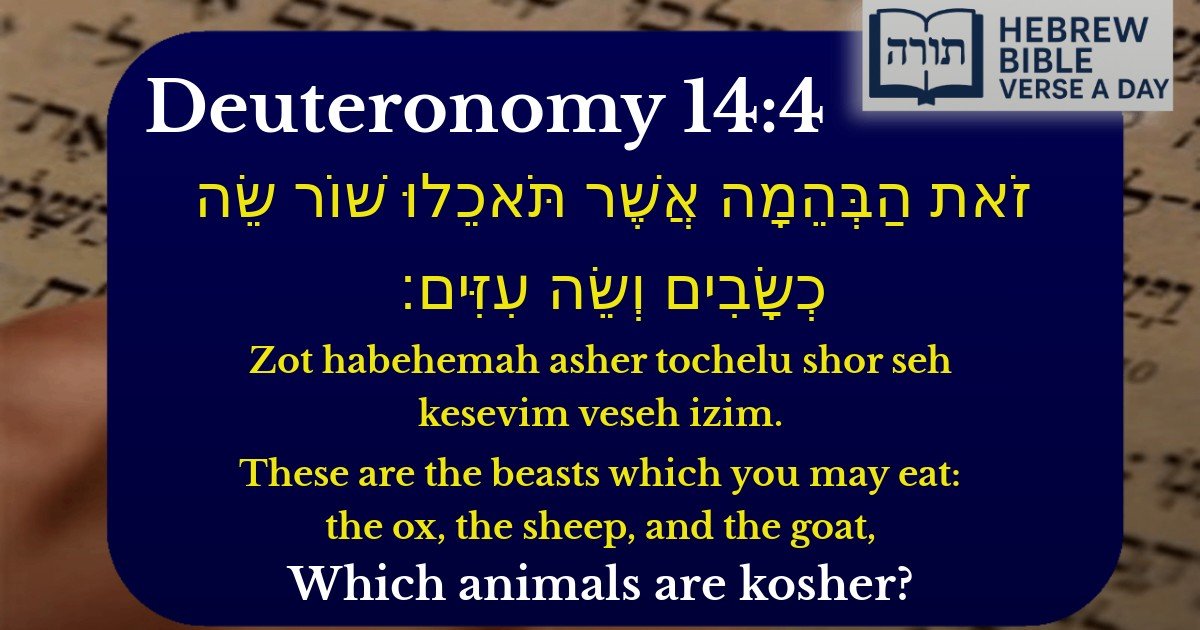

Overview of the Verse
The verse (Vayikra 11:2) introduces the laws of kosher animals, specifying which land animals are permitted for consumption according to Torah law. The ox, sheep, and goat are explicitly listed as permissible, serving as examples of animals that meet the criteria of kosher mammals—having split hooves and chewing their cud (as detailed later in the parsha).
Rashi's Commentary
Rashi explains that the phrase "זֹאת הַבְּהֵמָה" ("These are the beasts") serves to limit the scope of permitted animals to only those that possess the two signs of kosher mammals. He emphasizes that the Torah does not merely list examples but establishes a halachic principle: only animals with these traits may be eaten. The ox, sheep, and goat are mentioned because they were commonly raised livestock in the ancient Near East and serve as clear models of kosher animals.
Rambam's Perspective
In Hilchot Ma'achalot Asurot (1:1-2), the Rambam codifies these laws, stating that any animal not possessing both split hooves and the ability to chew its cud is forbidden. The explicit mention of the ox, sheep, and goat reinforces that even familiar, domesticated animals must be scrutinized for these signs before consumption.
Midrashic Insights
Halachic Implications
The verse lays the foundation for the detailed laws in subsequent verses (Vayikra 11:3-8). The Talmud (Chullin 59a) derives from this that:
Practical Application
While the Torah lists these three species, halacha extends permission to all animals meeting the criteria (e.g., deer, gazelles). The Shulchan Aruch (Yoreh De'ah 79) rules that one must verify both signs, even for animals resembling the ox, sheep, or goat, to avoid accidental consumption of non-kosher species.