

Join Our Newsletter To Be Informed When New Videos Are Posted
Hebrew Text
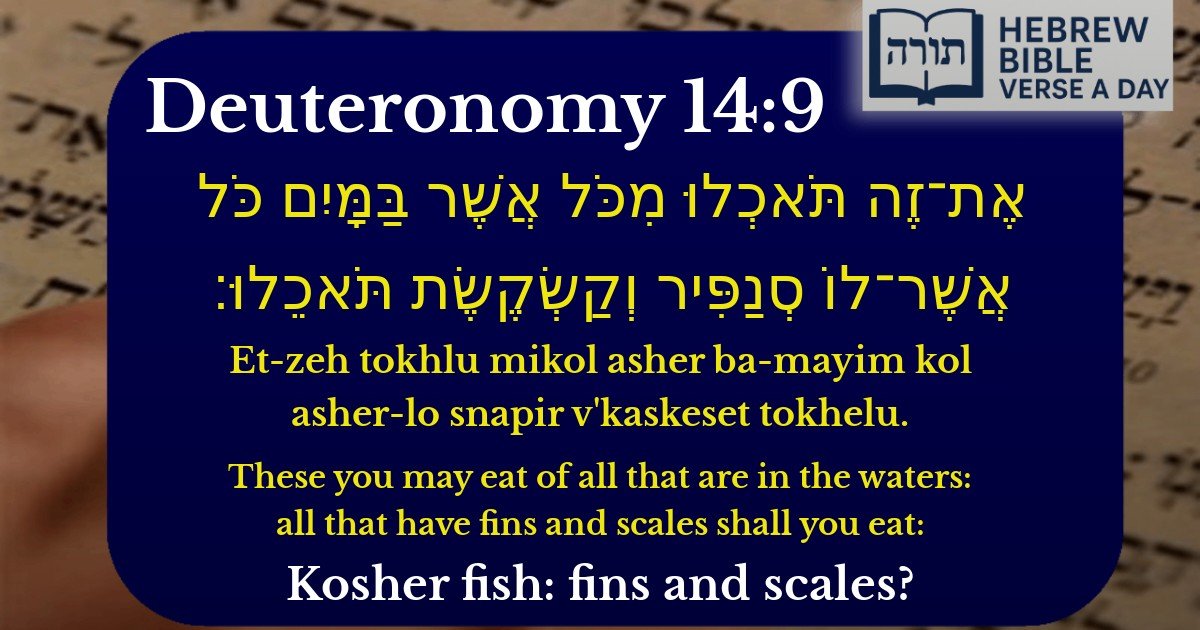
אֶת־זֶה תֹּאכְלוּ מִכֹּל אֲשֶׁר בַּמָּיִם כֹּל אֲשֶׁר־לוֹ סְנַפִּיר וְקַשְׂקֶשֶׂת תֹּאכֵלוּ׃
English Translation
These you may eat of all that are in the waters: all that have fins and scales shall you eat:
Transliteration
Et-zeh tokhlu mikol asher ba-mayim kol asher-lo snapir v'kaskeset tokhelu.
Hebrew Leining Text
אֶת־זֶה֙ תֹּֽאכְל֔וּ מִכֹּ֖ל אֲשֶׁ֣ר בַּמָּ֑יִם כֹּ֧ל אֲשֶׁר־ל֛וֹ סְנַפִּ֥יר וְקַשְׂקֶ֖שֶׂת תֹּאכֵֽלוּ׃
🎵 Listen to leining
Parasha Commentary
📚 Talmud Citations
This verse is quoted in the Talmud.
📖 Chullin 66b
The verse is discussed in the context of the laws regarding kosher fish, specifically the requirement for fins and scales.
📖 Niddah 51b
The verse is referenced in a discussion about the characteristics of kosher fish and the interpretation of the terms 'fins' and 'scales.'
Overview of the Verse
The verse (Vayikra 11:9) delineates the criteria for permissible aquatic creatures according to Jewish dietary laws (Kashrut). Only fish possessing both fins (סְנַפִּיר) and scales (קַשְׂקֶשֶׂת) are permitted for consumption. This law is foundational to the Torah's system of distinguishing between pure (טָהוֹר) and impure (טָמֵא) species.
Rashi's Commentary
Rashi (Rabbi Shlomo Yitzchaki) emphasizes that both fins and scales must be present for a fish to be kosher. He notes that while all fish with scales also have fins (based on the Talmud, Chullin 66b), the Torah mentions both to teach that scales are the primary indicator. If a fish loses its fins but retains scales, it remains kosher, but the reverse is not true.
Halachic Principles from Rambam
Rambam (Maimonides, Hilchot Ma'achalot Asurot 1:24) elaborates on the practical application:
Midrashic Insight
The Midrash Tanchuma (Shemini 12) connects this law to moral symbolism: fins represent movement (progress in mitzvot), while scales signify protection (moral boundaries). Just as scales shield a fish, Torah laws guard the Jewish soul from impurity.
Talmudic Analysis
The Talmud (Niddah 51b) discusses exceptions, such as the sturgeon, whose scales are embedded and non-detachable, rendering it non-kosher. This reinforces the requirement for scales to be easily removable—a key halachic test.
Practical Implications
Orthodox practice requires: