
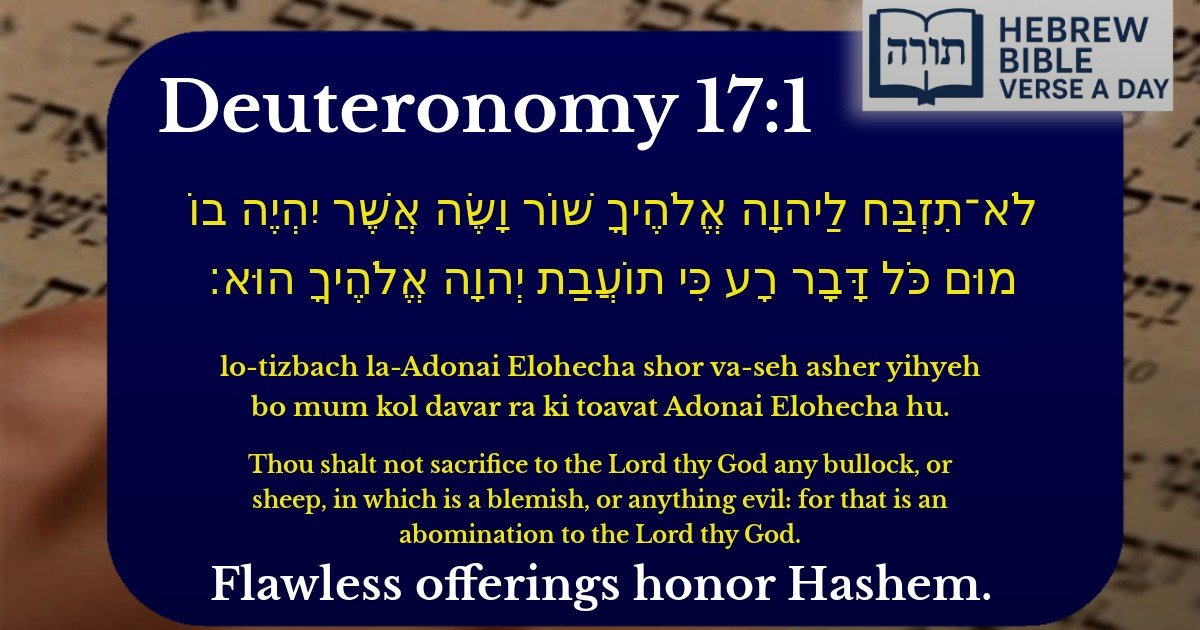

Deuteronomy 17:1 - Flawless offerings honor Hashem.

Deuteronomy 17:1 - דברים 17:1

Hebrew Text

לֹא־תִזְבַּח לַיהוָה אֱלֹהֶיךָ שׁוֹר וָשֶׂה אֲשֶׁר יִהְיֶה בוֹ מוּם כֹּל דָּבָר רָע כִּי תוֹעֲבַת יְהוָה אֱלֹהֶיךָ הוּא׃

English Translation

Thou shalt not sacrifice to the Lord thy God any bullock, or sheep, in which is a blemish, or anything evil: for that is an abomination to the Lord thy God.

Transliteration

Lo-tizbach la-Adonai Elohecha shor va-seh asher yihyeh bo mum kol davar ra ki toavat Adonai Elohecha hu.

Hebrew Leining Text

לֹא־תִזְבַּח֩ לַיהֹוָ֨ה אֱלֹהֶ֜יךָ שׁ֣וֹר וָשֶׂ֗ה אֲשֶׁ֨ר יִהְיֶ֥ה בוֹ֙ מ֔וּם כֹּ֖ל דָּבָ֣ר רָ֑ע כִּ֧י תוֹעֲבַ֛ת יְהֹוָ֥ה אֱלֹהֶ֖יךָ הֽוּא׃ {ס}        

🎵 Listen to leining

Parasha Commentary

Prohibition of Sacrificing Blemished Animals

The verse (Devarim 17:1) prohibits bringing an animal with a physical defect (mum) as a sacrifice to Hashem. This commandment underscores the principle that offerings must be of the highest quality, reflecting the honor due to the Divine service.

Rashi's Explanation

Rashi comments that the phrase "כל דבר רע" ("anything evil") refers not only to physical blemishes but also to animals acquired through theft or robbery. Even if the animal itself is unblemished, it is disqualified if obtained unlawfully, as it is considered "evil" in the eyes of Hashem.

Rambam's Perspective

In Hilchot Issurei Mizbe'ach (1:1-2), the Rambam elaborates that this prohibition applies to all sacrifices, whether obligatory or voluntary. He lists specific physical defects that render an animal invalid, as derived from the detailed criteria in Vayikra 22:17-25.

Midrashic Insight

The Midrash (Sifrei Devarim 144) compares this to a king who instructs his servants to prepare a feast using only the finest ingredients. Similarly, we must offer only unblemished animals to demonstrate our reverence for Hashem.

Philosophical Significance

  • Symbol of Perfection: The unblemished animal represents the ideal of striving for spiritual wholeness in our service of Hashem.
  • Rejection of the Inferior: Just as we reject defective offerings, we must reject flawed actions and intentions in our divine service.
  • Kavod Shamayim: The requirement for perfection honors the sanctity of the Beit HaMikdash and its rituals.

Halachic Implications

The Talmud (Zevachim 46b) discusses cases where a blemish develops after the animal was designated as a sacrifice. If the blemish is permanent, the animal is disqualified; if temporary, it may be healed and later offered.

📚 Talmud Citations

This verse is quoted in the Talmud.

📖 Temurah 28b
The verse is discussed in the context of the laws regarding sacrifices with blemishes, emphasizing the prohibition against offering defective animals.
📖 Chullin 13a
The verse is referenced in a discussion about the types of blemishes that disqualify animals from being sacrificed.
📖 Sifrei Devarim Piska 128
The verse is cited in a midrashic interpretation discussing the importance of offering unblemished sacrifices to God.

Frequently Asked Questions

Q: What does Deuteronomy 17:1 mean?
A: Deuteronomy 17:1 teaches that when bringing a sacrifice to Hashem, it must be without any physical blemish or defect. The Torah prohibits offering an animal with any imperfection, as it is considered an 'abomination' to G-d. This emphasizes the importance of giving our best to Hashem, as explained by Rashi and other commentators.
Q: Why is it important to bring unblemished sacrifices?
A: Bringing an unblemished sacrifice shows respect and honor to Hashem. The Rambam explains in the Mishneh Torah (Hilchot Issurei Mizbe'ach) that only the finest and healthiest animals are fitting for the altar. This teaches us the principle of 'hidur mitzvah'—enhancing a mitzvah by using the best available items when serving G-d.
Q: Does this verse apply today if we don't have the Temple?
A: While we cannot bring sacrifices without the Temple, the principle still applies in other areas of Jewish life. The Talmud (Berachot 5b) teaches that our prayers today take the place of sacrifices. Therefore, we should approach prayer with the same sincerity and wholeheartedness as one would bring a perfect sacrifice. Additionally, when giving tzedakah or performing mitzvot, we should strive to give our best.
Q: What counts as a 'blemish' in an animal according to Jewish law?
A: The Mishnah (Tractate Bekhorot) lists many types of blemishes that disqualify an animal for sacrifice, including blindness, lameness, broken limbs, or skin diseases. The Talmud elaborates on these conditions, and the Rambam codifies them in detail in Hilchot Issurei Mizbe'ach. Even minor defects can render an animal unfit, teaching us about the high standards required in divine service.
Q: What lesson can we learn from this verse in our daily lives?
A: This verse teaches us the importance of offering our best efforts in serving Hashem. Just as we wouldn't offer a defective animal, we shouldn't give half-hearted prayers or perform mitzvot carelessly. The Midrash (Sifrei Devarim) connects this idea to personal behavior—just as the sacrifice must be physically whole, we should strive to be spiritually whole in our devotion to G-d.