Frequently Asked Questions
Q: What does it mean that the Levites have no inheritance among their brethren?
A: This verse means that the tribe of Levi, who served in the Mishkan (Tabernacle) and later the Beit HaMikdash (Temple), did not receive a portion of land in Israel like the other tribes. Instead, their 'inheritance' was their sacred service to Hashem and the spiritual role they played among the Jewish people. Rashi explains that since they were dedicated to Divine service, Hashem Himself would provide for their needs through tithes and offerings from the other tribes.
Q: Why is the Levites' inheritance different from the other tribes?
A: The Levites were chosen for a special role in serving Hashem and teaching Torah to the nation. Since their work was spiritual rather than agricultural, they did not need land like the other tribes. The Rambam (Hilchot Shemita 13:12) teaches that their lack of physical inheritance emphasized their complete reliance on Hashem and their focus on spiritual matters. This arrangement allowed them to devote themselves fully to Torah and service without the distractions of working the land.
Q: How did the Levites live if they had no land?
A: The Levites were supported through the tithes (ma'aser) given by the other tribes, as well as portions from certain sacrifices. Numbers 18:20-24 details how the Levites received tithes from the produce of the land in exchange for their service. Additionally, they lived in 48 designated Levitical cities scattered throughout Israel (Numbers 35:1-8). This system ensured they could focus on their spiritual duties while being integrated among all the tribes.
Q: What lesson can we learn from 'Hashem is their inheritance' today?
A: This teaches us the value of dedicating one's life to spiritual pursuits and trusting in Hashem's providence. While most people engage in worldly occupations, the Levites' example shows that a life centered on Torah and service to Hashem is its own reward. The Sforno explains that their closeness to Hashem was their greatest possession. Today, this reminds us to prioritize our relationship with Hashem above material concerns, whether we are scholars, teachers, or simply striving to grow spiritually in our daily lives.
Q: Does this verse apply to Kohanim (priests) as well?
A: Yes, the Kohanim (who are from the tribe of Levi) also did not receive a portion of land, as their role was an elevated form of the Levitical service. The Talmud (Yoma 26a) discusses how both Kohanim and Levites shared this status of having Hashem as their inheritance. However, the Kohanim had additional privileges and responsibilities in the Temple service, and they received certain gifts (terumah and other portions) beyond what the Levites received.

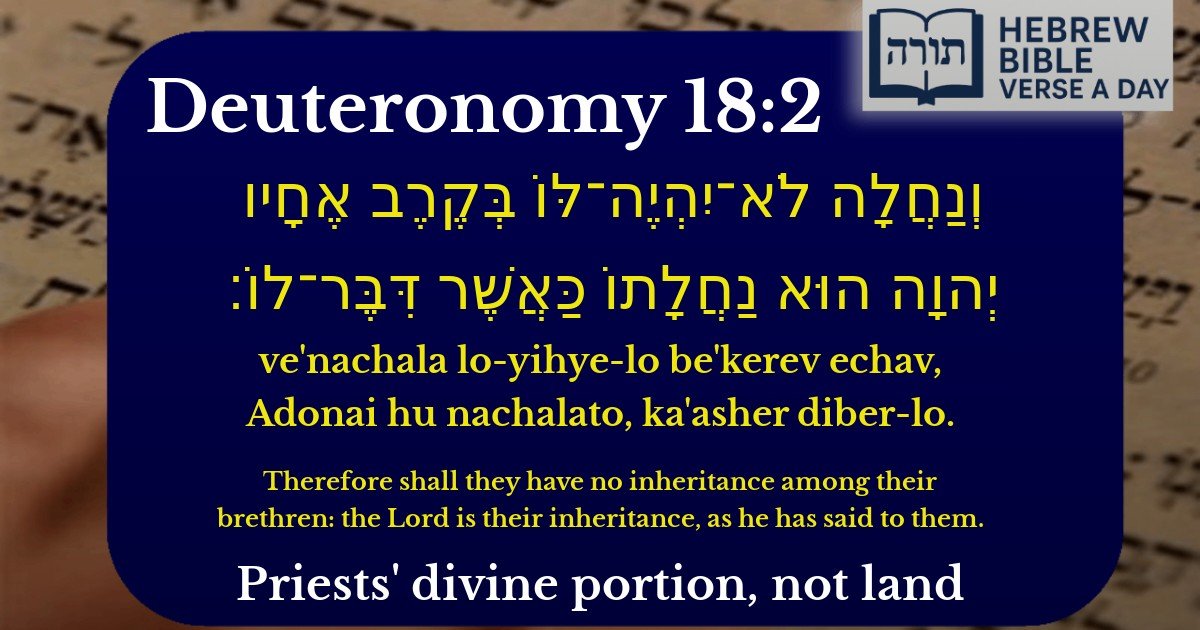

The Inheritance of the Levites
The verse states that the tribe of Levi shall have no inheritance among their brethren, as Hashem Himself is their portion. This refers to the unique status of the Levites, who were set apart for divine service and did not receive a territorial portion in the Land of Israel like the other tribes.
Rashi's Explanation
Rashi (Devarim 18:2) explains that since the Levites were designated for the service of Hashem in the Mishkan and later the Beit HaMikdash, they were not given a portion of land like the other tribes. Instead, their sustenance came from:
Rambam's Perspective
In Hilchot Shemita v'Yovel (13:12-13), the Rambam elaborates that the Levites' lack of physical inheritance was actually their great merit. Their complete devotion to Hashem's service meant they didn't need to be preoccupied with agricultural work like the other tribes. Their "inheritance" was the privilege of serving in the Beit HaMikdash and teaching Torah to the nation.
Midrashic Insight
The Midrash Tanchuma (Re'eh 10) compares this to a king who had a special son he wished to keep near him at all times. Rather than sending him to govern a distant province, the king declared "My portion shall be your portion." Similarly, Hashem told the Levites that He Himself would be their inheritance.
Spiritual Significance
This concept teaches that: