Frequently Asked Questions
Q: What does 'innocent blood' mean in Deuteronomy 21:9?
A: The term 'innocent blood' refers to the moral responsibility to prevent and rectify cases of wrongful death or injustice within the community. Rashi explains that this verse comes in the context of the ritual of the eglah arufah (the broken-necked heifer), which is performed when an unsolved murder occurs near a city. The verse emphasizes the importance of communal responsibility to uphold justice and remove guilt from the people.
Q: Why is it important to 'do what is right in the sight of the Lord' according to this verse?
A: Doing what is right in the sight of Hashem (God) is central to Jewish life and ensures divine favor and protection. The Rambam (Maimonides) teaches that justice and righteousness are foundational principles of Torah law. This verse reminds us that true righteousness is measured by God's standards, not human opinions, and requires active efforts to correct wrongs and pursue justice.
Q: How does Deuteronomy 21:9 apply to us today?
A: This verse teaches that society must take responsibility for injustices, especially those that go unresolved. The Talmud (Sotah 38b) discusses how leaders and communities must act to prevent bloodshed and corruption. Today, this applies to advocating for justice, supporting fair legal systems, and ensuring that no innocent person suffers due to negligence or wrongdoing.
Q: What is the connection between the eglah arufah ritual and this verse?
A: Deuteronomy 21:9 concludes the section about the eglah arufah (Deuteronomy 21:1-9), where the elders of the nearest town perform a ritual to atone for an unsolved murder. Rashi explains that this verse emphasizes that the ritual alone is not enough—the community must also actively pursue justice and moral behavior to 'remove innocent blood' from their midst.
Q: What lesson can we learn from 'putting away innocent blood'?
A: The verse teaches that justice is not passive—it requires action. The Midrash (Sifrei Devarim) states that ignoring injustice brings collective guilt. We learn that individuals and communities must correct wrongs, protect the innocent, and uphold Torah values to maintain a righteous society before God.


Verse Context
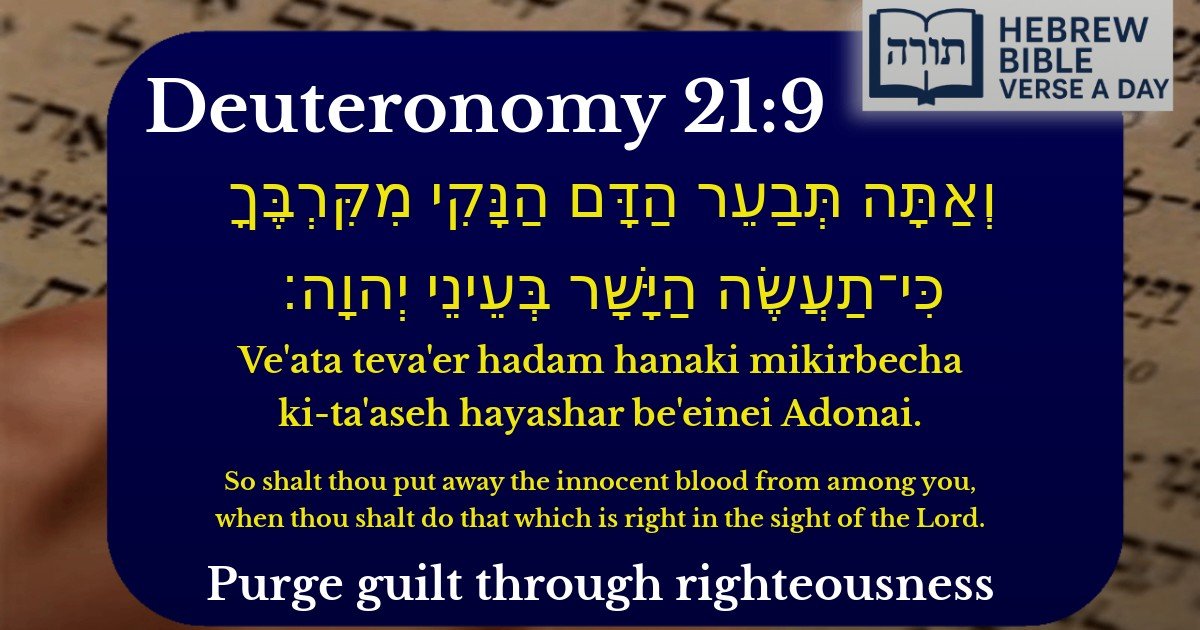
The verse appears in Devarim (Deuteronomy) 21:9, within the passage discussing the eglah arufah (the heifer whose neck is broken) as an atonement for an unsolved murder. The Torah emphasizes the communal responsibility to address and atone for innocent bloodshed when the perpetrator is unknown.
Literal Interpretation (Peshat)
Rashi explains that this verse refers to the purification of the Jewish people from the guilt of innocent bloodshed through the ritual of the eglah arufah. By performing this mitzvah, the community demonstrates its commitment to justice and distances itself from the moral stain of the unsolved crime.
Moral and Ethical Dimensions (Derash)
The Rambam (Hilchos Rotzeach 9:3) derives from this verse that a society must establish just courts and thorough investigative procedures to prevent bloodshed. The phrase "when thou shalt do that which is right in the sight of the Lord" implies that true justice aligns with Divine will.
Spiritual Implications
The Kli Yakar emphasizes that "innocent blood" refers not only to physical murder but also to spiritual harm—such as causing others to sin or failing to rebuke wrongdoing. The community must cleanse itself from all forms of moral corruption.
Practical Halachic Application
The Sefer HaChinuch (Mitzvah 530) explains that this mitzvah reinforces the idea that even unintentional negligence in societal justice requires atonement. The elders of the nearest city must take responsibility, symbolizing that leadership bears the duty to uphold righteousness.