Frequently Asked Questions
Q: What does Deuteronomy 22:20 mean?
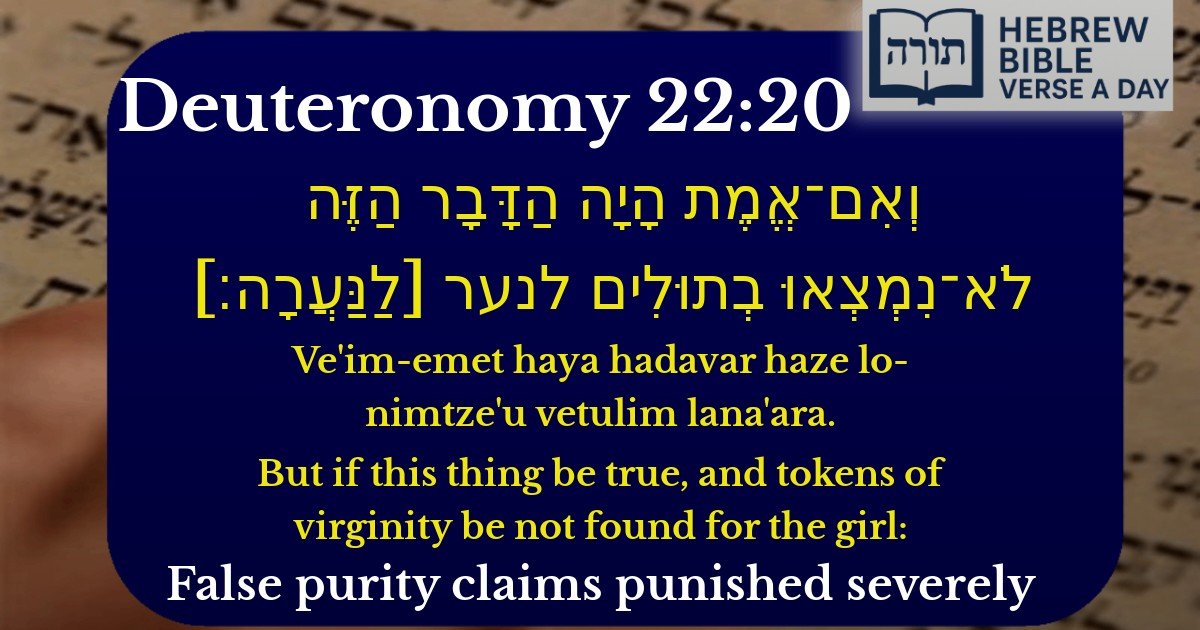
A: Deuteronomy 22:20 discusses a situation where a man accuses his new wife of not being a virgin before marriage. The verse states that if the accusation is true and evidence of her virginity (such as the cloth from the wedding night) is not found, there are legal consequences. This is part of the Torah's laws regarding marital purity and honesty.
Q: Why is the concept of virginity important in this verse?
A: In traditional Jewish law, virginity at the time of marriage was considered an important sign of purity and fidelity. The Torah places great emphasis on marital sanctity and trust between spouses. Rashi explains that this law protects women from false accusations and ensures justice is carried out properly.
Q: How does this verse apply today in Orthodox Jewish practice?
A: While the specific legal procedures described in this verse are not practiced today (due to the absence of the Sanhedrin and Temple courts), the underlying principles remain important. Jewish law still emphasizes honesty in relationships, the sanctity of marriage, and the severe consequences of false accusations. The Talmud (Ketubot) discusses these laws in detail, showing their ethical and legal foundations.
Q: What is the 'token of virginity' mentioned in this verse?
A: The 'tokens of virginity' refer to physical evidence (such as blood on a cloth) that would traditionally demonstrate a bride's virginity at the time of marriage. The Talmud (Ketubot 10a) discusses this in the context of Jewish marital law. However, halachic authorities note that this is not always definitive proof, as other factors could be involved.
Q: What lesson can we learn from Deuteronomy 22:20?
A: This verse teaches the importance of truthfulness in relationships and the gravity of making serious accusations without proper evidence. The Rambam (Hilchot Ishut) derives from this that one must be extremely careful before leveling charges that could harm another's reputation. It also highlights Judaism's emphasis on the sanctity and purity of marriage.


Context in Torah
The verse (Devarim 22:20) is part of the Torah's discussion regarding the laws of motzi shem ra (a husband who falsely accuses his wife of premarital infidelity) and the procedures for verifying a bride's virginity. The Torah outlines the consequences if the husband's accusations are proven false or if evidence contradicts his claims.
Rashi's Explanation
Rashi (Devarim 22:20) clarifies that the phrase "וְאִם־אֱמֶת הָיָה הַדָּבָר הַזֶּה" ("But if this thing be true") refers to a scenario where the husband's accusation is validated—meaning no evidence of virginity is found. Rashi emphasizes that this must be established through a beit din (Jewish court) investigation, not mere suspicion.
Rambam's Halachic Perspective
Rambam (Hilchot Ishut 24:11) elaborates on the legal process, stating that if the husband's claim is substantiated, the woman is subject to the penalty prescribed by the Torah. However, he stresses that stringent evidence is required, including testimony from witnesses and examination by experts, to avoid wrongful accusations.
Midrashic Insight
The Midrash (Sifrei Devarim 237) interprets this verse as a caution against public shaming. It teaches that even if the accusation is true, the Torah demands a fair and just process, underscoring the sanctity of human dignity. The phrase "לֹא־נִמְצְאוּ בְתוּלִים" ("tokens of virginity be not found") is seen as a call for thorough verification rather than hasty judgment.
Talmudic Discussion
The Talmud (Ketubot 46a) discusses the criteria for determining virginity, noting that physical signs alone are insufficient without corroborating testimony. The Gemara emphasizes that the absence of such signs does not automatically imply guilt, as there may be valid medical explanations.