Frequently Asked Questions
Q: What does Deuteronomy 27:22 mean?
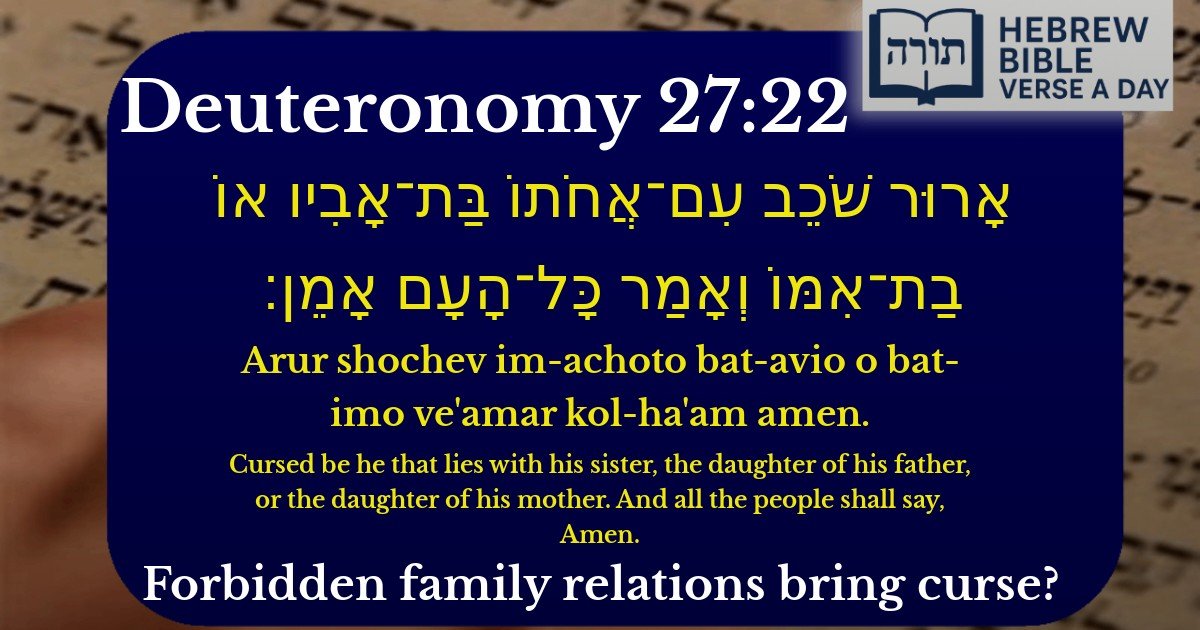
A: Deuteronomy 27:22 declares a curse upon someone who commits incest with their sister, whether she is the daughter of their father or mother. This is part of a series of curses pronounced for violating Torah laws. The verse emphasizes the severity of this sin by having the entire nation respond 'Amen,' affirming the curse.
Q: Why is this prohibition important in Judaism?
A: This prohibition is important because incest violates the sanctity of family relationships, which are foundational in Jewish law. The Torah (Leviticus 18:9) explicitly forbids such relationships, and this curse reinforces the severity of the transgression. The Rambam (Hilchot Issurei Biah 2:6) explains that these laws preserve moral boundaries and family purity.
Q: What can we learn from the people saying 'Amen' in this verse?
A: The response 'Amen' teaches us that the entire community must acknowledge and uphold moral boundaries. According to Rashi, saying 'Amen' signifies acceptance and agreement with the curse, showing collective responsibility in maintaining Torah values. The Talmud (Shevuot 29a) also discusses the power of public affirmation in reinforcing divine commandments.
Q: Does this law apply to half-siblings as well?
A: Yes, the prohibition applies to both full and half-siblings. The verse specifies 'the daughter of his father or the daughter of his mother,' meaning even if they share only one parent, the relationship is forbidden. The Talmud (Sanhedrin 58a) and Rambam (Hilchot Issurei Biah 2:6) confirm that this includes siblings from the same father or mother.
Q: How does this verse apply to Jewish life today?
A: This verse remains relevant today as incest is still strictly forbidden in Halacha (Jewish law). It reminds us of the importance of maintaining proper family boundaries and upholding moral conduct. The Sages teach (Yevamot 21a) that these laws protect the sanctity of marriage and family structure, ensuring a holy and ethical society.


The Prohibition of Incest in the Torah
The verse (Devarim 27:22) pronounces a curse upon one who engages in relations with his sister, whether she is the daughter of his father or the daughter of his mother. This prohibition is rooted in the broader framework of arayot</em (forbidden relationships) outlined in Vayikra 18:9 and 20:17. The severity of this sin is underscored by the public declaration of "Amen" by the entire nation, affirming the divine curse upon such behavior.
Rashi's Explanation
Rashi (Devarim 27:22) clarifies that the phrase "the daughter of his father or the daughter of his mother" includes both paternal and maternal sisters, whether from the same father or the same mother. This interpretation aligns with the Talmudic discussion in Sanhedrin 54a, which derives from this verse that relations with a half-sister (from either parent) are equally forbidden.
Rambam's Legal Perspective
Rambam (Mishneh Torah, Issurei Biah 2:6) codifies this prohibition as one of the issurei ervah</em (forbidden sexual relations) that carry the penalty of karet</em (divine excision) if violated intentionally. He emphasizes that this applies regardless of whether the sister is from the father's side, the mother's side, or even if she was conceived from an illicit relationship (e.g., born from adultery).
The Significance of the Public "Amen"
The Talmud (Shevuot 29a) explains that the communal response of "Amen" serves as a collective acceptance of the curse, reinforcing the gravity of the transgression. The Midrash (Sifrei Devarim 297) adds that this public declaration ensures that no individual can claim ignorance of the law, as the entire nation affirms its validity.
Moral and Social Implications