

Join Our Newsletter To Be Informed When New Videos Are Posted
Hebrew Text
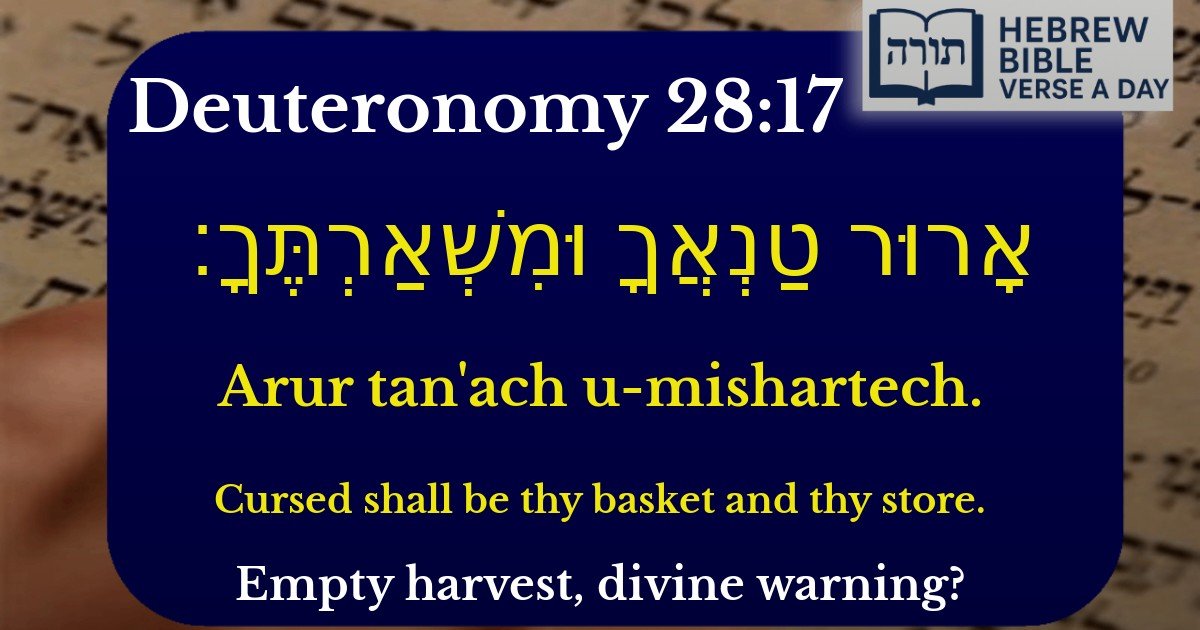
אָרוּר טַנְאֲךָ וּמִשְׁאַרְתֶּךָ׃
English Translation
Cursed shall be thy basket and thy store.
Transliteration
Arur tan'ach u-mishartech.
Hebrew Leining Text
אָר֥וּר טַנְאֲךָ֖ וּמִשְׁאַרְתֶּֽךָ׃
🎵 Listen to leining
Parasha Commentary
📚 Talmud Citations
This verse is quoted in the Talmud.
📖 Sotah 37b
The verse is cited in the context of discussing the curses mentioned in Deuteronomy 28, which are part of the admonitions given to the Israelites.
Understanding the Verse in Context
The verse "אָרוּר טַנְאֲךָ וּמִשְׁאַרְתֶּךָ" (Devarim 28:17) appears in the section of the Torah known as the Tochacha (Rebuke), where Moshe warns the Jewish people of the curses that will befall them if they fail to observe the mitzvos. This verse specifically refers to a curse upon one's bread basket (טַנְאֲךָ) and food storage (מִשְׁאַרְתֶּךָ), indicating a loss of sustenance and prosperity.
Rashi's Explanation
Rashi (Devarim 28:17) explains that "טַנְאֲךָ" refers to the basket used to carry bread, while "מִשְׁאַרְתֶּךָ" refers to the kneading bowl where dough is prepared. The curse implies that even when one gathers food, it will not sustain them—either because it will spoil, be stolen, or fail to satisfy. This aligns with the broader theme of the Tochacha, where disobedience leads to agricultural and economic hardship.
Rambam's Perspective on Divine Retribution
Rambam (Hilchos Ta’anis 1:1–3) discusses how curses such as these are not arbitrary punishments but are consequences of abandoning Torah observance. When the Jewish people stray from mitzvos, particularly those related to tithing (ma’aser) and agricultural laws (kilayim, shmittah), their sustenance is affected. The curse on the basket and storehouse reflects a disruption in the natural order due to spiritual failings.
Midrashic Interpretation
The Midrash (Sifri Devarim 28:17) elaborates that "טַנְאֲךָ" symbolizes the failure of one’s efforts in gathering produce, while "מִשְׁאַרְתֶּךָ" represents the inability to preserve what has been stored. This teaches that without divine blessing, human labor alone cannot guarantee success. The Midrash connects this to the principle of hashgacha pratis (divine providence), emphasizing that material prosperity is contingent on spiritual merit.
Practical Lessons from the Verse