Frequently Asked Questions
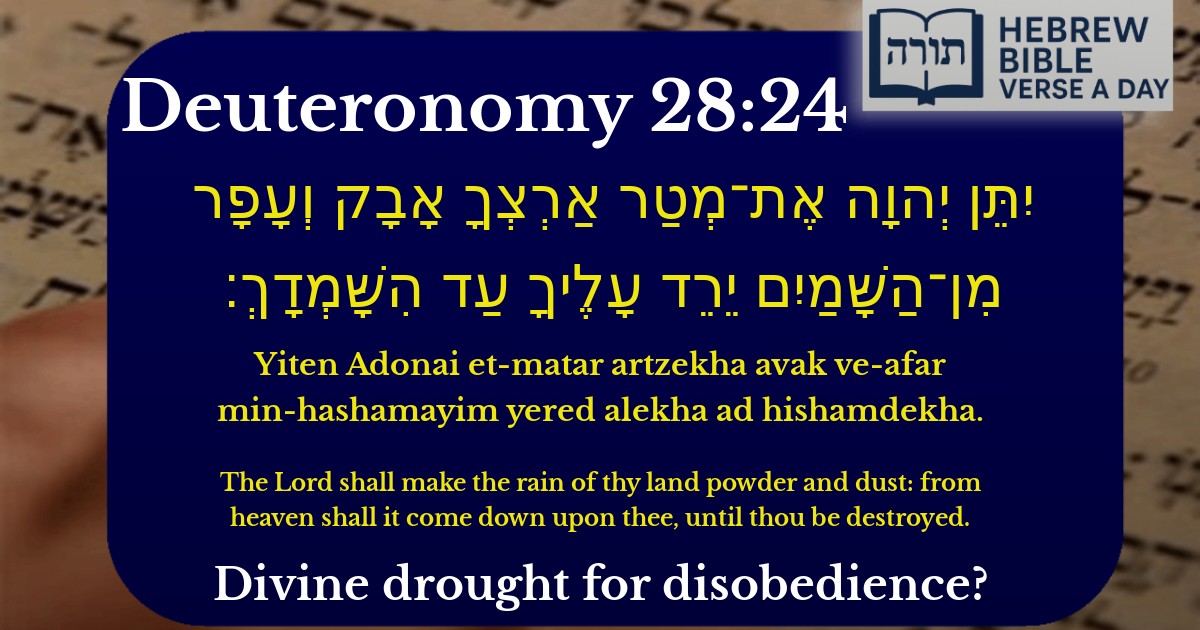
Q: What does Deuteronomy 28:24 mean?
A: Deuteronomy 28:24 is part of the 'Tochecha' (the rebuke), where the Torah describes the consequences of not following Hashem's commandments. This verse specifically warns that if the Jewish people stray from Torah observance, their land will suffer drought, with rain turning to dust—symbolizing devastation and lack of blessing from heaven.
Q: Why is this verse important in Judaism?
A: This verse is important because it emphasizes the direct relationship between the Jewish people's actions and the physical blessings or curses they receive. According to Rashi and other commentators, it teaches that agricultural success in the Land of Israel is tied to spiritual faithfulness, reinforcing the principle of 'measure for measure' (middah k'neged middah).
Q: How does this verse apply to us today?
A: While this verse speaks about the Land of Israel, the principle applies today as a reminder that our material well-being is connected to our spiritual commitment. The Rambam (Hilchos Ta'anis) explains that hardships should prompt self-reflection and teshuvah (repentance), as physical and spiritual realities are intertwined.
Q: What can we learn from this verse?
A: We learn that Hashem's blessings, like rain, are conditional upon our adherence to Torah. The Talmud (Ta'anis 2a) teaches that rain is a sign of divine favor, withheld when we neglect mitzvos. This verse urges us to recognize our dependence on Hashem and prioritize our spiritual growth.
Q: Does this verse only refer to literal rain?
A: While the verse literally describes drought, the Midrash (Sifrei) and commentators like the Ramban see deeper symbolism: dust instead of rain represents spiritual barrenness—when Torah wisdom ('rain') is absent, life becomes dry and futile. Thus, it warns against both physical and spiritual desolation.


Context in the Torah
This verse appears in Devarim (Deuteronomy) 28:24 as part of the Tochacha (Rebuke), a section detailing the severe consequences that will befall the Jewish people if they abandon the covenant with Hashem. The verse describes a supernatural curse where rain turns to dust, leading to devastation.
Rashi's Explanation
Rashi (Deuteronomy 28:24) explains that this curse is a reversal of the natural order. Instead of life-sustaining rain, Hashem will send "powder and dust" (avak v’afar) from the heavens, which will choke the land and prevent growth. This mirrors the punishment of the Generation of the Flood, where water—typically a source of life—became an agent of destruction.
Rambam's Perspective
In Hilchot Ta’anit (Laws of Fasting 1:1-4), the Rambam emphasizes that drought and unnatural weather phenomena are direct consequences of failing to follow the Torah. The curse of dust instead of rain reflects a breakdown in the covenantal relationship, where Hashem withdraws His blessings from the land.
Midrashic Interpretation
The Sifrei (Devarim 28:24) connects this verse to the sin of idolatry, suggesting that just as idolaters turn to false gods for sustenance, Hashem will replace rain—a symbol of divine providence—with barren dust. The Midrash Devarim Rabbah (7:11) further states that this curse is measure-for-measure: if the people reject the "heavenly" Torah, the heavens will reject them by withholding rain.
Symbolism of Dust
Halachic Implications
The Chazon Ish (Emunah U’Bitachon 3:1) cites this verse as a reminder that agricultural success in Eretz Yisrael is inherently tied to spiritual fidelity. Unlike other lands dependent on irrigation, Israel relies on direct heavenly rain (Devarim 11:10-12), making this curse a stark withdrawal of divine attention.