Frequently Asked Questions
Q: What does Deuteronomy 28:38 mean?
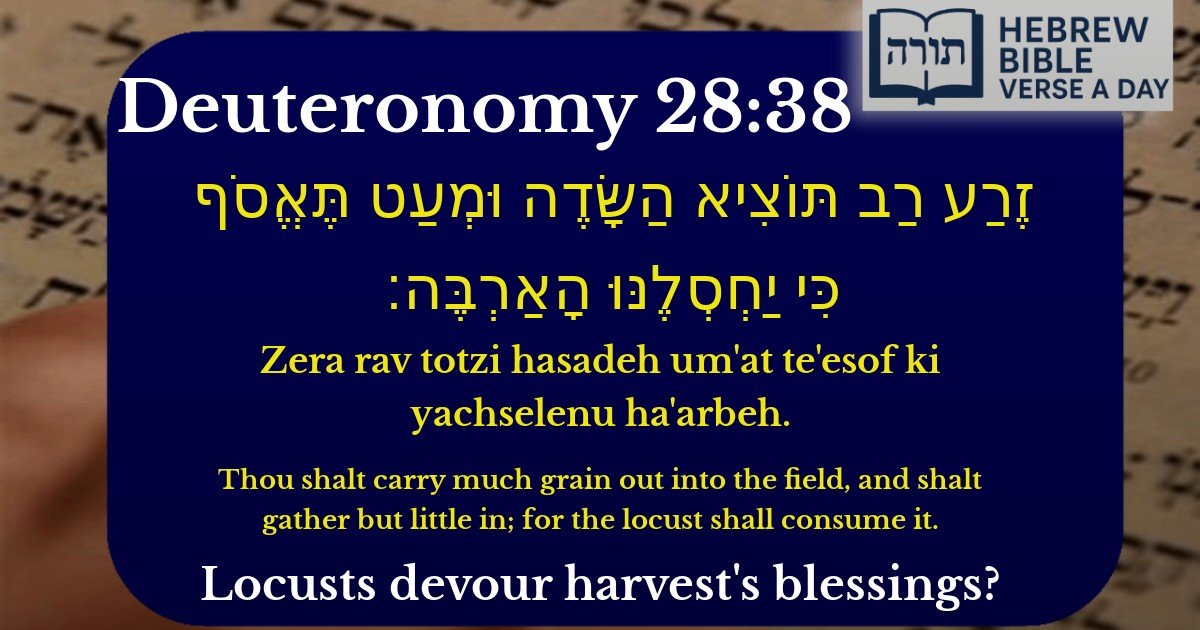
A: Deuteronomy 28:38 describes a curse that would befall the Jewish people if they do not follow Hashem's commandments. It means that even if they plant much grain in the field, they will harvest very little because locusts will destroy the crops. This is one of the consequences of straying from Torah observance.
Q: Why is this verse important in Judaism?
A: This verse is part of the 'Tochacha' (rebuke) in Parshat Ki Tavo, where Moshe warns the Jewish people about the consequences of abandoning the Torah. It serves as a reminder of the importance of keeping mitzvot and the tangible effects of our spiritual choices in the physical world, as explained by Rashi and other commentators.
Q: What can we learn from Deuteronomy 28:38 today?
A: We learn that our material success is directly connected to our spiritual faithfulness. The Torah teaches that when we follow Hashem's ways, we are blessed (as described in the earlier blessings), but straying leads to hardship. This principle remains relevant today—our relationship with Torah affects all aspects of life.
Q: How do traditional Jewish sources interpret the locusts in this verse?
A: Rashi explains that the locusts ('arbeh') symbolize devastation that comes as a consequence of ignoring Torah values. The Midrash (Sifrei) also connects this to the idea that when the Jewish people sin, natural disasters like locust plagues can occur as a wake-up call to return to Hashem.
Q: Does this verse only refer to agricultural failure, or is there a deeper meaning?
A: While it literally describes crop destruction, the Rambam (Hilchot Ta'anit) teaches that such curses are meant to inspire teshuva (repentance). The verse also symbolizes wasted effort in all areas of life when we distance ourselves from Torah—our 'planting' (efforts) may not yield proper 'harvest' (results) without divine blessing.


Context in Torah
This verse appears in Devarim (Deuteronomy 28:38) as part of the Tochacha (the Admonition), a section detailing the curses that will befall the Jewish people if they stray from the commandments. The verse describes a scenario where agricultural efforts will be in vain due to locusts consuming the produce.
Rashi's Commentary
Rashi explains that this curse illustrates futility in labor: one will sow abundantly but reap little because the locust (arbeh) will devour the crops. He emphasizes that this is a direct consequence of abandoning the Torah's commandments, as the verse follows the broader theme of divine retribution for disobedience.
Ibn Ezra's Insight
Ibn Ezra notes that the phrase "זֶרַע רַב תּוֹצִיא" ("thou shalt carry much seed out") implies excessive effort with minimal reward. The locusts' destruction symbolizes how natural disasters can overturn human toil when divine favor is withdrawn due to sin.
Midrashic Interpretation
The Midrash Tanchuma (Ki Tavo 1) connects this verse to the broader theme of exile and displacement. It suggests that even when the Jewish people attempt to establish stability (symbolized by agriculture), their efforts will be thwarted as a consequence of failing to uphold their covenant with Hashem.
Halachic Implications
Symbolism of the Locust
The Malbim explains that the locust (arbeh) represents an external force that dismantles human achievement. Its sudden devastation mirrors how swiftly blessings can reverse when the Jewish people deviate from Torah values.