
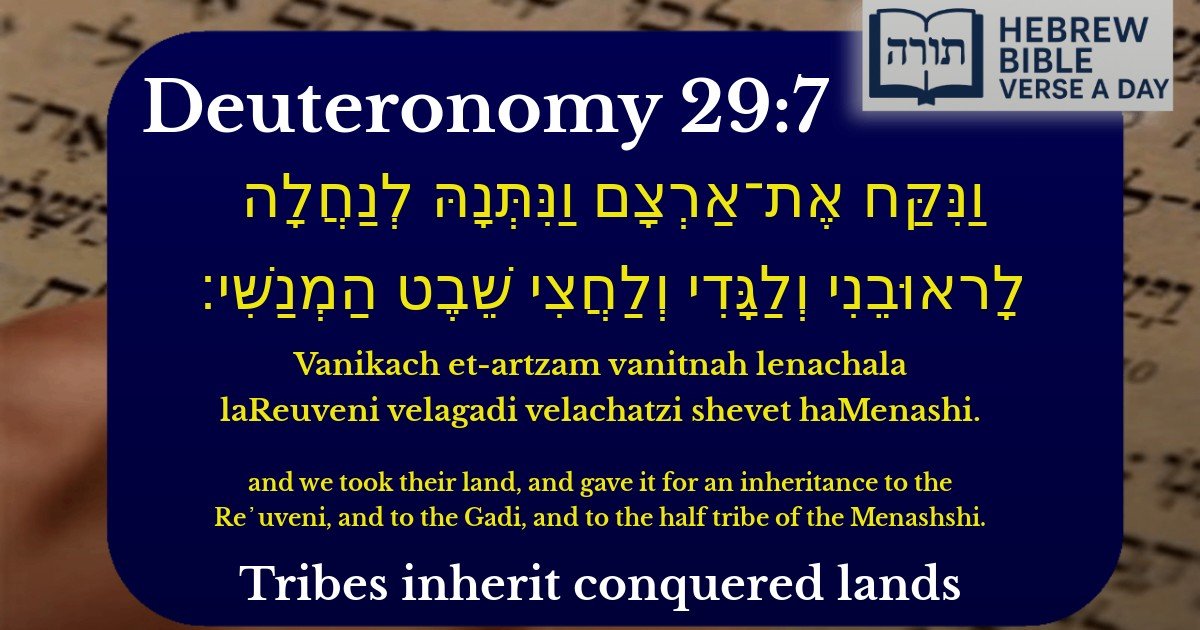

Deuteronomy 29:7 - Tribes inherit conquered lands

Deuteronomy 29:7 - דברים 29:7

Hebrew Text

וַנִּקַּח אֶת־אַרְצָם וַנִּתְּנָהּ לְנַחֲלָה לָראוּבֵנִי וְלַגָּדִי וְלַחֲצִי שֵׁבֶט הַמְנַשִּׁי׃

English Translation

and we took their land, and gave it for an inheritance to the Re᾽uveni, and to the Gadi, and to the half tribe of the Menashshi.

Transliteration

Vanikach et-artzam vanitnah lenachala laReuveni velagadi velachatzi shevet haMenashi.

Hebrew Leining Text

וַנִּקַּח֙ אֶת־אַרְצָ֔ם וַנִּתְּנָ֣הּ לְנַחֲלָ֔ה לָראוּבֵנִ֖י וְלַגָּדִ֑י וְלַחֲצִ֖י שֵׁ֥בֶט הַֽמְנַשִּֽׁי׃

🎵 Listen to leining

Parasha Commentary

Context of the Verse

This verse (Devarim 3:12) appears in Moshe's recounting of the conquest of the lands east of the Jordan River (Ever HaYarden) and their subsequent allocation to the tribes of Reuven, Gad, and half of Menashe. This event is first described in Bamidbar 32, where these tribes request this land due to its suitability for their livestock.

Rashi's Explanation

Rashi (Devarim 3:12) notes that the phrase "וַנִּקַּח אֶת־אַרְצָם" ("and we took their land") refers to the conquest of the lands of Sichon and Og, two powerful kings whose territories were captured by Bnei Yisrael. Rashi emphasizes that this conquest was miraculous, as these were formidable enemies, yet Hashem delivered them into Bnei Yisrael's hands.

Allocation to the Tribes

The verse specifies that the land was given as an inheritance (נַחֲלָה) to Reuven, Gad, and half of Menashe. The Ramban (Bamidbar 32:33) explains that this allocation was conditional upon these tribes first assisting the rest of Bnei Yisrael in conquering Eretz Yisrael proper (west of the Jordan). This condition is detailed in Bamidbar 32:20-22.

Half-Tribe of Menashe

The inclusion of half of Menashe is noteworthy. The Midrash (Bamidbar Rabbah 22:7) suggests that Menashe was split because they were descendants of Yosef, who had a special connection to these lands (as Yosef's bones were later buried in Shechem, in the territory of Menashe). Additionally, the Da'at Zekeinim notes that Menashe was a large tribe, and splitting them ensured a balanced distribution of land.

Spiritual Significance

  • The Kli Yakar (Devarim 3:12) highlights that this episode teaches the importance of unity among the tribes. Despite settling outside the main land, these tribes remained committed to the collective mission of Bnei Yisrael.
  • The Sforno adds that the inheritance was carefully apportioned to ensure each tribe received land suited to their needs, reflecting Hashem's providence in settling Bnei Yisrael.

📚 Talmud Citations

This verse is not quoted in the Talmud.

Frequently Asked Questions

Q: What does Deuteronomy 29:7 mean?
A: Deuteronomy 29:7 refers to the conquest and division of the land east of the Jordan River (Transjordan) among the tribes of Reuven, Gad, and half of Menashe. This was based on their request to settle there due to its suitability for their livestock (Numbers 32:1-5). Moshe agreed on the condition that they first help the other tribes conquer the land west of the Jordan (Rashi on Numbers 32:16).
Q: Why was the land divided this way?
A: The division reflected both Divine approval (through Moshe) and practical considerations. The tribes of Reuven and Gad were primarily shepherds and needed the pasturelands of Transjordan (Ramban on Numbers 32:1). Half of Menashe joined them, possibly to maintain unity among the tribes or because part of Menashe's territory naturally extended eastward (Talmud, Bava Batra 121b).
Q: What lesson can we learn from this verse?
A: This teaches us about communal responsibility - Reuven, Gad, and half-Menashe had to help their brethren conquer Canaan before settling their own land (Sifrei Devarim 307). It also shows that while individual needs matter (their livestock requirements), they must be balanced with the needs of the community. Additionally, it demonstrates that all parts of Eretz Yisrael are holy, including Transjordan (Rambam, Hilchot Terumot 1:1-2).
Q: How does this apply to Jews today?
A: This reminds us that all parts of Eretz Yisrael are significant in Jewish tradition and law. It also models how to balance personal/family needs with communal obligations - just as these tribes helped others before tending to their own needs, we too must prioritize helping the Jewish community (Midrash Tanchuma, Matot 7). The division also set precedents for Jewish land ownership laws that are still studied in halacha today.