

Deuteronomy 31:23 - Passing leadership with divine promise

Deuteronomy 31:23 - דברים 31:23

Hebrew Text

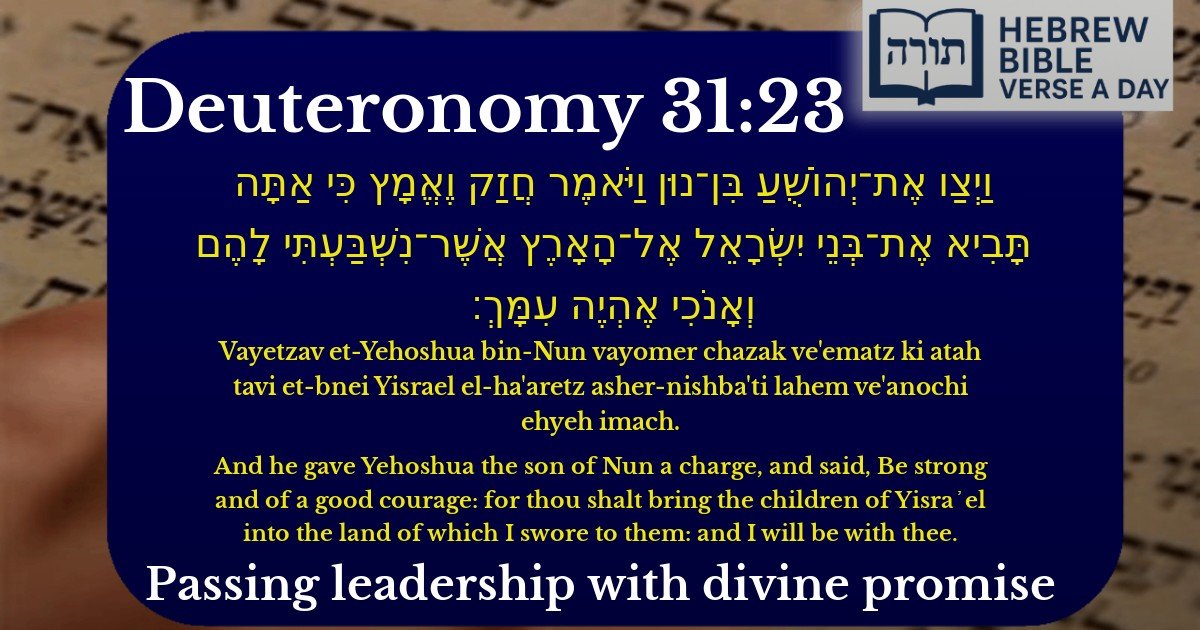
וַיְצַו אֶת־יְהוֹשֻׁעַ בִּן־נוּן וַיֹּאמֶר חֲזַק וֶאֱמָץ כִּי אַתָּה תָּבִיא אֶת־בְּנֵי יִשְׂרָאֵל אֶל־הָאָרֶץ אֲשֶׁר־נִשְׁבַּעְתִּי לָהֶם וְאָנֹכִי אֶהְיֶה עִמָּךְ׃

English Translation

And he gave Yehoshua the son of Nun a charge, and said, Be strong and of a good courage: for thou shalt bring the children of Yisra᾽el into the land of which I swore to them: and I will be with thee.

Transliteration

Vayetzav et-Yehoshua bin-Nun vayomer chazak ve'ematz ki atah tavi et-bnei Yisrael el-ha'aretz asher-nishba'ti lahem ve'anochi ehyeh imach.

Hebrew Leining Text

וַיְצַ֞ו אֶת־יְהוֹשֻׁ֣עַ בִּן־נ֗וּן וַיֹּ֘אמֶר֮ חֲזַ֣ק וֶאֱמָץ֒ כִּ֣י אַתָּ֗ה תָּבִיא֙ אֶת־בְּנֵ֣י יִשְׂרָאֵ֔ל אֶל־הָאָ֖רֶץ אֲשֶׁר־נִשְׁבַּ֣עְתִּי לָהֶ֑ם וְאָנֹכִ֖י אֶהְיֶ֥ה עִמָּֽךְ׃

🎵 Listen to leining

Parasha Commentary

The Command to Yehoshua

The verse (Devarim 31:23) records Moshe Rabbeinu's charge to Yehoshua bin Nun, instructing him to be "strong and of good courage" as he prepares to lead Bnei Yisrael into Eretz Yisrael. Rashi explains that this dual encouragement—"chazak ve'ematz"—addresses both Yehoshua's role as a military leader (chazak in battle) and as a spiritual guide (ematz in Torah and righteousness). The Sifrei adds that Yehoshua needed this reinforcement because assuming leadership after Moshe was a daunting task.

Divine Assurance

Hashem promises Yehoshua, "I will be with you" (v'Anochi eheyeh imach), echoing the assurance given to Moshe at the burning bush (Shemot 3:12). The Ramban notes that this guarantee was essential to counterbalance Yehoshua's humility and potential self-doubt. The Talmud (Sanhedrin 8a) derives from here that a leader must not rely solely on their own strength but must recognize that success comes from Divine assistance.

The Mission: Fulfilling the Covenant

  • Bringing Bnei Yisrael to the Land: The verse emphasizes that Yehoshua's task is to actualize the oath Hashem made to the Avot (Bereishit 12:7, 26:3). The Kli Yakar highlights that this was not merely a territorial conquest but the fulfillment of a covenantal promise, linking Yehoshua's leadership to the broader destiny of Klal Yisrael.
  • Continuity of Leadership: The Midrash Tanchuma (Va'etchanan 6) compares Moshe's charge to Yehoshua to the passing of a torch, ensuring the seamless transition of authority. This underscores the principle of mesorah—the unbroken chain of Torah leadership.

Lessons in Leadership

The Ohr HaChaim explains that Yehoshua's strength would come from his unwavering faith in Hashem's presence. The repetition of chazak ve'ematz in Sefer Yehoshua (1:6-9) reinforces that true leadership requires both resilience in action (chazak) and moral courage (ematz). The Netziv adds that a leader must internalize this duality to guide the nation physically and spiritually.

📚 Talmud Citations

This verse is quoted in the Talmud.

📖 Sotah 34a
The verse is referenced in the discussion about the spies sent by Moses and the encouragement given to Joshua, emphasizing the theme of strength and courage in fulfilling divine commandments.
📖 Berakhot 32b
The verse is mentioned in the context of prayers and supplications, illustrating how Joshua was encouraged by God to be strong and courageous.

Frequently Asked Questions

Q: Why did Moshe tell Yehoshua to 'be strong and courageous'?
A: Moshe told Yehoshua to 'be strong and courageous' (Devarim 31:23) because leading Bnei Yisrael into Eretz Yisrael would be a difficult task. Rashi explains that Yehoshua needed extra encouragement since he was taking over from Moshe, the greatest leader of the Jewish people. The phrase is repeated multiple times (also in Yehoshua 1:6-9) to emphasize the importance of strength and faith when fulfilling Hashem's mission.
Q: What does it mean that Hashem said 'I will be with you' to Yehoshua?
A: When Hashem tells Yehoshua 'I will be with you' (Devarim 31:23), it means that Yehoshua would have divine assistance in conquering and settling Eretz Yisrael. The Rambam (Hilchot Melachim 7:15) explains that a Jewish leader who follows Torah and acts with sincerity will merit Hashem's help in all endeavors. This promise gave Yehoshua confidence that he wasn't alone in this monumental task.
Q: Why was Yehoshua chosen to lead Bnei Yisrael into the land?
A: Yehoshua was chosen to lead Bnei Yisrael because he had been Moshe's faithful student (Pirkei Avot 1:1 calls him 'Moshe's disciple') and had demonstrated loyalty to Torah values. The Midrash (Bamidbar Rabbah 21:14) notes that Yehoshua served Moshe selflessly and was completely devoted to Torah study. Additionally, he had already shown leadership skills as one of the spies who remained faithful to Hashem's promise (Bamidbar 14:6-9).
Q: How can we apply 'be strong and courageous' in our lives today?
A: The instruction to 'be strong and courageous' (Devarim 31:23) teaches us to face challenges with faith and determination. The Sforno explains that this applies whenever we pursue mitzvot or Torah ideals despite difficulties. In modern times, this could mean standing firm in Jewish observance, overcoming obstacles in Torah study, or maintaining Jewish identity in challenging environments - always remembering that Hashem is with us when we follow His ways.
Q: What is the significance of Moshe giving this charge to Yehoshua?
A: Moshe giving this charge to Yehoshua (Devarim 31:23) represents the formal transfer of leadership to ensure continuity of Torah values. The Talmud (Bava Batra 75a) compares Moshe to the sun and Yehoshua to the moon - showing that while no leader equals Moshe, Yehoshua would faithfully continue his mission. This moment teaches the importance of preparing the next generation to carry on Torah traditions, a principle that applies to parents, teachers, and leaders in every generation.