
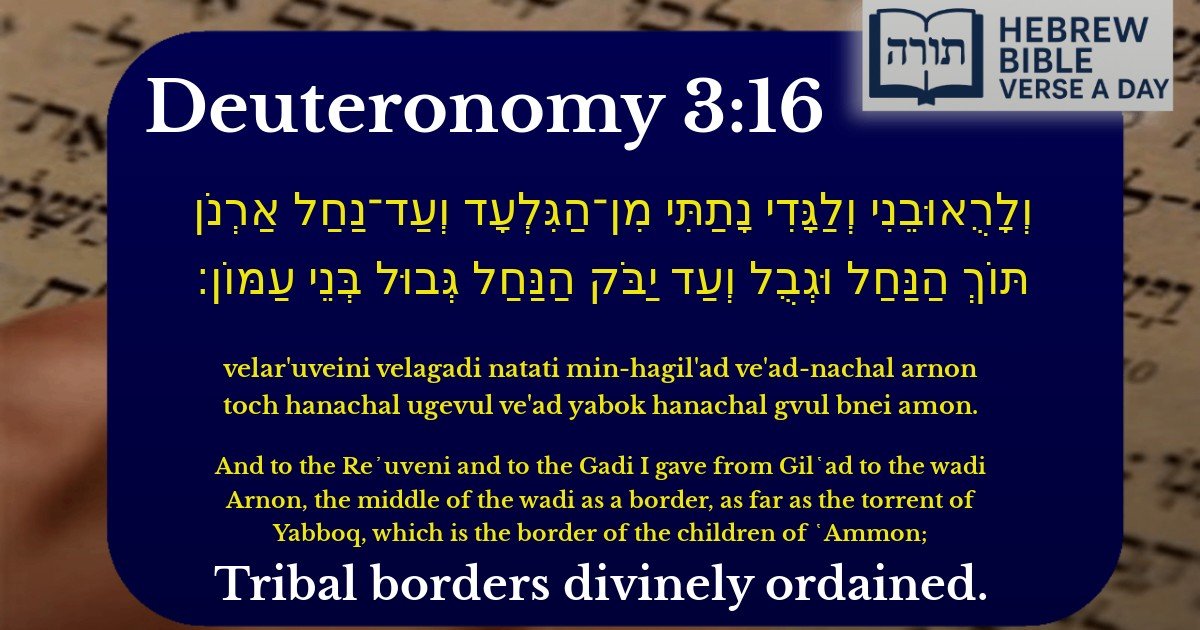

Deuteronomy 3:16 - Tribal borders divinely ordained.

Deuteronomy 3:16 - דברים 3:16

Hebrew Text

וְלָרֻאוּבֵנִי וְלַגָּדִי נָתַתִּי מִן־הַגִּלְעָד וְעַד־נַחַל אַרְנֹן תּוֹךְ הַנַּחַל וּגְבֻל וְעַד יַבֹּק הַנַּחַל גְּבוּל בְּנֵי עַמּוֹן׃

English Translation

And to the Re᾽uveni and to the Gadi I gave from Gil῾ad to the wadi Arnon, the middle of the wadi as a border, as far as the torrent of Yabboq, which is the border of the children of ῾Ammon;

Transliteration

Velar'uveini velagadi natati min-hagil'ad ve'ad-nachal arnon toch hanachal ugevul ve'ad yabok hanachal gvul bnei amon.

Hebrew Leining Text

וְלָראוּבֵנִ֨י וְלַגָּדִ֜י נָתַ֤תִּי מִן־הַגִּלְעָד֙ וְעַד־נַ֣חַל אַרְנֹ֔ן תּ֥וֹךְ הַנַּ֖חַל וּגְבֻ֑ל וְעַד֙ יַבֹּ֣ק הַנַּ֔חַל גְּב֖וּל בְּנֵ֥י עַמּֽוֹן׃

🎵 Listen to leining

Parasha Commentary

Geographical Boundaries of Reuven and Gad

The verse delineates the territorial allotment given to the tribes of Reuven and Gad east of the Jordan River. According to Rashi (Devarim 3:16), this land was granted to them due to their request for pastureland for their abundant livestock (Bamidbar 32:1-4). The boundaries stretch from Gilad (Gilead) in the north to Nachal Arnon (the Arnon River) in the south, with the middle of the wadi serving as the border. The eastern boundary extends to Yabok River, which marked the frontier of Ammonite territory.

Halachic and Historical Significance

Rambam (Hilchot Terumot 1:6) discusses the sanctity of these lands, noting that territories east of the Jordan, though part of Eretz Yisrael, had a lower level of sanctity compared to the western side. The Mishnah (Shevi’it 6:1) also addresses agricultural laws specific to these regions.

Midrashic Insights

  • Midrash Tanchuma (Matot 5) explains that the tribes of Reuven and Gad chose this land due to its fertility, but Moshe rebuked them for prioritizing material wealth over entering Eretz Yisrael with their brethren.
  • The Sifrei (Devarim 11:24) emphasizes that these borders were divinely ordained, reinforcing that conquest and settlement were part of Hashem’s covenant with Bnei Yisrael.

Border Disputes and Ammonite Claims

The verse specifies that the Yabok River was the border of Ammon, resolving potential disputes. Rashi (Bamidbar 21:24) clarifies that although Ammon once claimed parts of this land, Hashem had already granted it to Israel, as stated in Devarim 2:37.

📚 Talmud Citations

This verse is not quoted in the Talmud.

Frequently Asked Questions

Q: Why did Moshe give land to the tribes of Reuven and Gad east of the Jordan River?
A: The tribes of Reuven and Gad requested the land east of the Jordan because it was good for their large flocks and herds (Bamidbar 32:1-5). Moshe agreed on condition that they first help conquer the land of Israel with the other tribes (Bamidbar 32:20-22). This verse describes the specific boundaries of their territory.
Q: What is the significance of the boundaries mentioned in this verse?
A: The boundaries (from Gilad to Nachal Arnon to Yabok) mark the divinely-appointed borders of the Israelite settlement east of the Jordan. Rashi explains these were the lands conquered from Sichon and Og (Devarim 2:24-3:11). The precise borders prevented future disputes with neighboring nations like Ammon.
Q: Why does the Torah specify 'the middle of the wadi' as a border?
A: The Talmud (Bava Basra 56a) learns from this that when a river divides territories, the border runs through the midpoint unless specified otherwise. This became an important halachic principle for determining property boundaries and international borders in Jewish law.
Q: How does this allocation of land relate to Jewish law today?
A: While these specific territories are not currently under Jewish sovereignty, Rambam (Hilchot Terumot 1:2) rules that the lands east of the Jordan have the same sanctity as the land of Israel proper regarding agricultural laws. The boundaries also teach important principles about keeping one's word, as Reuven and Gad had to fulfill their promise to fight with the other tribes.