Frequently Asked Questions
Q: What does Deuteronomy 32:19 mean when it says 'he abhorred them'?
A: The verse describes Hashem's reaction to the sins of the Jewish people. According to Rashi, this means that when Hashem saw their rebellious behavior, He distanced Himself from them in anger. However, this is not a permanent rejection—Hashem still loves His people and awaits their repentance.
Q: Why does the verse mention 'his sons and daughters'?
A: The Torah refers to the Jewish people as Hashem's 'sons and daughters' to emphasize the close relationship between G-d and Israel. The Midrash (Sifrei Devarim) explains that even when we sin, we remain His children, though our actions may provoke His displeasure.
Q: What lesson can we learn from Deuteronomy 32:19?
A: This verse teaches us that our actions directly affect our relationship with Hashem. The Rambam (Hilchot Teshuvah) explains that while sin creates distance, sincere repentance can restore the bond. It reminds us to avoid behavior that would 'provoke' Hashem's displeasure.
Q: How does this verse apply to us today?
A: Just as in biblical times, our actions today impact our spiritual connection with Hashem. The Talmud (Yoma 86a) teaches that when we sin, we should remember verses like this to motivate us to return to Hashem through teshuvah (repentance) and improved behavior.
Q: What does 'provocation' mean in this context?
A: The Hebrew word 'ka'as' (translated as 'provocation') refers to actions that anger Hashem, particularly idolatry and abandonment of Torah values. Ibn Ezra explains that this refers to the Israelites' behavior during wilderness journeys when they repeatedly tested Hashem's patience.


Context of the Verse
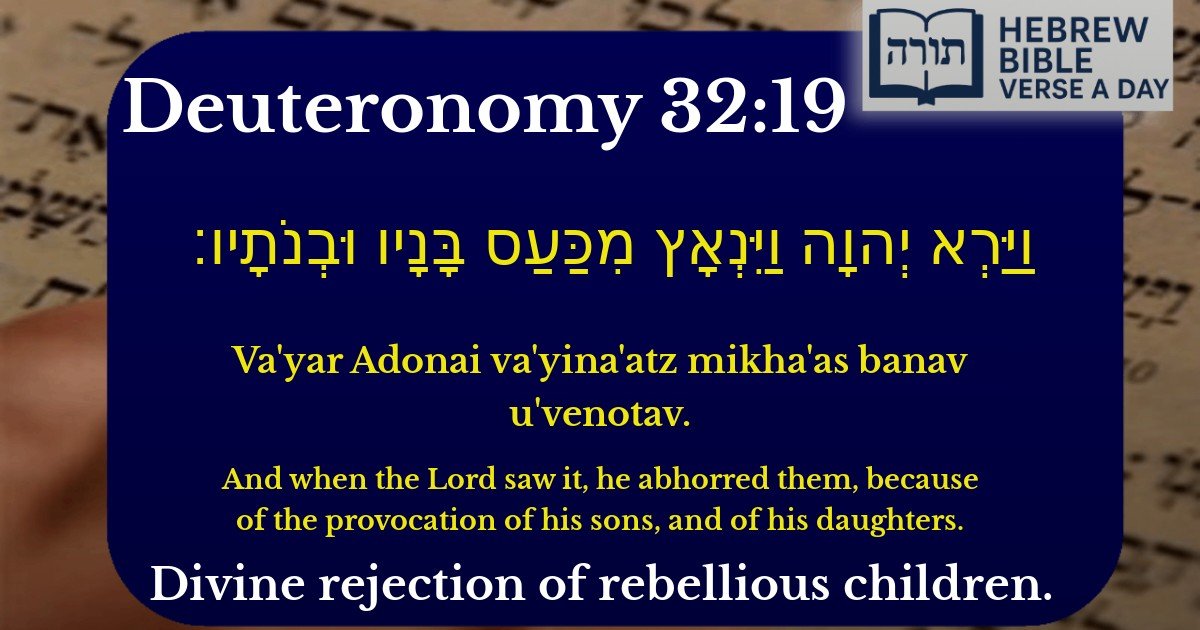
This verse appears in Devarim (Deuteronomy) 32:19, within the broader context of Shirat Ha'azinu (the Song of Ha'azinu), a prophetic poem delivered by Moshe Rabbeinu (Moses) before his passing. The song serves as a warning to Bnei Yisrael (the Children of Israel) about the consequences of abandoning Hashem's commandments.
Literal Interpretation (Peshat)
The verse describes Hashem's reaction to the rebellious behavior of Bnei Yisrael. The phrase "וַיַּרְא יְהוָה וַיִּנְאָץ" ("And when the Lord saw it, He abhorred") conveys a strong divine displeasure. Rashi explains that "וַיִּנְאָץ" (He abhorred) indicates that Hashem was filled with disgust due to their sinful actions, particularly idolatry and moral corruption.
Midrashic Interpretation (Derash)
The Midrash (Sifrei Devarim 32:19) elaborates that the provocation of "בָּנָיו וּבְנֹתָיו" ("His sons and daughters") refers to the collective sins of the nation, including:
The Midrash emphasizes that despite being called "His sons and daughters," their actions caused a rupture in their relationship with Hashem.
Rambam's Perspective (Philosophical Approach)
Rambam (Maimonides) in Moreh Nevuchim (Guide for the Perplexed) explains that anthropomorphic language like "He abhorred" is a metaphorical way to describe divine justice. Hashem's "displeasure" is not an emotional reaction but a reflection of the natural consequences of straying from the path of righteousness.
Ibn Ezra's Commentary
Ibn Ezra notes that the phrase "מִכַּעַס" ("because of the provocation") implies that Bnei Yisrael's actions were deliberate and persistent, not accidental. Their repeated rebellion led to divine retribution, as outlined in the subsequent verses.
Halachic Implications
The Talmud (Sanhedrin 27a) derives from this verse that collective punishment is sometimes necessary when corruption becomes widespread. However, it also teaches that teshuvah (repentance) can reverse divine decrees, as Hashem always awaits the return of His children.