Frequently Asked Questions
Q: What does it mean when G-d says 'I will hide My face' in Deuteronomy 32:20?
A: According to Rashi and other Jewish commentators, 'hiding His face' (הסתרת פנים) means G-d will temporarily withdraw His direct providence and protection, allowing consequences to unfold naturally. This is a form of divine discipline when the Jewish people stray from Torah. The Talmud (Chagigah 5a) explains this as G-d's way of encouraging repentance.
Q: Why does the verse call them 'a perverse generation' and 'children without faith'?
A: The Ramban explains this refers to a generation that fundamentally distorts (תהפוכות) moral and spiritual values. 'Children without faith' (בנים לא אמון בם) means they break their covenant with G-d despite being His chosen people, as explained in Midrash Tanchuma. This describes a breakdown in the parent-child relationship between G-d and Israel.
Q: How does this verse apply to us today?
A: The Sforno teaches this serves as a timeless warning: when Jews abandon Torah values, they risk losing divine protection. However, the 'hiding' is temporary - the verse concludes by G-d watching 'their end,' implying He never fully abandons us. This inspires repentance (teshuvah) even in difficult times, as discussed in Maimonides' Laws of Repentance.
Q: What is the significance of G-d saying 'I will see what their end shall be'?
A: The Kli Yakar explains this shows G-d's enduring commitment - even during estrangement, He observes with hope for our return. The Talmud (Berachos 7a) relates this to the concept of 'the end is wedged in the beginning' - hidden within every challenge is the seed of redemption, if we choose to realign with Torah.
Q: Why is this verse part of the Song of Ha'azinu?
A: As Rashi notes on Deuteronomy 31:19, this song serves as eternal testimony. This verse specifically warns future generations that spiritual decline leads to divine concealment (hester panim), a recurring theme in Jewish history. The Midrash (Sifrei Devarim 322) connects it to later exiles, showing the prophetic nature of Moshe's words.

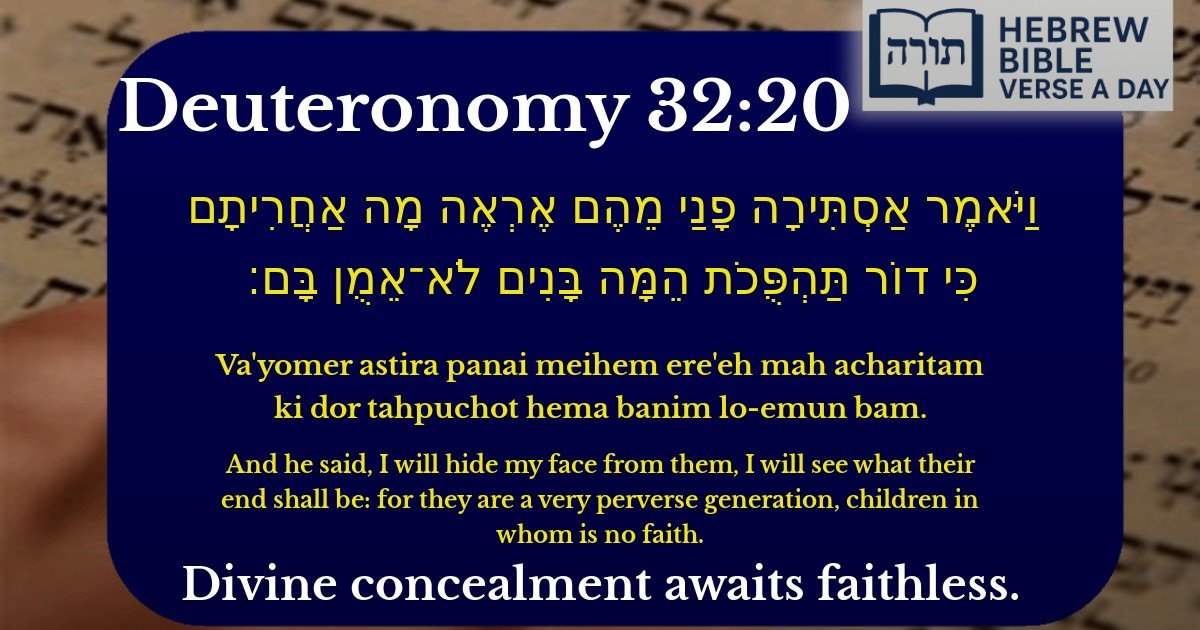

Context in the Torah
The verse (Devarim 32:20) appears in Shirat Ha'azinu, Moshe's prophetic song warning Bnei Yisrael of the consequences of abandoning Hashem's covenant. This passage reflects divine judgment due to the nation's moral and spiritual failings.
Rashi's Explanation
Rashi interprets "אסתירה פני מהם" (I will hide My face from them) as Hashem withdrawing His direct providence, allowing suffering to come upon them as a consequence of their actions. The phrase "אראה מה אחריתם" (I will see what their end shall be) indicates that despite their waywardness, Hashem still observes their fate, leaving room for eventual repentance.
Ibn Ezra's Insight
Ibn Ezra emphasizes that "דור תהפכות" (a perverse generation) refers to a generation that inverts moral truths, calling evil good and good evil. The term "בנים לא אמון בם" (children in whom is no faith) suggests a breakdown in the covenant relationship, where the people lack steadfastness in their commitment to Torah.
Midrashic Interpretation
Rambam's Perspective
In Moreh Nevuchim (3:36), Rambam explains that divine "hiding" results from human free will—when people choose evil, they distance themselves from Hashem's protection. The phrase "אראה מה אחריתם" reflects the principle that consequences naturally follow actions.
Chassidic Interpretation
The Kedushat Levi (R' Levi Yitzchak of Berditchev) teaches that even during Hester Panim, Hashem's hidden presence sustains the world. The seeming absence is itself a form of divine mercy, allowing time for repentance before final judgment.