Frequently Asked Questions
Q: What does it mean when G-d says 'I lift up my hand to heaven' in Deuteronomy 32:40?
A: Rashi explains that this gesture symbolizes G-d taking an oath, as lifting the hand is a sign of swearing (similar to how people raise their hand when taking an oath). Here, G-d is solemnly declaring His eternal existence and commitment to justice.
Q: Why does G-d emphasize 'I live forever' in this verse?
A: The Rambam teaches that this declaration reinforces the fundamental Jewish belief in G-d's eternity (Yesodei HaTorah 1:11). Unlike mortal beings, G-d has no beginning or end. This verse reminds us that His justice and providence are everlasting, giving assurance that He will ultimately reward righteousness and punish evil.
Q: How does Deuteronomy 32:40 relate to the rest of the Torah portion?
A: This verse appears in the Song of Ha'azinu, where Moshe warns Israel about future disobedience. The Sforno explains that G-d's oath of eternal existence serves as a reassurance - even when Israel strays, G-d remains forever capable of redeeming them when they repent, as His power never diminishes.
Q: What practical lesson can we learn from 'I live forever' in daily life?
A: The Talmud (Berachos 10a) derives from this that we should always relate to G-d as the Eternal Living One - meaning our service should be with vitality and joy. Additionally, the Midrash (Sifri 32:40) teaches this verse comforts us that G-d always oversees the world, so we can trust in divine justice even when it's not immediately visible.
Q: Why does G-d use anthropomorphic language ('lift My hand') if He has no physical form?
A: The Rambam (Moreh Nevuchim 1:46) explains that the Torah speaks in human terms so we can understand. 'Lifting the hand' is a metaphor for G-d's absolute will being expressed, just as a human oath involves physical action. This doesn't imply G-d has a body, but communicates the seriousness of His declaration in terms we comprehend.


Context and Source
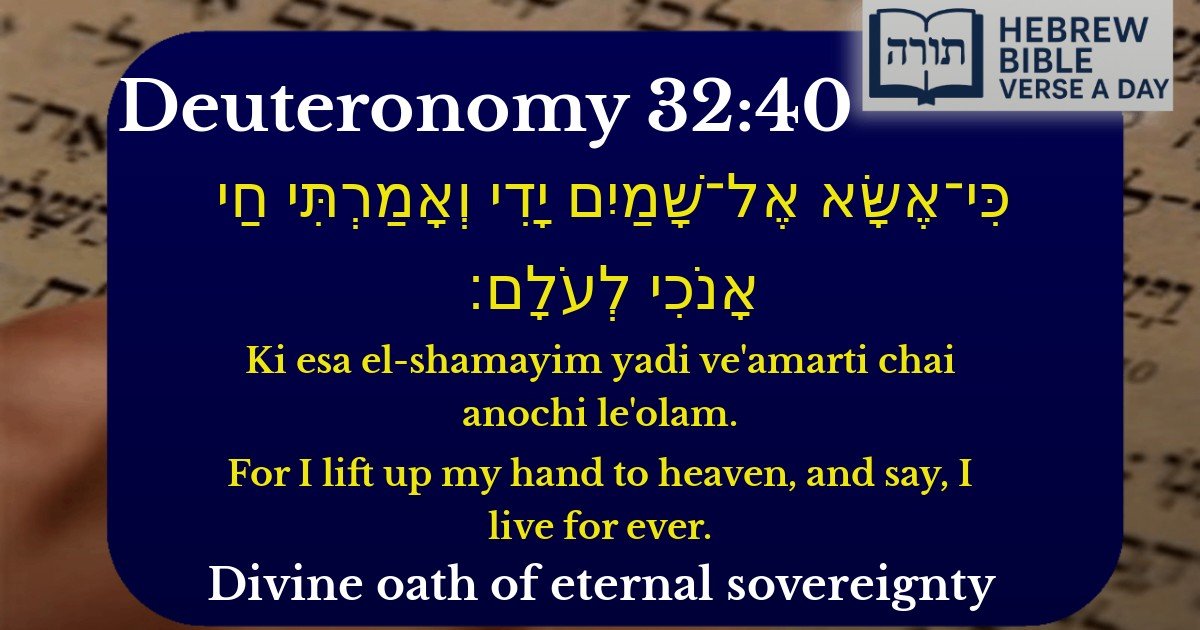
The verse "כִּי־אֶשָּׂא אֶל־שָׁמַיִם יָדִי וְאָמַרְתִּי חַי אָנֹכִי לְעֹלָם" appears in Devarim (Deuteronomy) 32:40, within Shirat Ha'azinu, the song that Moshe (Moses) delivers to Bnei Yisrael before his passing. This song serves as a prophetic warning and testimony about the consequences of abandoning Hashem's covenant.
Literal Interpretation (Peshat)
Rashi explains that the lifting of the hand to heaven symbolizes an oath, as was customary in ancient times (see Bereishit 14:22). When Hashem declares "חַי אָנֹכִי לְעֹלָם" ("I live forever"), it is an affirmation of His eternal existence and sovereignty, reinforcing that His judgment and promises are absolute and unchanging.
Midrashic Insights
The Sifrei (a halachic Midrash on Devarim) connects this verse to Hashem's role as the eternal Judge. By swearing upon His eternal existence, Hashem assures that justice will ultimately prevail, even if it is delayed. The Midrash further elaborates that this oath is a response to the nations who doubt His providence over Israel.
Theological Implications
Rambam (Maimonides) in Hilchot Yesodei HaTorah (1:1-4) underscores that Hashem’s eternal existence is a foundational principle of Jewish belief. This verse serves as a reminder that His governance is not bound by time, and His covenant with Israel is everlasting.
Kabbalistic Perspective
The Zohar interprets the "lifting of the hand" as an allusion to the Sefirah of Gevurah (Divine Judgment), while "heaven" represents Tiferet (Harmony and Mercy). The declaration of eternal life signifies the unification of these Divine attributes, ensuring that justice is always tempered with compassion.