Frequently Asked Questions
Q: Why was Moshe (Moses) allowed to see the land but not enter it?
A: According to Rashi and the Talmud (Sotah 14a), Moshe was not allowed to enter Eretz Yisrael (the Land of Israel) because of the incident at Mei Merivah (Numbers 20:12), where he struck the rock instead of speaking to it as Hashem commanded. However, Hashem showed him the land from afar as a consolation and to demonstrate His promise to the Jewish people.
Q: What is the significance of Moshe seeing the land before his passing?
A: The Midrash (Devarim Rabbah 11:10) explains that Moshe seeing the land was both a reward for his leadership and a way to strengthen the Jewish people's faith. By seeing the land, Moshe could testify to its goodness and inspire the nation to trust in Hashem's promise to bring them there.
Q: How does this verse teach us about accepting divine judgment?
A: The Rambam (Hilchot Teshuvah 3:1) teaches that this verse demonstrates Moshe's acceptance of Hashem's decree with humility, showing that even the greatest leader must submit to divine will. It serves as a lesson in accepting judgments we may not fully understand.
Q: Why does the verse emphasize 'the land which I give to the children of Israel'?
A: Rashi explains that this phrasing emphasizes that the land is a gift from Hashem to the Jewish people, not something earned through human merit. Even Moshe, who led them out of Egypt, couldn't enter based on his own merits - entry was conditional on following Hashem's commands.
Q: What practical lesson can we learn from Moshe seeing but not entering the land?
A: The Talmud (Berachot 5a) derives from this that sometimes righteous people may not merit to see the completion of their work, but their efforts still bear fruit for future generations. Moshe didn't enter, but his leadership brought the Jewish people to the threshold of the Promised Land.


Context in the Torah
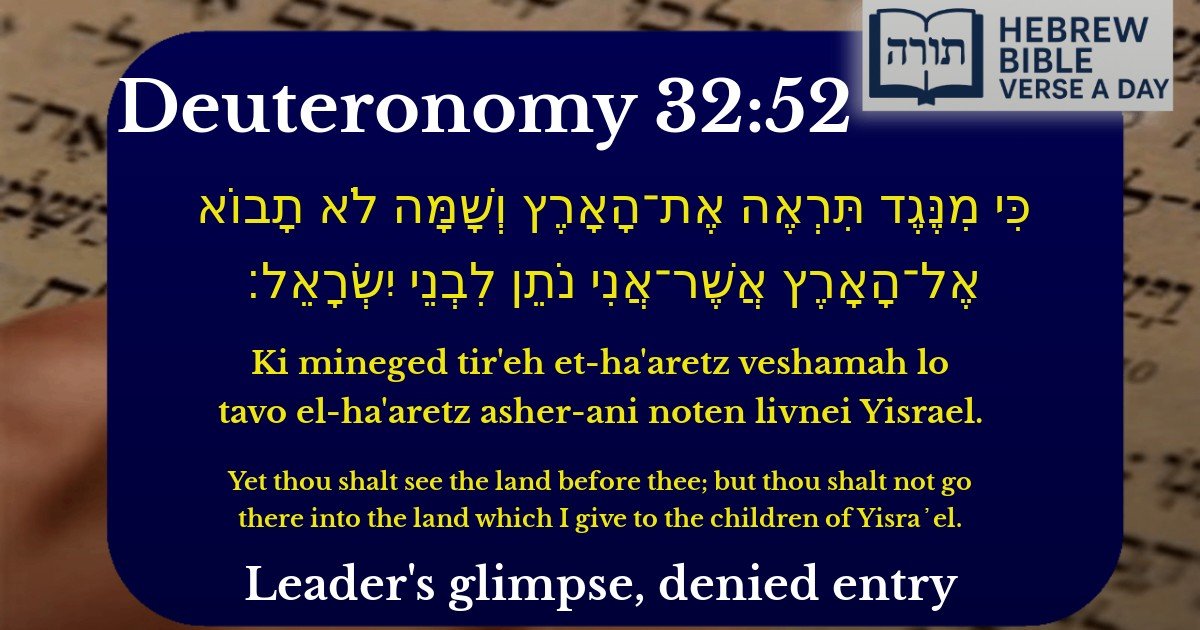
This verse (Devarim 32:52) is part of Hashem's final instructions to Moshe Rabbeinu before his passing. It follows the episode where Moshe struck the rock (Bamidbar 20:1-13) instead of speaking to it, which resulted in him being prohibited from entering Eretz Yisrael.
Rashi's Explanation
Rashi explains that Moshe was shown the entire Land of Israel from Mount Nebo, fulfilling the phrase "מִנֶּגֶד תִּרְאֶה" - "you shall see opposite." He notes that Moshe was granted this vision as a consolation, allowing him to behold the land even though he could not enter it physically. Rashi also emphasizes that this was a punishment measure-for-measure: just as Moshe "turned away" from following Hashem's exact command at Mei Merivah, so too he would only see the land "from opposite" but not enter it.
Rambam's Perspective
In Moreh Nevuchim (3:24), Rambam discusses how this episode demonstrates the principle that even the greatest leaders are held accountable for their actions. The severity of Moshe's punishment highlights the importance of precise obedience to divine commandments, especially for those in leadership positions who serve as examples for Klal Yisrael.
Talmudic Insights
Midrashic Interpretations
The Midrash (Devarim Rabbah 11:10) elaborates that Hashem showed Moshe:
- The entire land spread out before him like a map
- The future conquests by Yehoshua
- The locations of all the tribal inheritances
- The sites of future holy places and cities of refuge
This comprehensive vision served both as comfort and as preparation for Moshe to properly advise Yehoshua and the nation before his passing.Chassidic Perspective
The Sefat Emet explains that Moshe's vision represents the tzaddik's ability to perceive the spiritual potential of the land - its kedusha and divine purpose - even when physical entry is impossible. This teaches that while we may not always reach our desired destinations, we can still connect to their holiness through vision and intention.