Frequently Asked Questions
Q: What does Deuteronomy 32:6 mean?
A: Deuteronomy 32:6 is part of Moses' song (Ha'azinu) where he rebukes the Israelites for their lack of gratitude to Hashem. The verse questions how a foolish and unwise people could fail to recognize and repay Hashem, who is like a father to them—creating, acquiring, and establishing them as a nation. Rashi explains that 'bought thee' refers to Hashem redeeming Israel from Egypt, and 'established thee' means He made them a strong and enduring nation.
Q: Why is Deuteronomy 32:6 important?
A: This verse is important because it reminds the Jewish people of their foundational relationship with Hashem. The Rambam (Maimonides) teaches that recognizing Hashem as our Creator and Sustainer is a fundamental principle of faith. The verse emphasizes ingratitude as foolishness, urging us to reflect on our obligations to Hashem, who acts as a loving father to His people.
Q: What can we learn from Deuteronomy 32:6 today?
A: We learn the importance of hakarat hatov (recognizing the good) and showing gratitude to Hashem for all He has done for us. The Midrash (Sifrei Devarim) highlights that forgetting Hashem’s kindness leads to spiritual downfall. Today, this verse reminds us to acknowledge Hashem’s constant care—just as He redeemed our ancestors, He continues to guide and sustain us.
Q: How does Deuteronomy 32:6 describe Hashem's relationship with the Jewish people?
A: The verse describes Hashem as a father who acquires, creates, and establishes His people. The Talmud (Berachot 10a) explains that this fatherly relationship means Hashem guides and disciplines us out of love, just as a parent cares for a child. The term 'bought thee' also alludes to the Exodus, showing that Hashem actively chose and redeemed Israel as His treasured nation.
Q: Why does the verse call the people 'foolish and unwise'?
A: The verse calls the people foolish (naval) and unwise (lo chacham) because they fail to recognize Hashem’s kindness and respond with disobedience. Rashi explains that a 'naval' acts disgracefully despite knowing better, while 'lo chacham' implies neglecting to learn wisdom. The Talmud (Avodah Zarah 5b) teaches that true wisdom begins with fearing Hashem, and ignoring His role in our lives is the height of folly.

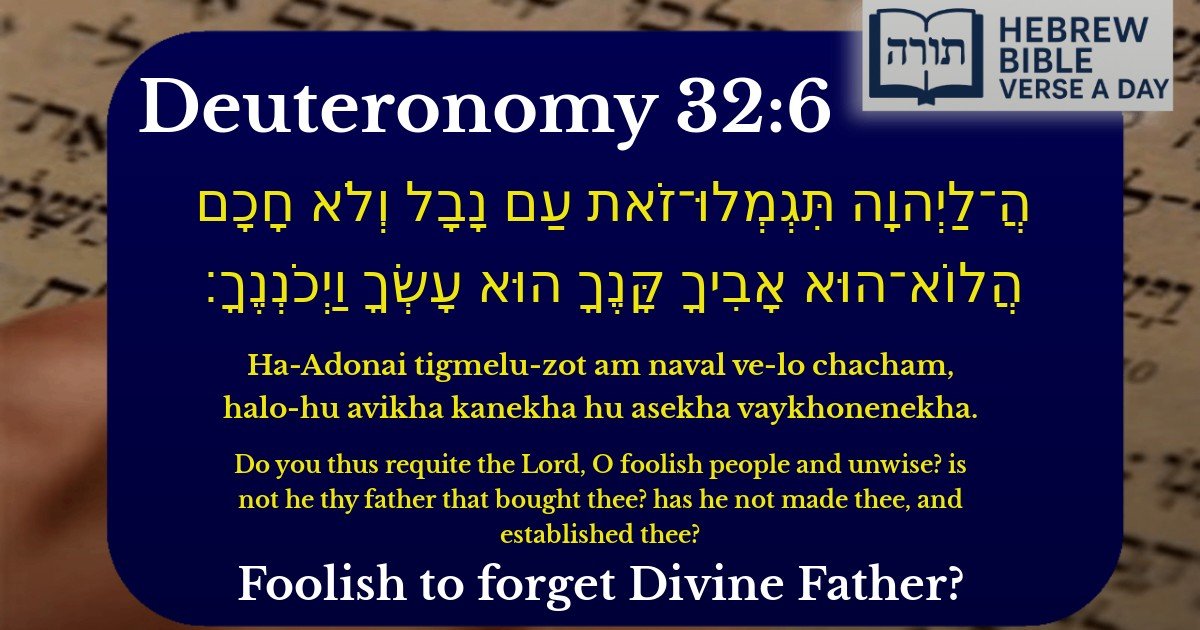

Context in Devarim (Deuteronomy) 32:6
This verse appears in Shirat Ha'azinu (the Song of Moses), where Moshe Rabbeinu rebukes Bnei Yisrael for their ingratitude toward Hashem. The verse contrasts the people's foolishness with Hashem's role as their Creator and Sustainer.
Key Themes and Interpretations
Midrashic Insights
The Midrash Tanchuma (Ha'azinu 2) compares this verse to a prince who rebels against his father despite being raised in luxury. Similarly, Bnei Yisrael’s defiance is irrational given Hashem’s constant care. The Sifrei links "עַם נָבָל" to the episode of the Golden Calf, where their folly was rejecting Hashem after witnessing His miracles.
Halachic and Ethical Implications
The Rambam (Hilchot De'ot 3:1) derives from this verse that ingratitude (כפיות טובה) is a hallmark of foolishness. The Sefer HaChinuch (Mitzvah 33) ties it to the obligation of hakarat hatov (recognizing kindness), as failing to acknowledge Hashem’s role as Creator and Sustainer undermines the foundation of Torah observance.