Frequently Asked Questions
Q: What does Deuteronomy 32:7 mean?
A: Deuteronomy 32:7 teaches us to remember Jewish history and the lessons from past generations. Rashi explains that this verse urges us to reflect on how G-d has guided and protected the Jewish people throughout history. By learning from our ancestors and elders, we gain wisdom and strengthen our faith.
Q: Why is remembering the past important in Judaism?
A: Remembering the past is a key principle in Judaism because it connects us to our heritage and reinforces our relationship with G-d. The Rambam (Maimonides) emphasizes that recalling miracles and divine providence—like the Exodus from Egypt—helps us recognize G-d's hand in history and inspires us to follow Torah teachings.
Q: How can we apply Deuteronomy 32:7 today?
A: We apply this verse by studying Jewish history, listening to our parents and teachers, and preserving traditions. The Talmud (Pirkei Avot 4:1) teaches that a wise person learns from everyone, especially elders. Today, this means engaging with Torah scholars, reading Jewish texts, and passing down stories to future generations.
Q: What does 'ask your father and elders' mean in this verse?
A: The phrase 'ask your father and elders' highlights the importance of seeking knowledge from those with experience and Torah wisdom. The Midrash (Sifrei Devarim) explains that elders (זְקֵנִים) refers to Torah sages, whose insights help us understand G-d's will and the deeper meaning of our traditions.
Q: How does this verse relate to Jewish education?
A: Deuteronomy 32:7 underscores the Torah's emphasis on education across generations. The Talmud (Kiddushin 30a) states that parents must teach their children Torah, ensuring continuity. This verse reminds us that Jewish learning—whether from family, teachers, or texts—is essential for spiritual growth and communal survival.


Understanding the Verse
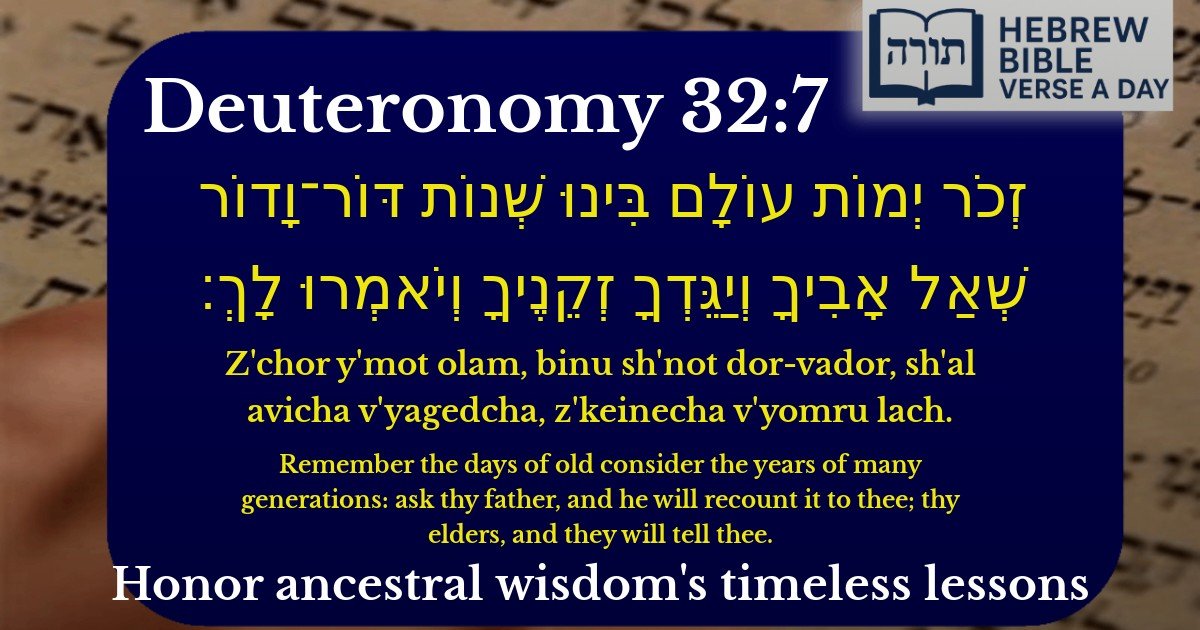
The verse "זְכֹר יְמוֹת עוֹלָם בִּינוּ שְׁנוֹת דּוֹר־וָדוֹר" (Devarim 32:7) calls upon the Jewish people to remember and deeply contemplate the events of past generations. Rashi explains that this is a directive to reflect on the kindness of Hashem throughout history, particularly during the formative periods of our nation, such as the Exodus from Egypt and the giving of the Torah at Har Sinai. By doing so, we strengthen our emunah (faith) and recognize Hashem's guiding hand in our lives.
The Role of Transmission
The second part of the verse, "שְׁאַל אָבִיךָ וְיַגֵּדְךָ זְקֵנֶיךָ וְיֹאמְרוּ לָךְ", emphasizes the importance of mesorah (tradition). The Rambam (Hilchos Avodah Zarah 1:3) teaches that the transmission of Torah and Jewish history from father to son and from elders to the younger generation is a fundamental principle of Judaism. This ensures the continuity of our heritage and prevents distortion of the truth.
Lessons from the Midrash
Practical Application
This verse teaches that Jewish identity is rooted in both collective memory and active engagement with our past. The Chofetz Chaim (in his commentary on Chumash) highlights that studying Jewish history—especially the miracles and trials of our ancestors—reinforces our commitment to mitzvos and trust in Hashem. By consulting our fathers and elders, we ensure that the lessons of the past remain vibrant and relevant for future generations.