

Join Our Newsletter To Be Informed When New Videos Are Posted
Hebrew Text
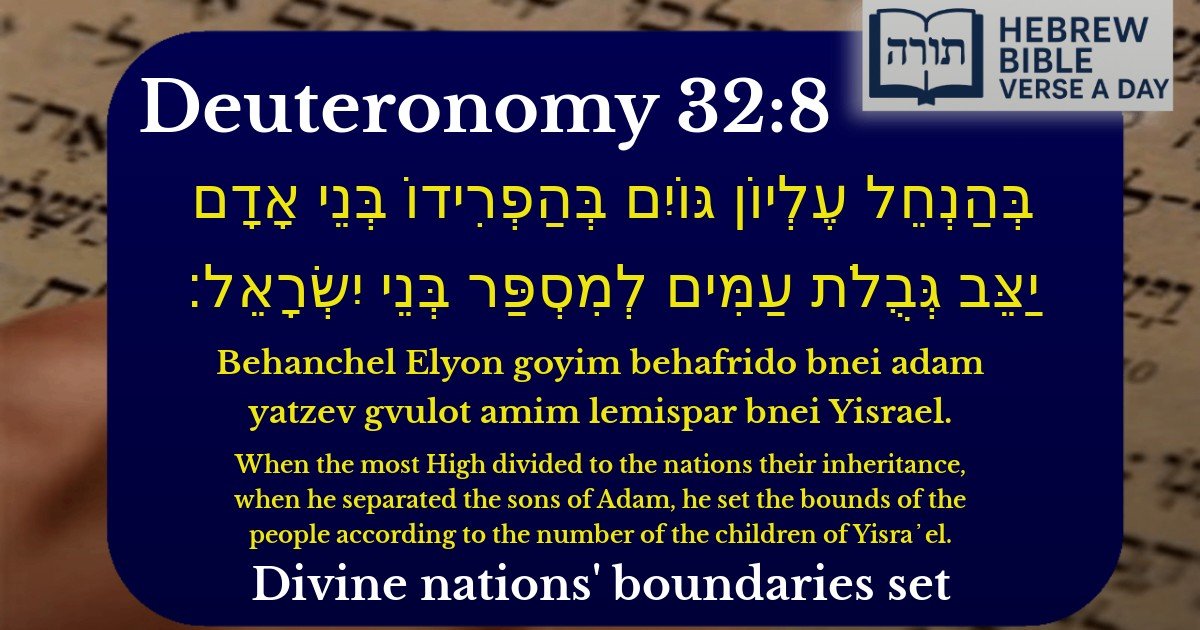
בְּהַנְחֵל עֶלְיוֹן גּוֹיִם בְּהַפְרִידוֹ בְּנֵי אָדָם יַצֵּב גְּבֻלֹת עַמִּים לְמִסְפַּר בְּנֵי יִשְׂרָאֵל׃
English Translation
When the most High divided to the nations their inheritance, when he separated the sons of Adam, he set the bounds of the people according to the number of the children of Yisra᾽el.
Transliteration
Behanchel Elyon goyim behafrido bnei adam yatzev gvulot amim lemispar bnei Yisrael.
Hebrew Leining Text
בְּהַנְחֵ֤ל עֶלְיוֹן֙ גּוֹיִ֔ם בְּהַפְרִיד֖וֹ בְּנֵ֣י אָדָ֑ם יַצֵּב֙ גְּבֻלֹ֣ת עַמִּ֔ים לְמִסְפַּ֖ר בְּנֵ֥י יִשְׂרָאֵֽל׃
🎵 Listen to leining
Parasha Commentary
📚 Talmud Citations
This verse is quoted in the Talmud.
📖 Chullin 60b
The verse is referenced in a discussion about the division of lands among the nations and the special status of Israel.
Context in Devarim (Deuteronomy) 32:8
The verse appears in Shirat Ha'azinu (the Song of Moses), where Moshe Rabbeinu recounts Hashem's providence over the nations and His special relationship with Bnei Yisrael. The phrase "בְּהַנְחֵל עֶלְיוֹן גּוֹיִם" describes the division of lands among the seventy nations after the dispersion at Migdal Bavel (Tower of Babel), as referenced in Bereishit (Genesis) 11.
Rashi's Interpretation
Rashi explains that when Hashem apportioned the world to the nations, He did so "לְמִסְפַּר בְּנֵי יִשְׂרָאֵל"—"according to the number of Bnei Yisrael." This means that the boundaries of the nations were determined based on the future number of Yaakov's descendants (the seventy souls who descended to Egypt, corresponding to the seventy nations). Rashi cites the Midrash (Bereishit Rabbah) to emphasize that Eretz Yisrael was reserved for Klal Yisrael, even as other nations received their territories.
Ramban's Insight
The Ramban (Nachmanides) expands on this idea, stating that Hashem established the seventy nations under the governance of heavenly ministers (sarim), but Eretz Yisrael remained under His direct sovereignty. This reflects the unique status of Am Yisrael as the chosen nation, not subject to celestial intermediaries.
Talmudic and Midrashic Perspectives
Theological Implication
The verse underscores the divine plan in world history: the boundaries of nations were not arbitrary but designed to facilitate the ultimate purpose of Am Yisrael's role in the world. This reinforces the concept of hashgacha pratit (divine providence) over all nations, with Klal Yisrael at the center of Hashem's plan.