Frequently Asked Questions
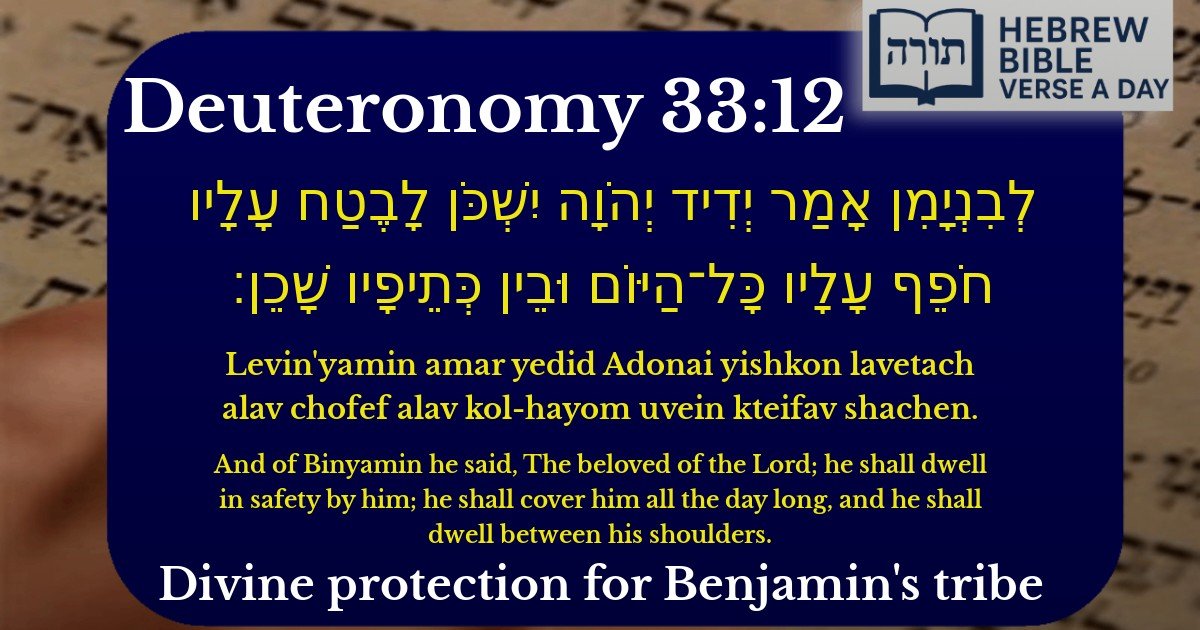
Q: What does the verse 'The beloved of the Lord; he shall dwell in safety by him' mean about the tribe of Binyamin?
A: This verse from Moshe's blessing to the tribe of Binyamin (Devarim 33:12) highlights their special closeness to Hashem. Rashi explains that the Beis HaMikdash (Holy Temple) was built in Binyamin's portion of Eretz Yisrael, showing their unique relationship with Hashem. The phrase 'he shall dwell in safety by him' refers to the Divine Presence resting securely in Binyamin's territory.
Q: Why is Binyamin called 'the beloved of the Lord' in this verse?
A: The Midrash (Bereishis Rabbah 99:1) teaches that Binyamin was the only son of Yaakov born in Eretz Yisrael, making him especially beloved. Additionally, the Talmud (Zevachim 54b) notes that the Shechinah (Divine Presence) rested in Binyamin's portion of land where the Beis HaMikdash stood, earning him this title of 'beloved.'
Q: What does 'he shall cover him all the day long' mean in this blessing to Binyamin?
A: Rashi explains this phrase means that Hashem's protection constantly surrounds Binyamin like a covering. The Kli Yakar adds that this refers to the continuous Divine protection over the Beis HaMikdash which stood in Binyamin's territory, safeguarding it from enemies throughout the day and night.
Q: What is the significance of 'he shall dwell between his shoulders' in this verse?
A: The phrase refers to the Beis HaMikdash being built on Mount Moriah, which was in Binyamin's portion. Rashi explains that 'between his shoulders' is a metaphor for the high mountain (shoulders being the elevated part), where the Temple stood. The Ramban adds that this symbolizes the honor and responsibility Binyamin carried in hosting the holiest site.
Q: How does this blessing to Binyamin apply to us today?
A: While we don't have the Beis HaMikdash today, this verse teaches us about Hashem's special relationship with those who dedicate themselves to holiness. The Sforno explains that just as Binyamin merited Divine protection through his connection to the Temple, we too can merit Hashem's protection by connecting to holiness through Torah study, prayer, and mitzvos.


Overview of the Verse
The verse (Devarim 33:12) is part of Moshe Rabbeinu's final blessings to the tribes of Israel before his passing. Binyamin is described as "the beloved of Hashem," with a unique relationship to the Divine Presence and protection.
Rashi's Explanation
Rashi explains that Binyamin is called "the beloved of Hashem" because the Shechinah (Divine Presence) rested in his portion of Eretz Yisrael—specifically in the Beis HaMikdash (Holy Temple), which was built in Yerushalayim, a city partly within Binyamin's territory. The phrase "he shall dwell in safety by Him" refers to the Shechinah residing securely in Binyamin's portion.
Midrashic Insights
Rambam's Perspective
In Hilchos Beis HaBechirah, the Rambam emphasizes the sanctity of the Beis HaMikdash's location in Binyamin's portion, reinforcing the idea that this tribe merited a unique closeness to Hashem. The "covering" mentioned in the verse symbolizes divine protection over the Mikdash.
Talmudic Interpretation
The Gemara (Zevachim 54b) discusses how the Shechinah "dwells between his shoulders," interpreting this as a reference to the Beis HaMikdash being situated on a mountain (Har HaMoriah), which is likened to the high point between shoulders.
Kli Yakar's Commentary
The Kli Yakar explains that Binyamin's blessing includes both physical and spiritual security. "He shall cover him all the day long" means Hashem's protection is constant, while "dwelling between his shoulders" signifies that the Divine Presence rests permanently in his portion, unlike other tribes where it was temporary (e.g., in Shiloh).