Frequently Asked Questions
Q: What does 'Israel shall dwell in safety alone' mean in Deuteronomy 33:28?
A: This verse describes the unique protection and security that Hashem grants to the Jewish people when they follow His ways. Rashi explains that 'alone' (בָּדָד) means Israel will dwell securely without needing alliances with other nations, as their true protection comes from Hashem. The Talmud (Berachot 35b) connects this to the idea that when Israel fulfills Torah, they are sustained independently.
Q: Why is the 'land of corn and wine' mentioned in this verse?
A: The 'land of corn and wine' symbolizes the material and spiritual blessings of Eretz Yisrael. Rambam (Hilchot Melachim 12:5) teaches that the land's abundance is a sign of divine favor when the Jewish people are righteous. The Midrash (Sifrei Devarim 354) adds that this bounty reflects the ideal state of harmony between the physical and spiritual in the Land of Israel.
Q: What is the significance of the 'heavens dropping down dew' in this verse?
A: Dew (טל) represents divine blessing and renewal. The Talmud (Taanit 3a) states that dew is a sign of Hashem's constant kindness, as it nourishes the land even when rain is withheld. The Midrash (Bereishit Rabbah 13:14) compares dew to the revival of the dead in the future, symbolizing eternal hope for Israel.
Q: How does Deuteronomy 33:28 apply to Jewish life today?
A: This verse reminds us that true security comes from our relationship with Hashem, not political power. The Sforno teaches that when Jews live according to Torah, they merit divine protection. Practically, this encourages trust in Hashem (bitachon) while actively observing mitzvot—especially those tied to Eretz Yisrael, like terumot and ma'aserot that acknowledge the land's holiness.
Q: Why is Yaakov's name used ('the fountain of Yaakov') instead of Yisrael in this verse?
A: The name Yaakov (יעקב) represents the Jewish people in their humble, struggling state, while still connected to holiness. Rashi notes that even when Jews are at their 'fountain' (source), they remain 'Yaakov'—acknowledging our ongoing spiritual work. The Kli Yakar adds that this duality shows our blessings flow from maintaining both the simplicity of Yaakov and the elevated status of Yisrael.

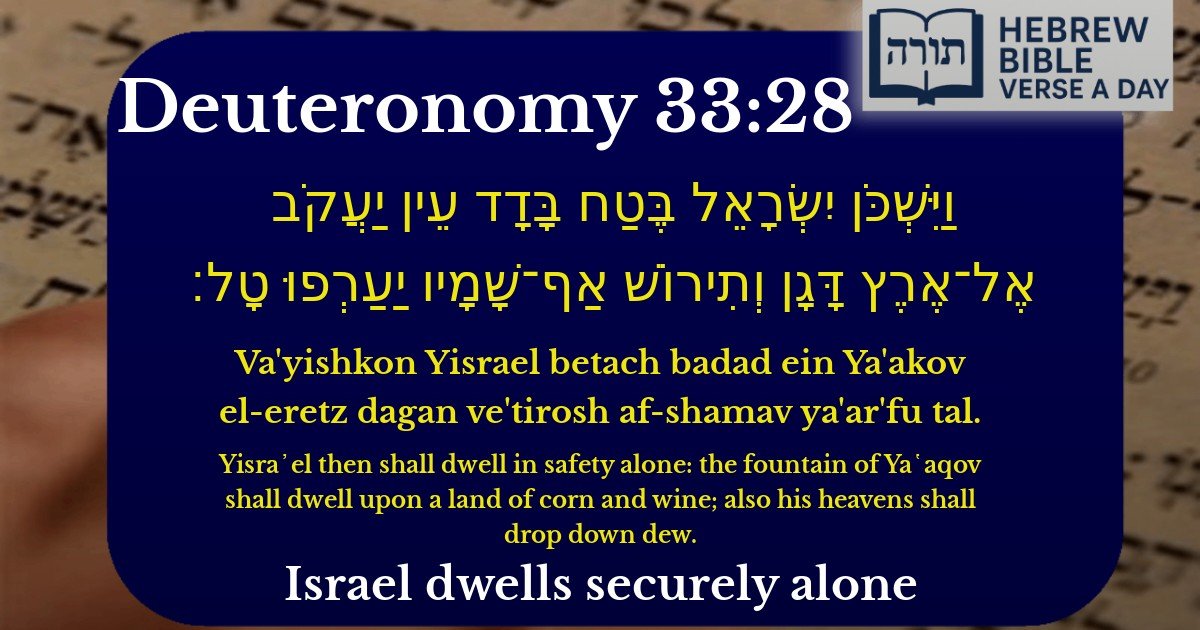

Overview of the Verse
The verse (Devarim 33:28) describes the future security and prosperity of the Jewish people in the Land of Israel. It emphasizes their unique relationship with Hashem, their agricultural blessings, and the Divine favor bestowed upon them.
Dwelling in Safety Alone (וַיִּשְׁכֹּן יִשְׂרָאֵל בֶּטַח בָּדָד)
Rashi explains that "alone" (בָּדָד) signifies the distinctiveness of Israel—they are a nation set apart, not intermingling with others in idolatry or foreign customs. The Ramban adds that this solitude reflects their Divine protection, as they rely solely on Hashem rather than alliances with other nations.
The Midrash Tanchuma (Devarim 11) teaches that Israel's security comes from their adherence to Torah, making them impervious to external threats when they fulfill Hashem's will.
The Fountain of Yaakov (עֵין יַעֲקֹב)
Rashi interprets "the fountain of Yaakov" as a reference to the Torah, which flows like a spring of wisdom from Yaakov's descendants. The Talmud (Taanit 7a) compares Torah scholars to a fountain, constantly renewing their wisdom.
Alternatively, the Sforno explains that this phrase alludes to the Divine Providence (עין ה׳) watching over Yaakov's descendants, ensuring their sustenance and protection.
Land of Corn and Wine (אֶל־אֶרֶץ דָּגָן וְתִירוֹשׁ)
This symbolizes the material blessings of Eretz Yisrael. The Ibn Ezra notes that grain (דגן) and wine (תירוש) represent the primary agricultural products, indicating abundance. The Rambam (Hilchot Melachim 12:5) connects this to the era of Mashiach, when the land will yield its produce in full measure.
Heavens Dropping Dew (אַף־שָׁמָיו יַעַרְפוּ טָל)
Dew is a symbol of Divine blessing, as it sustains the land without human effort. The Talmud (Taanit 3b) teaches that dew represents Hashem's constant kindness, unlike rain, which depends on merit. The Kli Yakar emphasizes that dew signifies uninterrupted blessing, even when other nations face hardship.
Key Themes in Orthodox Jewish Thought