

Join Our Newsletter To Be Informed When New Videos Are Posted
Hebrew Text
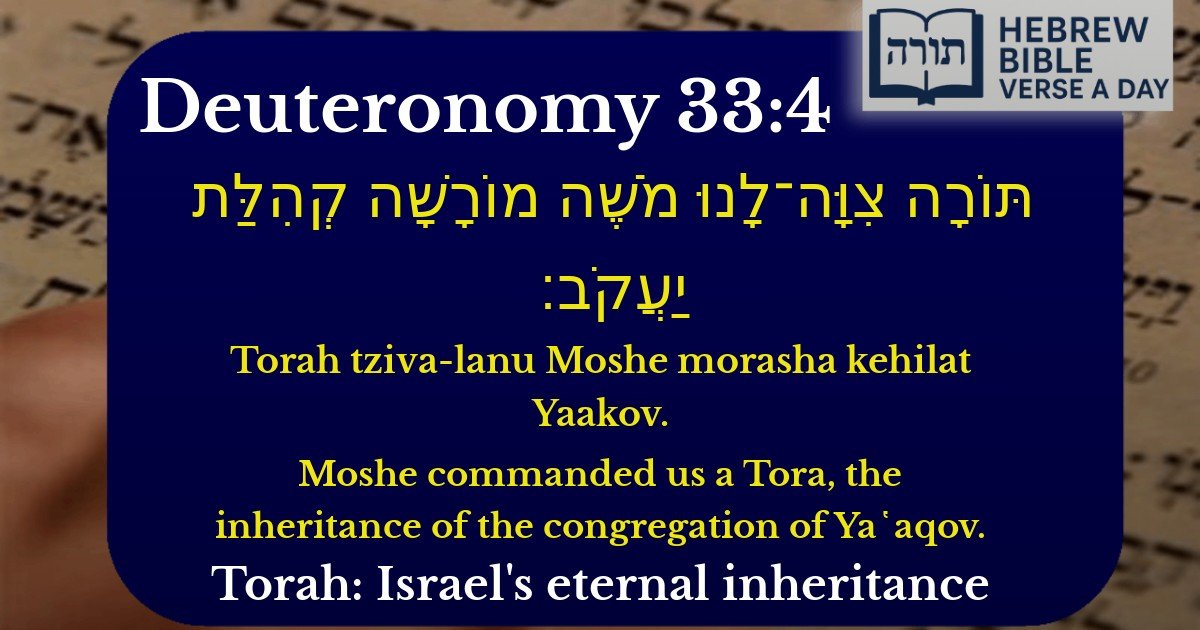
תּוֹרָה צִוָּה־לָנוּ מֹשֶׁה מוֹרָשָׁה קְהִלַּת יַעֲקֹב׃
English Translation
Moshe commanded us a Tora, the inheritance of the congregation of Ya῾aqov.
Transliteration
Torah tziva-lanu Moshe morasha kehilat Yaakov.
Hebrew Leining Text
תּוֹרָ֥ה צִוָּה־לָ֖נוּ מֹשֶׁ֑ה מוֹרָשָׁ֖ה קְהִלַּ֥ת יַעֲקֹֽב׃
🎵 Listen to leining
Parasha Commentary
📚 Talmud Citations
This verse is quoted in the Talmud.
📖 Berakhot 5a
The verse is cited in a discussion about the importance of Torah study and its transmission from Moses to the Jewish people.
📖 Sanhedrin 59a
The verse is referenced in a debate about the universality of Torah commandments and their applicability to all of Israel.
Introduction to the Verse
The verse "תּוֹרָה צִוָּה־לָנוּ מֹשֶׁה מוֹרָשָׁה קְהִלַּת יַעֲקֹב" (Devarim 33:4) is part of Moshe Rabbeinu's final blessing to Bnei Yisrael before his passing. It emphasizes the eternal bond between the Jewish people and the Torah, which was given through Moshe.
Rashi's Commentary
Rashi explains that the phrase "תּוֹרָה צִוָּה־לָנוּ מֹשֶׁה" ("Moshe commanded us a Torah") underscores that Moshe transmitted the Torah to Bnei Yisrael on Hashem's behalf. He did not teach it as his own but as the word of Hashem. Rashi further notes that the term "מוֹרָשָׁה" ("inheritance") signifies that the Torah is an everlasting possession of the Jewish people, passed down through generations.
Rambam's Perspective
In Mishneh Torah (Hilchot Talmud Torah 1:1), the Rambam elaborates that the mitzvah of Torah study is incumbent upon every Jew, regardless of status or background. The phrase "קְהִלַּת יַעֲקֹב" ("the congregation of Yaakov") highlights that the Torah belongs to the entire Jewish people collectively, not just to scholars or leaders.
Midrashic Insights
Concept of "Morasha" (Inheritance)
The term "מוֹרָשָׁה" is distinct from a simple gift (matana). The Kli Yakar explains that an inheritance is acquired without effort, symbolizing that even a newborn Jew has a share in the Torah. However, the Meshech Chochma adds that while the Torah is our birthright, we must still labor in its study to fully acquire it.
Collective Responsibility
The phrase "קְהִלַּת יַעֲקֹב" emphasizes the communal aspect of Torah. The Ohr HaChaim teaches that the Torah was given to the entire nation, binding every Jew to one another through shared learning and observance. This unity is essential for preserving the Torah through the ages.