Frequently Asked Questions
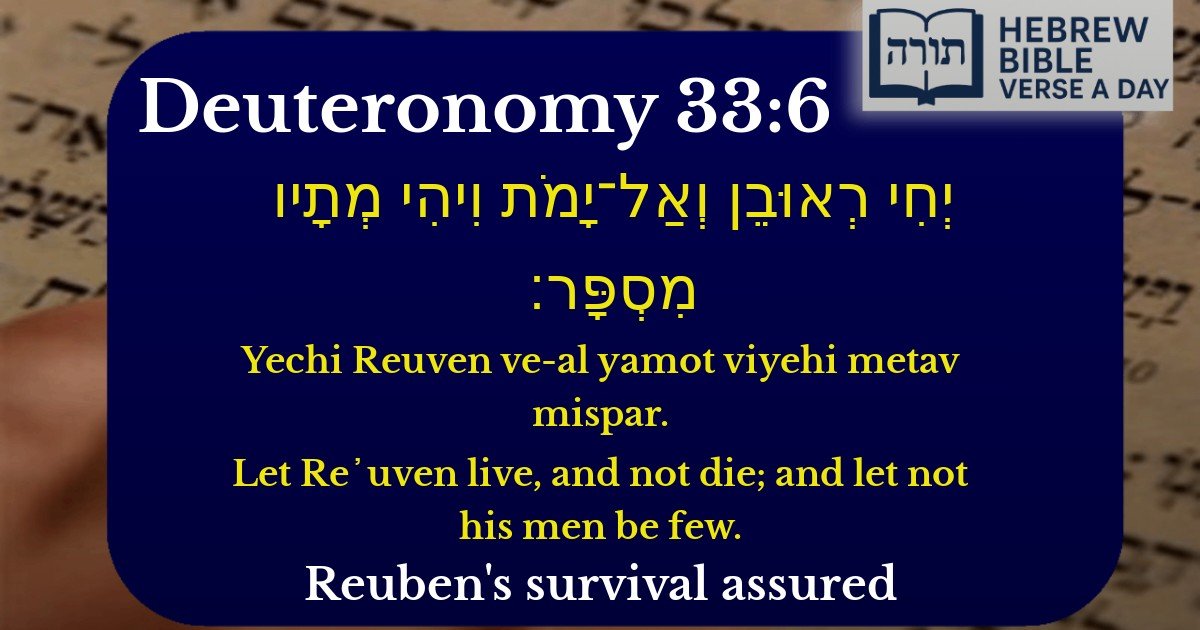
Q: What does the verse 'Let Re'uven live, and not die; and let not his men be few' mean?
A: This verse is part of Moshe's blessing to the tribe of Re'uven before his passing. Rashi explains that Moshe prayed for Re'uven's survival and prosperity, asking that they not diminish in number. The Midrash connects this to Re'uven's earlier repentance for his past mistakes, showing that sincere teshuvah (repentance) brings merit.
Q: Why did Moshe specifically bless Re'uven with survival and not diminishing in numbers?
A: According to the Talmud (Berachos 7a), Re'uven was the first to do teshuvah (repent) for his actions regarding Bilhah (as mentioned in Bereishis 35:22). Moshe's blessing acknowledges this repentance and asks that Re'uven's descendants be protected from dying out. The Rambam teaches that sincere repentance can transform past sins into merits.
Q: How does this verse about Re'uven apply to us today?
A: This verse teaches the power of teshuvah (repentance) and how it can secure a person's future. Just as Re'uven's sincere repentance earned him this blessing, we learn that no matter what mistakes we've made, genuine repentance can bring forgiveness and blessing. The Sforno notes that this also emphasizes the importance of maintaining Jewish continuity.
Q: Why is Re'uven mentioned first in Moshe's blessings to the tribes?
A: Rashi explains that although Re'uven was the firstborn, he lost his birthright due to his actions. However, Moshe still gave him honor by mentioning him first in the blessings. This teaches that even when someone loses a high status, they can still regain honor through repentance and good deeds.
Q: What does 'let not his men be few' teach us about Jewish survival?
A: This phrase reflects the eternal Jewish concern for continuity. The Midrash teaches that Moshe was praying that Re'uven's tribe should not become insignificant in numbers among the Jewish people. This applies to all generations - we must strive to maintain and grow the Jewish nation through Torah observance and family life.


Context of the Verse
This verse is part of Moshe Rabbeinu's final blessings to the tribes of Israel before his passing (Devarim 33:6). The blessing for Reuven, Yaakov's firstborn, appears first among the tribes. The language reflects both a prayer for physical survival ("Let Reuven live, and not die") and demographic stability ("let not his men be few").
Rashi's Explanation
Rashi (Devarim 33:6) explains that Moshe's blessing comes to counteract Yaakov's earlier rebuke of Reuven (Bereishit 49:4), where Yaakov said, "Unstable as water, you shall not have preeminence." Moshe's blessing reassures that despite losing the firstborn rights, Reuven would not perish entirely from among the tribes.
Ibn Ezra's Insight
Ibn Ezra notes that the double language ("live and not die") emphasizes that Reuven's tribe would endure through all generations, despite their diminished status after the incident with Bilhah (Bereishit 35:22). The second phrase ("let not his men be few") is a blessing for numerical strength.
Midrashic Interpretation
The Midrash (Devarim Rabbah 33:6) connects this verse to Reuven's repentance for his earlier actions. The phrase "let Reuven live" refers to eternal life in Olam Haba, earned through his sincere teshuvah. The Midrash also links this to Reuven's descendants who would later stand up against wrongdoing (e.g., the sons of Reuven opposing Moshe in Bamidbar 16).
Halachic Perspective
Rambam (Hilchos Teshuvah 2:1) cites Reuven as the paradigm of complete repentance, showing that even after serious transgressions, sincere teshuvah can bring full atonement. Moshe's blessing thus confirms that Reuven's repentance was accepted.
Kabbalistic Dimension
The Zohar (3:267a) interprets "let Reuven live" as referring to the soul's connection to the Divine Source of life. The numerical value of "Reuven" (רְאוּבֵן) equals 259, which some connect to the concept of "eternal life" (חַיִּים נִצְחִיִּים) through gematria.
Practical Lessons