Frequently Asked Questions
Q: What is the significance of the places mentioned in Deuteronomy 34:3?
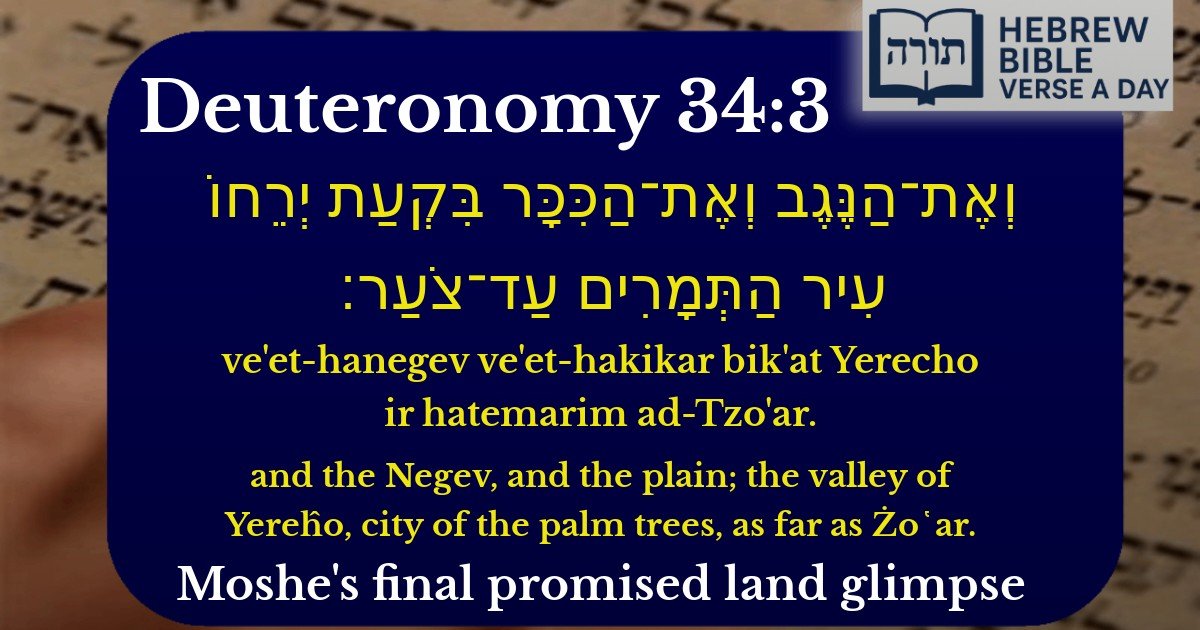
A: Deuteronomy 34:3 describes the view Moses saw before his passing, including the Negev, the plain, the valley of Jericho (the 'city of palm trees'), and Zoar. According to Rashi, these places were significant because they were part of the Land of Israel that the Israelites were about to enter. The 'city of palm trees' refers to Jericho, known for its lush vegetation, symbolizing the fertility of the land Hashem promised to the Jewish people.
Q: Why did Moses see these specific locations before his death?
A: The Talmud (Sotah 13b) explains that Hashem showed Moses the entire Land of Israel before his death to fulfill the promise that he would see the land, even if he could not enter it (Deuteronomy 32:52). This was a gesture of divine kindness, allowing Moses to witness the beauty of the land his people would inherit. The Midrash adds that this vision also served as a final reassurance that the Israelites would indeed conquer the land.
Q: What does 'the city of palm trees' refer to in Deuteronomy 34:3?
A: The phrase 'city of palm trees' refers to Jericho, as explained by Rashi and other traditional commentators. Jericho was known for its abundant date palms, a sign of blessing and prosperity. The Talmud (Ta'anit 29a) also mentions that Jericho’s climate was ideal for palm trees, making it a symbol of the land’s richness. This description highlights the fertility of the Land of Israel, reinforcing its desirability as the Jewish homeland.
Q: How does Deuteronomy 34:3 connect to the broader narrative of Moses' death?
A: Deuteronomy 34:3 is part of the final passage describing Moses’ last moments. According to Rambam (Hilchot Yesodei HaTorah 7:6), Moses’ clear vision of the land before his death demonstrated his unique prophetic clarity. Unlike other prophets who saw visions in dreams or parables, Moses saw reality with perfect clarity—even in his final moments. This verse emphasizes that Moses died with full awareness of the land his people would inherit.
Q: What lesson can we learn from Moses seeing the Land of Israel before his death?
A: A key lesson from this verse, as derived from Midrashic teachings, is the importance of having faith in Hashem’s promises. Even though Moses did not enter the land himself, he was granted a vision of its beauty, reinforcing that the Israelites would inherit it. This teaches us to trust in divine promises, even if we do not see their fulfillment in our lifetime. Additionally, it highlights Moses’ selflessness—he rejoiced in the future of his people despite his own loss.


Geographical Context in the Torah
The verse describes the southern region (Negev), the plain (Kikar), and the valley of Yerecho (Jericho), known as the "city of palm trees," extending to Tzo'ar. These locations are significant in biblical narratives, particularly in relation to the journeys of Avraham and Lot (Bereishit 13:10-12) and the later conquest of Eretz Yisrael by Yehoshua (Joshua 6). Rashi (Bereishit 13:10) explains that the Kikar refers to the fertile plain near the Dead Sea, which was lush before its destruction due to the sins of Sodom and Amorah.
Yerecho as the "City of Palm Trees"
The Talmud (Ta'anit 29a) notes that Yerecho was renowned for its date palms, a symbol of prosperity. Rambam (Hilchot Shmita v'Yovel 10:2) mentions that the fertility of Yerecho made it a strategic location for agriculture. The Midrash (Bereishit Rabbah 41:5) connects its name ("Yarei'ach," meaning moon) to its fragrant air, which was as pleasant as the moon's light.
The Significance of Tzo'ar
Tzo'ar was one of the five cities of the plain spared from destruction due to Lot's plea (Bereishit 19:20-22). The Talmud (Sanhedrin 109b) discusses its eventual fate, linking it to the broader moral lessons of the Sodom narrative. Rashi (Bereishit 19:22) emphasizes that Tzo'ar was a small city, highlighting Hashem's mercy in preserving it temporarily.
Spiritual Lessons from the Landscape