Frequently Asked Questions
Q: Why was Moshe (Moses) buried in an unknown location?
A: According to Rashi and the Midrash (Sifrei Devarim 357), Moshe's burial place was kept hidden to prevent people from turning it into a site of idolatrous worship. Since Moshe was such a great leader, there was concern that people might mistakenly worship him instead of Hashem.
Q: Where exactly was Moshe buried according to Jewish tradition?
A: The Torah states he was buried in the valley in the land of Mo'av, opposite Beit Pe'or (Devarim 34:6). The Talmud (Sotah 14a) explains that this location was specifically chosen because it was near where Moshe had prayed for mercy for Bnei Yisrael after the sin of Pe'or (Bamidbar 25:3).
Q: Why does the Torah say 'no man knows his grave to this day'?
A: The Ramban explains this emphasizes that the location remained unknown even when the Torah was given to Israel, showing it was deliberately hidden by Hashem. The Talmud (Sotah 13b) states that even the angels argued about where Moshe was buried, showing its complete concealment.
Q: What lesson can we learn from Moshe's hidden burial place?
A: The Kli Yakar teaches that this teaches humility - even the greatest leader wasn't given a public monument. Additionally, it shows that true greatness is in one's teachings and legacy (Torah), not physical memorials. As Pirkei Avot (4:13) states, the crown of a good name is greater than the crown of Torah.
Q: Was anyone present at Moshe's burial?
A: The Midrash (Devarim Rabbah 11:10) states that Hashem Himself buried Moshe, as it says 'He buried him' (Devarim 34:6), showing the unique honor given to Moshe. The Talmud (Sotah 14a) explains this was because no human was worthy to perform this final service for Moshe.

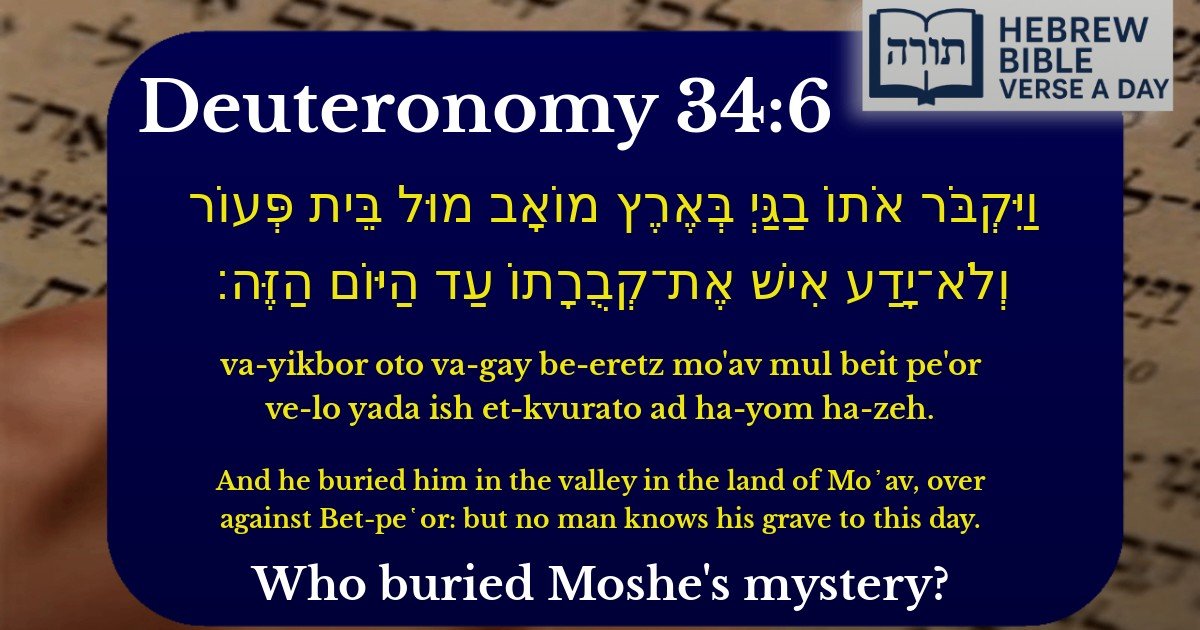

The Burial of Moshe in the Land of Moav
The verse (Devarim 34:6) describes the burial of Moshe Rabbeinu in the land of Moav, opposite Beit Pe'or. Rashi explains that Hashem Himself buried Moshe, as indicated by the passive verb form "ויקבר" ("and he was buried"), implying a divine act. This demonstrates the unique honor accorded to Moshe, whose burial was performed by the Almighty.
The Hidden Location of Moshe's Grave
The Torah emphasizes that "no man knows his grave to this day." Ramban (Nachmanides) comments that this concealment was deliberate to prevent the grave from becoming a site of idolatrous worship. The Sages (Sotah 14a) teach that this also reflects Moshe's humility—just as his leadership was marked by modesty, so too was his burial place hidden from public knowledge.
Significance of the Location Near Beit Pe'or
The burial site is specified as being opposite Beit Pe'or, a place associated with the idol Pe'or. The Kli Yakar suggests this location was chosen to atone for the sin of Pe'or (Bamidbar 25), where Bnei Yisrael were led astray. Moshe's presence in death serves as a spiritual counterbalance to the impurity of that place.