

Join Our Newsletter To Be Informed When New Videos Are Posted
Hebrew Text
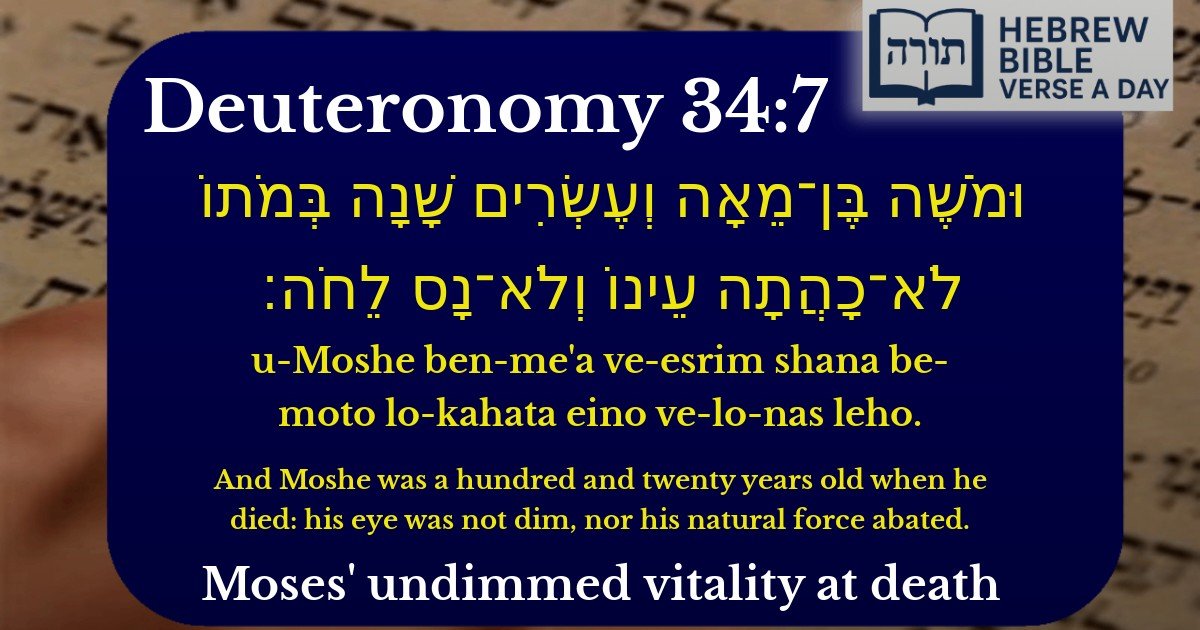
וּמֹשֶׁה בֶּן־מֵאָה וְעֶשְׂרִים שָׁנָה בְּמֹתוֹ לֹא־כָהֲתָה עֵינוֹ וְלֹא־נָס לֵחֹה׃
English Translation
And Moshe was a hundred and twenty years old when he died: his eye was not dim, nor his natural force abated.
Transliteration
U-Moshe ben-me'a ve-esrim shana be-moto lo-kahata eino ve-lo-nas leho.
Hebrew Leining Text
וּמֹשֶׁ֗ה בֶּן־מֵאָ֧ה וְעֶשְׂרִ֛ים שָׁנָ֖ה בְּמֹת֑וֹ לֹא־כָהֲתָ֥ה עֵינ֖וֹ וְלֹא־נָ֥ס לֵחֹֽה׃
🎵 Listen to leining
Parasha Commentary
📚 Talmud Citations
This verse is quoted in the Talmud.
📖 Sotah 13b
The verse is cited to discuss the exceptional physical and spiritual condition of Moses at the time of his death, emphasizing his undiminished vigor and clarity of vision.
📖 Bava Batra 17a
The verse is referenced in a discussion about the righteous and their deaths, highlighting Moses' unique qualities even in his final moments.
Moshe's Age and Vitality at His Passing
The verse states that Moshe was 120 years old at the time of his death, yet his eyesight and physical strength remained undiminished. This is remarkable, as the natural aging process typically weakens a person's faculties. Rashi (Devarim 34:7) explains that this was a sign of divine favor, demonstrating that Moshe's death was not due to natural decline but rather by the decree of Hashem, as stated earlier (Devarim 31:2).
Symbolism of 120 Years
The number 120 is significant in Jewish tradition. The Midrash (Bereishit Rabbah 26:6) notes that this lifespan was decreed after the Flood (Bereishit 6:3), representing a complete and full measure of years. Moshe's life was divided into three equal parts of 40 years (Sotah 12b):
This structure emphasizes the divine providence guiding his life's mission.
Undiminished Eyes and Strength
The Talmud (Sotah 13b) comments that Moshe's eyes did not grow dim because he had not misused them for sinful purposes. Similarly, his physical strength remained intact because he had dedicated his entire being to serving Hashem. Rambam (Hilchot De'ot 4:20) derives from this that proper conduct preserves a person's health and vitality.
Spiritual vs. Physical Decline
The Kli Yakar (Devarim 34:7) notes that while Moshe's physical faculties remained strong, the Torah emphasizes that his prophetic vision was even greater - "no prophet arose like Moshe" (Devarim 34:10). This teaches that spiritual greatness is independent of physical condition, and true vitality comes from connection to the Divine.