Frequently Asked Questions
Q: What does the verse 'And you came near and stood under the mountain' mean?
A: This verse describes the awe-inspiring moment when the Israelites gathered at Mount Sinai to receive the Torah. Rashi explains that they stood 'under the mountain' to show their complete submission to Hashem's will, as if the mountain was held over them to emphasize their commitment to accept the Torah.
Q: Why was the mountain burning with fire at Mount Sinai?
A: The burning fire symbolized the divine presence (Shechinah) and the overwhelming holiness of the moment when Hashem revealed Himself to give the Torah. The Midrash (Shemot Rabbah 29:9) teaches that the fire represented both the purity of Torah and the awe it inspires, showing that Torah is compared to fire—just as fire illuminates, so too does Torah enlighten the soul.
Q: What is the significance of the darkness, clouds, and thick darkness mentioned in the verse?
A: The darkness and thick clouds (ענן וערפל) signify the hidden and mysterious aspects of Torah wisdom. Rambam (Moreh Nevuchim 3:9) explains that these elements represent the layers of deeper meaning in Torah that require study and effort to uncover. The Talmud (Chagigah 14b) also teaches that the 'thick darkness' alludes to the profound mysteries of Kabbalah, accessible only to those properly prepared.
Q: How does this verse apply to us today?
A: Just as the Israelites stood at Mount Sinai in awe and commitment, we are reminded to approach Torah study with reverence and dedication. The imagery of fire teaches that Torah should ignite our souls with passion, while the darkness reminds us that some truths require patience and deeper learning. The Sages (Avot 6:2) say that Torah is acquired through humility and awe, just as the Israelites stood humbly at Sinai.
Q: Why is this moment at Mount Sinai so important in Judaism?
A: This event marks the giving of the Torah—the foundation of Jewish faith and practice. The Talmud (Shabbat 88a) teaches that every Jewish soul, past and future, was present at Sinai, making it a binding covenant for all generations. The fire, darkness, and clouds emphasize that Torah is eternal, divine, and requires both reverence and lifelong study to fully grasp its depth.

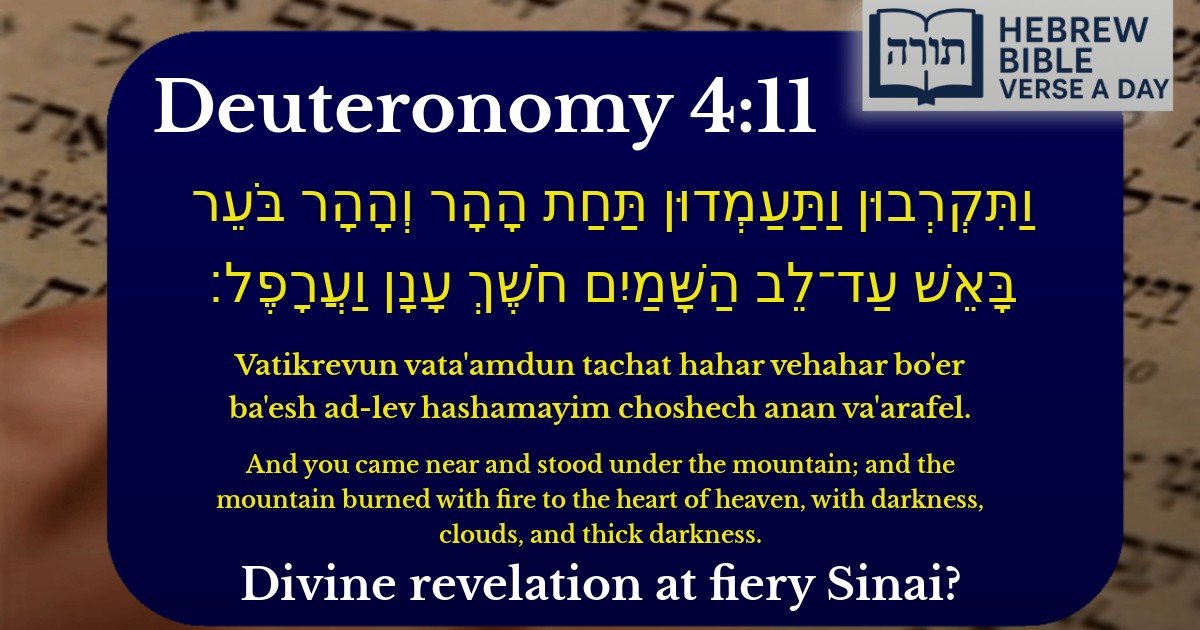

The Revelation at Har Sinai
The verse describes Bnei Yisrael standing at the foot of Har Sinai during Matan Torah (the giving of the Torah), where the mountain was engulfed in fire reaching the heavens, accompanied by darkness, clouds, and thick darkness. This imagery conveys the awe-inspiring nature of the Divine revelation.
Rashi's Explanation
Rashi (Devarim 4:11) explains that the fire and darkness were not separate phenomena but coexisted miraculously—the fire burned within the darkness. This demonstrates that the revelation transcended natural laws, emphasizing the supernatural nature of Matan Torah.
Symbolism of the Darkness and Fire
The Rambam's Perspective
In Moreh Nevuchim (1:64), Rambam explains that the thick darkness represents the limitations of human understanding when encountering the Divine. The overwhelming sensory experience at Har Sinai was necessary to impress upon Bnei Yisrael the gravity of the moment.
The Talmudic View
Chagigah 14b describes how the fire and darkness were intertwined to teach that Torah study requires both the "fire" of passion and the humility ("darkness") of recognizing one's limitations in understanding Hashem's wisdom.
The Mountain "Burning to the Heart of Heaven"
The Kli Yakar (Devarim 4:11) notes that the fire reached the "heart of heaven" to show that Torah connects earthly existence with the heavenly realm. The Torah given at Sinai bridges the physical and spiritual worlds.