Frequently Asked Questions
Q: What does Deuteronomy 4:17 mean?
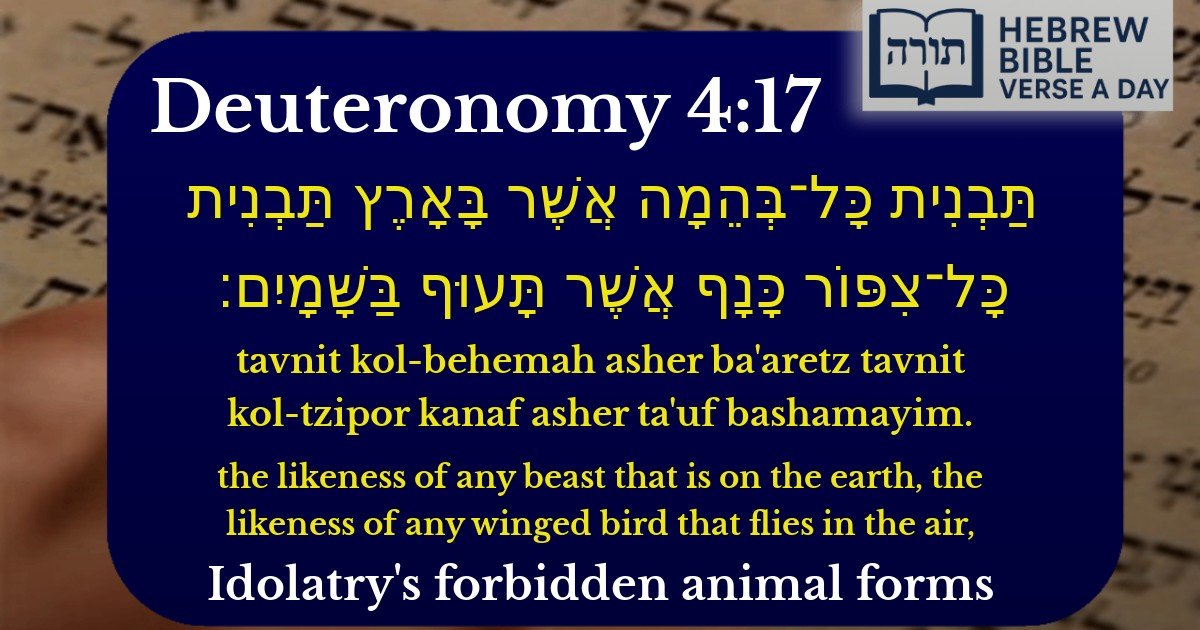
A: Deuteronomy 4:17 warns against creating idols or images in the form of animals or birds for worship. This is part of the Torah's prohibition against idolatry (avodah zarah), emphasizing that Hashem is beyond physical representation. Rashi explains that this verse specifically forbids making images of creatures that exist in nature, as people might mistakenly worship them.
Q: Why is this verse important in Judaism?
A: This verse is important because it reinforces the fundamental Jewish belief in Hashem's absolute unity and incorporeality. The Rambam (Maimonides) teaches in Hilchot Avodah Zarah that any representation of creation for worship distorts our understanding of G-d's true nature. The Talmud (Avodah Zarah 43b) also discusses how even images not intended for worship can lead to improper thoughts.
Q: How does this apply to art and sculptures today?
A: According to halacha (Jewish law), creating or displaying sculptures or detailed images of humans, animals or birds is problematic if there's concern people might worship them, or if it's common in society to worship such images. The Shulchan Aruch (Yoreh De'ah 141) rules that three-dimensional images of creatures with wings are generally prohibited, while two-dimensional paintings are more lenient, provided there's no idolatrous intent.
Q: What's the difference between this prohibition and the golden calf?
A: While both involve making images, the golden calf (Exodus 32) was explicitly created as an object of worship, directly violating the Second Commandment. Deuteronomy 4:17 expands the prohibition to include any animal or bird images that could potentially become objects of worship, even if not initially intended as such. The Midrash (Sifrei Devarim) connects this to the need to avoid anything that might lead to idolatrous practices.
Q: Does this mean Jews can't have bird or animal decorations?
A: The halacha distinguishes between decorative items and objects that might be worshipped. Simple animal figurines or bird decorations are generally permitted if they're clearly for decoration and not worshipped (Mishneh Torah, Avodah Zarah 3:10-11). However, prominent poskim (halachic authorities) caution against having statues or prominent animal images in synagogues or places of Torah study to maintain proper focus on spiritual matters.


Context in the Torah
This verse (Devarim 4:17) appears in Moshe's warning to Bnei Yisrael against creating graven images or idols. The Torah prohibits forming physical representations of living creatures for the purpose of worship, emphasizing the incorporeal nature of Hashem.
Rashi's Explanation
Rashi (Devarim 4:16) clarifies that the prohibition extends to making images of celestial beings (e.g., angels, sun, moon, stars) or earthly creatures (animals and birds), even if one does not intend to worship them. The concern is that others might mistakenly venerate these images.
Rambam's Perspective
In Mishneh Torah (Hilchot Avodah Zarah 3:10), the Rambam explains that this prohibition roots out any association of physicality with the Divine. Since Hashem transcends form, creating likenesses of His creations risks attributing corporeality to Him or leading to idolatrous practices.
Midrashic Insight
The Midrash Tanchuma (Ki Tisa 8) connects this verse to the sin of the Golden Calf. By fashioning an image of a calf, Bnei Yisrael violated the principle that no earthly form—no matter how majestic (like a lion or eagle)—can represent Hashem’s infinite essence.
Halachic Implications
Philosophical Dimension
The Sefer HaChinuch (Mitzvah 39) teaches that this commandment cultivates pure faith in Hashem’s unity. By avoiding physical representations, we train ourselves to relate to the Divine beyond sensory perception, aligning with the principle of Ein Sof (Hashem’s boundlessness).