Frequently Asked Questions
Q: What does Deuteronomy 4:35 mean?
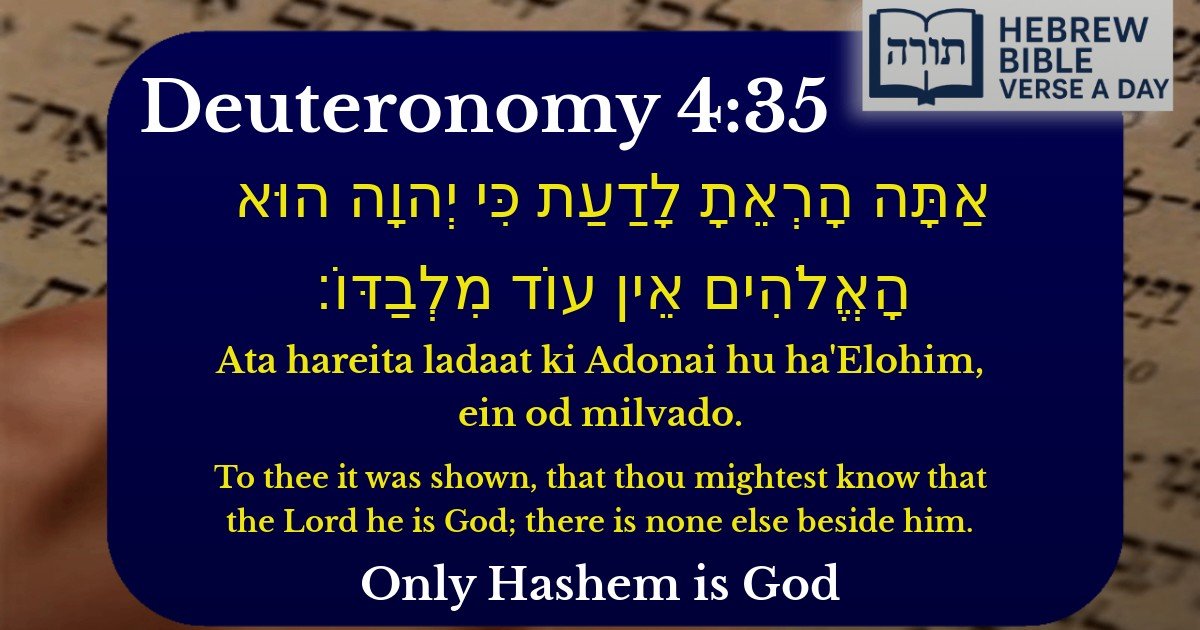
A: Deuteronomy 4:35 teaches that Hashem (God) revealed Himself to the Jewish people so they would know with certainty that He is the one true God, and there is no other power or deity besides Him. This verse emphasizes the fundamental Jewish belief in monotheism, as explained by Rashi and Rambam.
Q: Why is Deuteronomy 4:35 important in Judaism?
A: This verse is central to Judaism because it affirms the core principle of monotheism—the belief in one God. The Rambam (Maimonides) includes this concept in his 13 Principles of Faith. It reminds us that Hashem alone is the Creator and Sustainer of the universe, with no other forces or gods sharing His authority.
Q: How does Deuteronomy 4:35 apply to our lives today?
A: This verse reminds us to recognize Hashem's presence in our daily lives and in world events. The Talmud (Berachot 33b) teaches that everything comes from Hashem alone. Practically, this means we should direct our prayers, gratitude, and trust only to Him, not to any intermediaries or other powers.
Q: What does 'there is none else beside Him' mean?
A: As explained by traditional commentators like Rashi and the Sforno, this phrase means that Hashem is the only true existence and source of all power in the universe. While other things may appear to have independent power, they ultimately derive their existence from Hashem alone. This is a key concept in Jewish thought about God's unity.
Q: How was this knowledge 'shown' to the Jewish people?
A: The Midrash (Sifrei Devarim) explains that this refers to the miraculous events of the Exodus from Egypt and the revelation at Mount Sinai, where Hashem demonstrated His exclusive divinity through open miracles. These experiences gave the Jewish people direct, empirical knowledge of God's unity and power.


Context and Source
The verse (Devarim 4:35) appears in Moshe's speech to Bnei Yisrael, emphasizing the uniqueness of Hashem after witnessing the miracles of Yetziat Mitzrayim and Matan Torah. Rashi explains that this verse refers to the divine revelation at Har Sinai, where Hashem's absolute oneness was unmistakably demonstrated.
Meaning of "הָרְאֵתָ לָדַעַת" (You were shown to know)
The Ramban notes that this phrase underscores that Bnei Yisrael did not arrive at belief in Hashem through philosophical inquiry alone, but through direct, empirical experience of His miracles. The Sforno adds that this experiential knowledge was granted so they could transmit this truth with certainty to future generations.
"כִּי יְהוָה הוּא הָאֱלֹהִים" (That the Lord He is God)
Rabbeinu Bachya explains that this declares two fundamental truths:
"אֵין עוֹד מִלְבַדּוֹ" (There is none else beside Him)
The Rambam (Hilchot Yesodei HaTorah 1:7) cites this verse as the biblical source for the principle of yichud Hashem (Divine Unity), meaning:
Midrashic Interpretation
The Mechilta (Beshalach 15:11) connects this verse to Kriat Yam Suf, noting that even the simplest Israelite at the sea perceived Hashem's majesty more clearly than the greatest prophets. This became the foundation for their unwavering belief in His exclusive divinity.