Frequently Asked Questions
Q: Why did Moshe set apart three cities on the east side of the Jordan?
A: Moshe designated these three cities as 'arei miklat' (cities of refuge) for someone who accidentally killed another person (Devarim 4:41-43). This was in partial fulfillment of the mitzvah to establish six cities of refuge (Bamidbar 35:9-15), with the other three to be designated later in Eretz Yisrael proper (Makkos 9b).
Q: What is the significance of the phrase 'toward the sun rising' in this verse?
A: Rashi explains that 'toward the sun rising' specifies these cities were in the eastern side of the Jordan River, in the territory that had already been conquered (the lands of Sichon and Og). The phrase helps geographically locate these cities in relation to Eretz Yisrael proper.
Q: Why did Moshe only designate three cities instead of all six?
A: The Talmud (Makkos 9b) explains that Moshe could only designate cities in territory that was already conquered (east of the Jordan). The other three cities had to wait until after Yehoshua led the Jewish people into Eretz Yisrael proper, because the Torah specifies that all six cities must be in 'the land that Hashem your God gives you to possess' (Devarim 19:2).
Q: How do the cities of refuge apply to us today without a Temple?
A: While we cannot practically fulfill this mitzvah today, the concept teaches us about the value of human life and the importance of proper justice. The Rambam (Hilchos Rotzeach 8:4) explains these laws emphasize how seriously we must treat accidental deaths, and how society must provide protection and due process even for unintended harm.
Q: What practical lesson can we learn from Moshe establishing these cities?
A: The Midrash (Sifrei Devarim) notes that Moshe eagerly fulfilled this mitzvah despite knowing he wouldn't enter Eretz Yisrael, teaching us to perform mitzvos with enthusiasm even when we won't see their completion. Additionally, the cities of refuge model how society must create systems to protect the innocent while upholding justice.


Setting Apart the Cities of Refuge
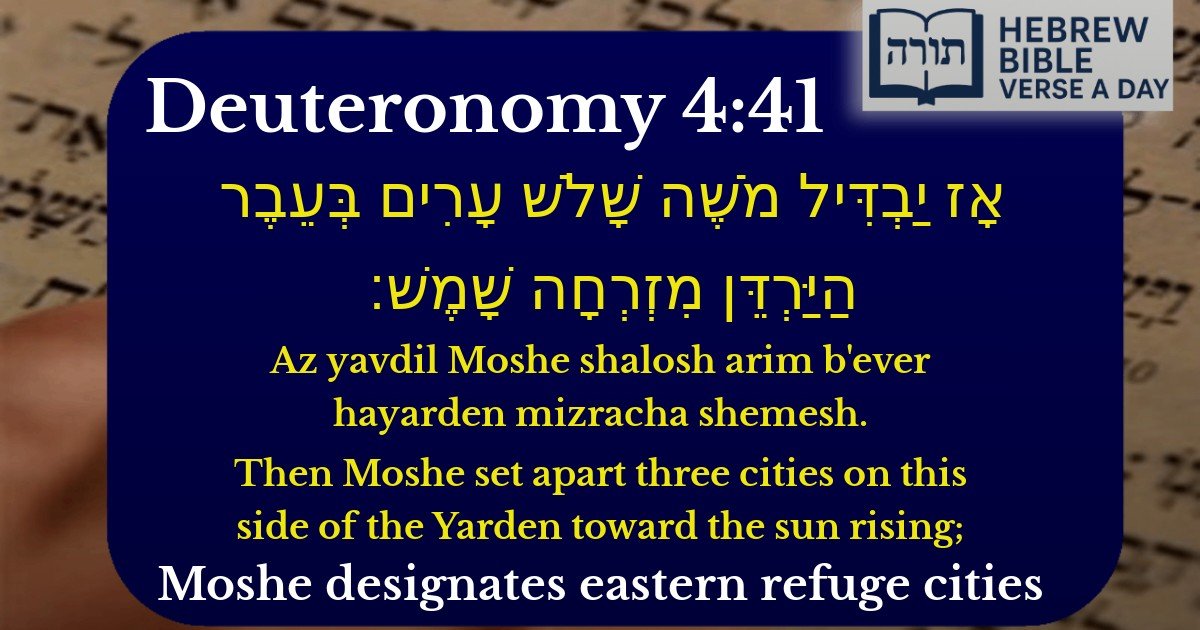
The verse (Devarim 4:41) describes Moshe Rabbeinu designating three cities of refuge (arei miklat) on the eastern side of the Yarden. According to Rashi, these cities were established for individuals who committed accidental manslaughter (shogeg), allowing them to find protection from blood avengers (go'el hadam).
Geographical and Halachic Context
Rambam (Hilchos Rotzeach 8:2-3) explains that Moshe designated these cities even though they would only fully function as cities of refuge after Yehoshua consecrated the additional three cities in Eretz Yisrael proper. This demonstrates Moshe's eagerness to fulfill the mitzvah at the earliest possible opportunity, as derived from the principle of "zerizin makdimin l'mitzvos" (the zealous perform mitzvos promptly).
Symbolic Significance of Location
The phrase "mizrachah shemesh" (toward the sun rising) is interpreted by the Sifri as indicating these cities were in the eastern portion of the territory. The Kli Yakar adds that the mention of the sun's rising alludes to the concept of repentance - just as the sun rises anew each day, so too the accidental killer is given an opportunity for spiritual renewal during his exile.
Three Cities vs. Six Cities
Moshe's Proactive Leadership
The Midrash Tanchuma (Masei 8) highlights that Moshe's initiative in establishing these cities reflects his characteristic trait of seeking justice and protection for all members of Klal Yisrael, even as his own leadership was coming to an end.